Unpacking the Hippocampal Logic of Disentangled Representations and Mental Maps
Researchers have identified specific neural circuit mechanisms that allow the brain to separate overlapping experiences while maintaining the ability to generalize across new contexts.
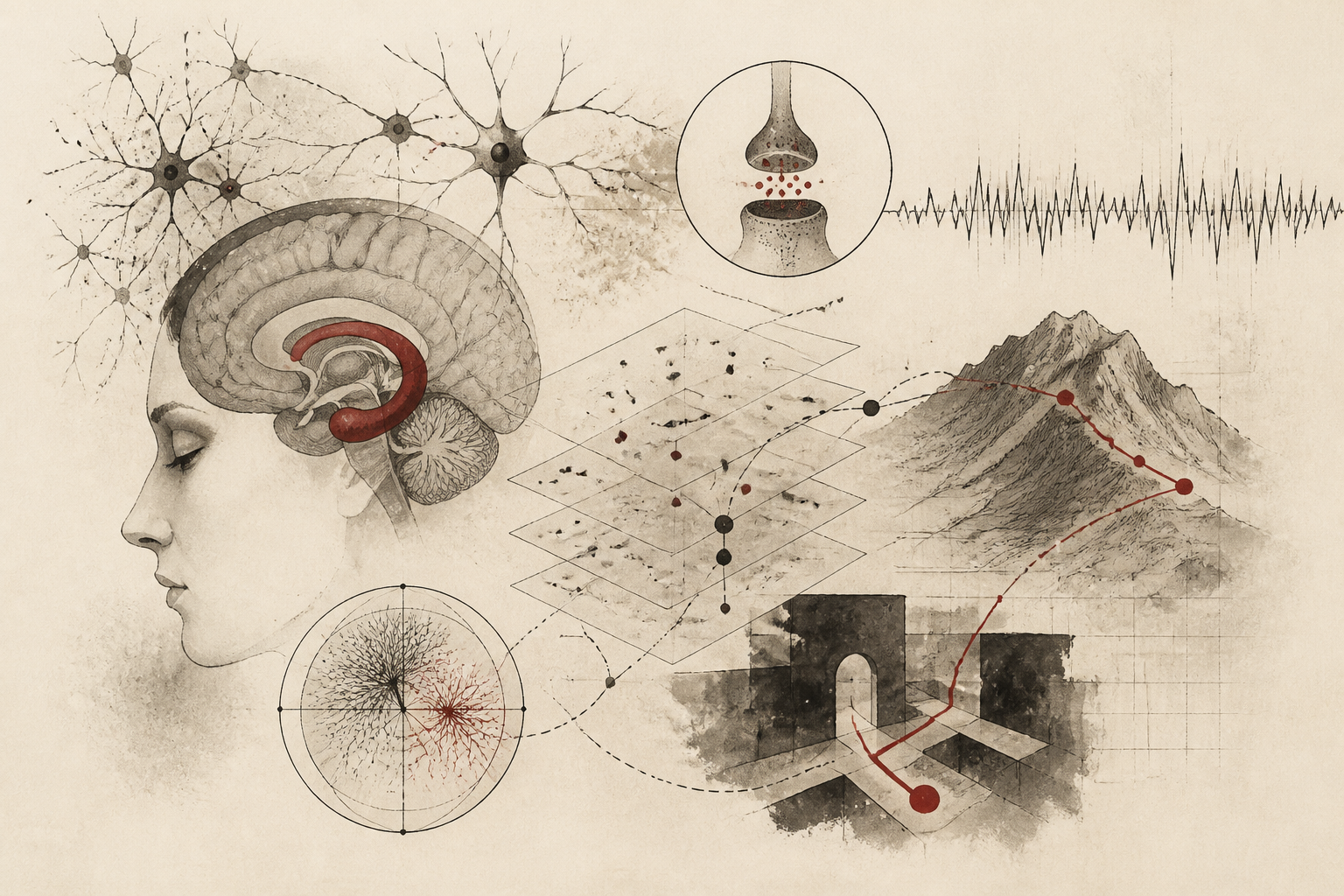
In the study of cognitive architecture, one of the most persistent mysteries involves how the mammalian brain balances two seemingly contradictory tasks: remembering the unique details of a specific event and identifying broad patterns that apply to new situations. This cognitive flexibility is the cornerstone of intelligence, allowing an organism to distinguish its current location from a similar one while simultaneously applying learned rules about how space and logic work. A recent study published in Nature Neuroscience, titled "Circuit mechanisms for disentangled representations and generalization in the hippocampus," provides a rigorous look into the cellular and circuit-level dynamics that make this possible. The research team, through a combination of advanced neuroimaging and computational modeling, has identified how the hippocampus employs "disentangled representations" to organize complex information.
At the heart of this discovery is the concept of a mental map. For decades, neuroscientists have known that the hippocampus is essential for spatial navigation and episodic memory. However, the exact mechanism by which the brain prevents these memories from interfering with one another—a phenomenon known as representation overlap—has remained partially obscured. When we enter a familiar grocery store that has been slightly rearranged, our brain must simultaneously recognize the store's general layout (generalization) while updating the specific coordinates of the produce section (disentanglement). The findings detailed in the Nature Neuroscience report suggest that the brain does not treat these as separate processes but rather as a unified computation managed by specific hippocampal circuits.
The Architecture of Disentangled Neural Representation
The study’s findings center on the discovery of how the hippocampus structures neural activity to represent different variables of an experience independently. In traditional neural networks, information is often "entangled," meaning that a change in one aspect of an environment might trigger a complete overhaul of how the entire environment is represented in the brain. The researchers found that the hippocampus avoids this inefficiency through a process that separates distinct features—such as spatial location, task demands, and sensory cues—into orthogonal dimensions of neural activity.
This disentanglement is crucial because it allows the brain to perform what the researchers call "zero-shot generalization." This refers to the ability to correctly navigate a new environment or solve a new problem immediately, based on the abstract rules learned in previous, different contexts. By keeping the representation of the "rule" (e.g., how to find an exit) separate from the representation of the "place" (e.g., the specific room), the hippocampus can transplant the rule into any new place without having to re-learn the basics. The neural data suggests that this is achieved through the coordinated firing of specific cell assemblies that maintain a stable geometric structure across different environments.
Methodological Advances in Mapping Circuit Logic
To reach these conclusions, the research team utilized high-resolution calcium imaging and electrophysiological recordings to monitor the activity of thousands of neurons in the hippocampus as subjects performed complex navigation tasks. The experimental design required the subjects to switch between different sets of rules while in the same physical space, or to apply the same rules in vastly different physical spaces. This "cross-condition" design was essential for isolating which neurons were responding to the physical environment and which were responding to the abstract task structure.
Following the data collection, the researchers applied sophisticated mathematical frameworks, including dimensionality reduction and manifold learning, to visualize the structure of the neural population activity. They observed that the neural representations were organized onto low-dimensional manifolds—essentially geometric shapes in the high-dimensional space of neural firing. These manifolds were not random; they exhibited a specific topology that preserved the relationships between different variables. When the subject moved through space, the activity moved along one axis of the manifold; when the subject switched tasks, the activity shifted along a different, independent axis. This geometric separation is the physical manifestation of disentanglement.
Mechanisms of Generalization and Cognitive Transfer
One of the most significant interpretations of this study involves how these disentangled manifolds facilitate learning. In an entangled system, learning a new task in a new environment would require a massive amount of synaptic adjustment, as the new information would conflict with existing memories. However, the Nature Neuroscience study suggests that because the hippocampus maintains a modularized representation, it only needs to map the new environment onto the existing "task axis." This mechanism explains why humans and other mammals are so much more efficient at learning than current artificial intelligence systems, which often suffer from "catastrophic forgetting" when introduced to new tasks.
Furthermore, the researchers identified that the strength of this disentanglement predicted how well the subjects could generalize. Subjects whose hippocampal circuits showed more clearly defined, orthogonal representations were significantly faster at adapting to changes in the environment. This suggests that the quality of our mental maps is not just about the density of information we store, but about the geometric clarity with which that information is organized. The study points toward a specific role for inhibitory interneurons in maintaining these boundaries, acting as the "gatekeepers" that prevent the different dimensions of representation from bleeding into one another.
Limitations and Future Inquiries in Neuroscience
While the study represents a landmark in our understanding of hippocampal function, the authors acknowledge several limitations that warrant further investigation. Firstly, the study primarily focused on relatively simple task variables and spatial environments. It remains to be seen how the hippocampus handles high-dimensional social information or complex emotional states where the variables may not be so easily discretized. Whether the same "orthogonal manifold" strategy applies to non-spatial abstract reasoning is a primary question for the next generation of cognitive research.
Another open question involves the role of other brain regions, such as the prefrontal cortex, in guiding the hippocampus. While the hippocampus appears to house these disentangled maps, the prefrontal cortex likely plays a role in selecting which map is relevant at any given time. The dialogue between these two regions is a critical frontier for understanding how we prioritize certain information over others. Additionally, while the study identifies the presence of these structures, it does not fully map the developmental trajectory—how do these circuits learn to disentangle information in the first place during early childhood and brain development?
The Broader Impact on Cognitive Science and AI
The implications of this research extend far beyond the laboratory. Understanding the circuit mechanisms of the hippocampus provides a biological blueprint for the development of more robust artificial intelligence. Current AI models often struggle with the very thing the hippocampus excels at: applying old knowledge to new problems without overwriting previous data. By mimicking the "disentangled representation" strategy of the mammalian brain, engineers may be able to create systems that are more adaptable and energy-efficient.
For the field of psychology and neurology, these findings offer potential insights into disorders where memory and generalization are impaired, such as Alzheimer’s disease or schizophrenia. If the core issue in these conditions is a breakdown in the geometric organization of neural representations, new therapeutic interventions could be designed to stabilize these manifolds. Ultimately, the work published in Nature Neuroscience reaffirms the hippocampus not just as a recorder of events, but as a sophisticated computational engine that generates the abstract structures through which we perceive and navigate the world.
Quick answers
- What are disentangled representations in the brain?
- Disentangled representations are a method by which the hippocampus organizes neural activity so that different aspects of an experience, like location and task rules, are processed independently on separate neural 'axes.' This prevents information overlap and aids in learning.
- How does the hippocampus help with generalization?
- By keeping abstract rules separate from specific environmental details, the hippocampus allows the brain to apply previously learned logic to entirely new situations without needing to re-learn the underlying principles.
- Why is this research important for artificial intelligence?
- It provides a biological model for how systems can learn new tasks without forgetting old ones, potentially helping AI developers overcome the problem of 'catastrophic forgetting' through modular information organization.
Rewritten by Zeit editorial AI. Based on original reporting at Nature Neuroscience.