Uncovering the Disinhibitory Logic of Motor Control in Feeding Behavior
Recent research in Nature Neuroscience reveals how Drosophila motor neurons utilize a disinhibitory cascade to regulate the sequential execution of complex feeding tasks.
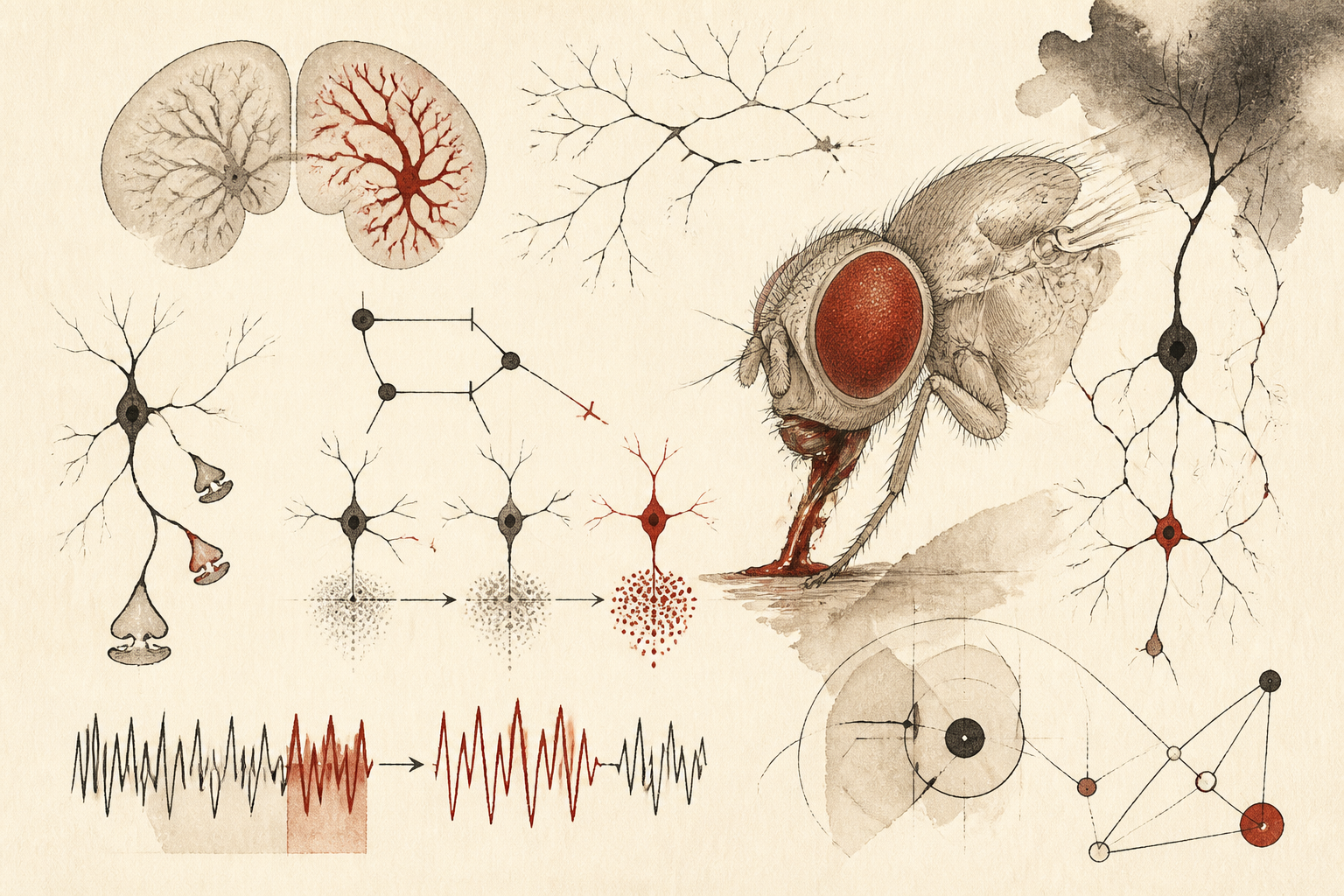
In the study of behavioral neuroscience, one of the most persistent questions involves how the brain organizes discrete physical actions into a coherent, functional sequence. Whether it is a human reaching for a cup of coffee or an insect navigating its environment, motor control requires a precise temporal arrangement of muscle activations. A groundbreaking study published in Nature Neuroscience, titled "Motor neurons organize Drosophila feeding sequences via a disinhibitory cascade," provides a transformative look at this process by examining the neural architecture of the fruit fly, Drosophila melanogaster. By focusing on the fly’s feeding apparatus, researchers have identified a specific circuit mechanism—a disinhibitory cascade—that allows motor neurons to not only execute individual movements but to actively coordinate the transition between different stages of a behavioral routine.
The Architecture of Sequential Motor Control
The ability to transition smoothly from one action to the next is fundamental to survival. For the Drosophila, feeding is not a single muscle contraction but a sophisticated series of movements involving the proboscis, the primary feeding organ. This sequence typically involves the extension of the proboscis, the spreading of the labella to access nutrients, and the rhythmic pumping required to ingest liquid food. Historically, neuroscientists have debated whether these sequences are governed by high-level command neurons that issue instructions to passive motor units, or if the motor neurons themselves play a more integrated role in the timing and logic of the sequence.
The Nature Neuroscience report suggests the latter, highlighting a decentralized yet highly structured system. The researchers utilized the relatively small and well-mapped nervous system of the fruit fly to trace the synaptic connections between the neurons responsible for different feeding actions. What they discovered was not a simple linear chain of activation, but a complex hierarchy where the activation of one set of motor neurons effectively 'unlocked' the next set by removing an existing layer of inhibition. This finding shifts our understanding of motor neurons from simple output cables to active participants in the computational logic of behavior.
Deciphering the Disinhibitory Cascade Mechanism
The central finding of the study involves the identification of a disinhibitory cascade. In neural terms, inhibition is the process by which one neuron prevents another from firing. Disinhibition occurs when a third neuron inhibits the inhibitor, thereby allowing the second neuron to fire. The research team found that in the Drosophila feeding circuit, motor neurons associated with the initial steps of feeding—such as proboscis extension—send signals that inhibit the inhibitory interneurons controlling the subsequent steps, such as labellar spreading.
This mechanism ensures that the steps of feeding occur in the correct order. Without this disinhibitory gate, the fly might attempt to pump food before the proboscis is fully extended, leading to inefficient feeding or physical damage. The study utilized advanced optogenetic tools, which allow researchers to activate specific neurons with light, to test these pathways. By stimulating the neurons for early-stage feeding, they observed the systematic removal of inhibition from later-stage motor neurons. This suggests that the sequence is hardwired into the motor system's architecture, providing a robust template for behavior that requires minimal top-down oversight once the sequence is initiated.
Methodological Rigor and Synaptic Mapping
The researchers employed a multi-disciplinary approach to reach these conclusions, combining high-resolution electron microscopy (EM) with functional imaging. The use of EM datasets allowed the team to map the 'connectome' of the fly—a complete diagram of every synaptic connection within the relevant neural circuits. This anatomical evidence provided the blueprint, showing exactly which neurons were physically connected to one another. However, anatomy alone does not explain function, which is why the team integrated live imaging of neuronal activity.
By observing the calcium dynamics in the brains of living flies during feeding, the researchers could see the sequence of activation in real-time. The synchronization between the anatomical map and the functional data confirmed that the disinhibitory cascade was the primary driver of the feeding rhythm. Furthermore, the study involved the use of genetic silencing, where specific neurons were 'turned off' to see how the behavior changed. When the disinhibitory links were broken, the flies were unable to complete the feeding sequence, often stalling after the first movement or performing movements out of order. This validated that the cascade is necessary for the transition between behavioral states, not just a byproduct of the movement itself.
Limitations and Theoretical Open Questions
While the study provides a definitive look at the feeding sequence of Drosophila, several questions remain regarding the generalizability of these findings. First, the Drosophila nervous system is significantly less complex than that of vertebrates. While the principle of disinhibition is universal in neuroscience, it remains to be seen if mammalian motor sequences—such as those involved in human speech or locomotion—rely on a similarly rigid disinhibitory cascade or if they utilize more flexible, cortical-heavy mechanisms.
Additionally, the study primarily focused on a 'hardwired' sequence. It does not yet address how environmental feedback might modify this cascade. For example, if a fly encounters a physical obstruction during proboscis extension, can the disinhibitory cascade be paused or reversed? Understanding the plasticity of these circuits—how they learn from failure or adapt to new food textures—represents a vital next step for the research team. There is also the question of energy efficiency; the researchers noted that this cascade system is highly reliable, but the metabolic cost of maintaining constant inhibition just to remove it during action is an area that warrants further investigation in the context of evolutionary biology.
The Broader Implications for Neurobiology
The implications of this research extend far beyond the feeding habits of fruit flies. Understanding the fundamental rules of motor organization is critical for the field of robotics and the development of neural prosthetics. If complex sequences can be managed through local disinhibitory loops rather than central processing, engineers may be able to design more efficient autonomous systems that mimic biological efficiency.
Moreover, in the realm of clinical psychology and neurology, this study provides a new lens through which to view motor disorders. Conditions such as Parkinson’s disease or various forms of apraxia involve the breakdown of behavioral sequences. If the human motor system utilizes cascades similar to those found in Drosophila, these disorders might be understood as a failure of disinhibitory gating. By localizing the specific 'gates' that fail, future therapeutic interventions could potentially target the inhibitory interneurons to restore smooth motor transitions. The work published in Nature Neuroscience reminds us that even the simplest behaviors are underpinned by sophisticated neural logic, and that by looking closely at the fly, we gain invaluable insights into the basic building blocks of all animal movement.
Quick answers
- What is a disinhibitory cascade in motor control?
- It is a neural mechanism where the activation of one neuron inhibits an inhibitory interneuron, effectively 'releasing' or activating a third neuron to execute the next step in a sequence.
- How did researchers study the feeding behavior of fruit flies?
- The team used electron microscopy to map synaptic connections (the connectome) and optogenetics to activate specific neurons with light to observe behavioral changes.
- Why is this research significant for human medicine?
- By understanding how neural circuits organize sequences, researchers can better understand motor disorders like Parkinson's where the ability to transition between movements is impaired.
Rewritten by Zeit editorial AI. Based on original reporting at Nature Neuroscience.