The Mathematical Rhythm of Rapport: Pink Noise as the Foundation of Conversational Chemistry
Researchers identify a specific 'pink noise' pattern in semantic alignment that differentiates deep connection from mundane dialogue.
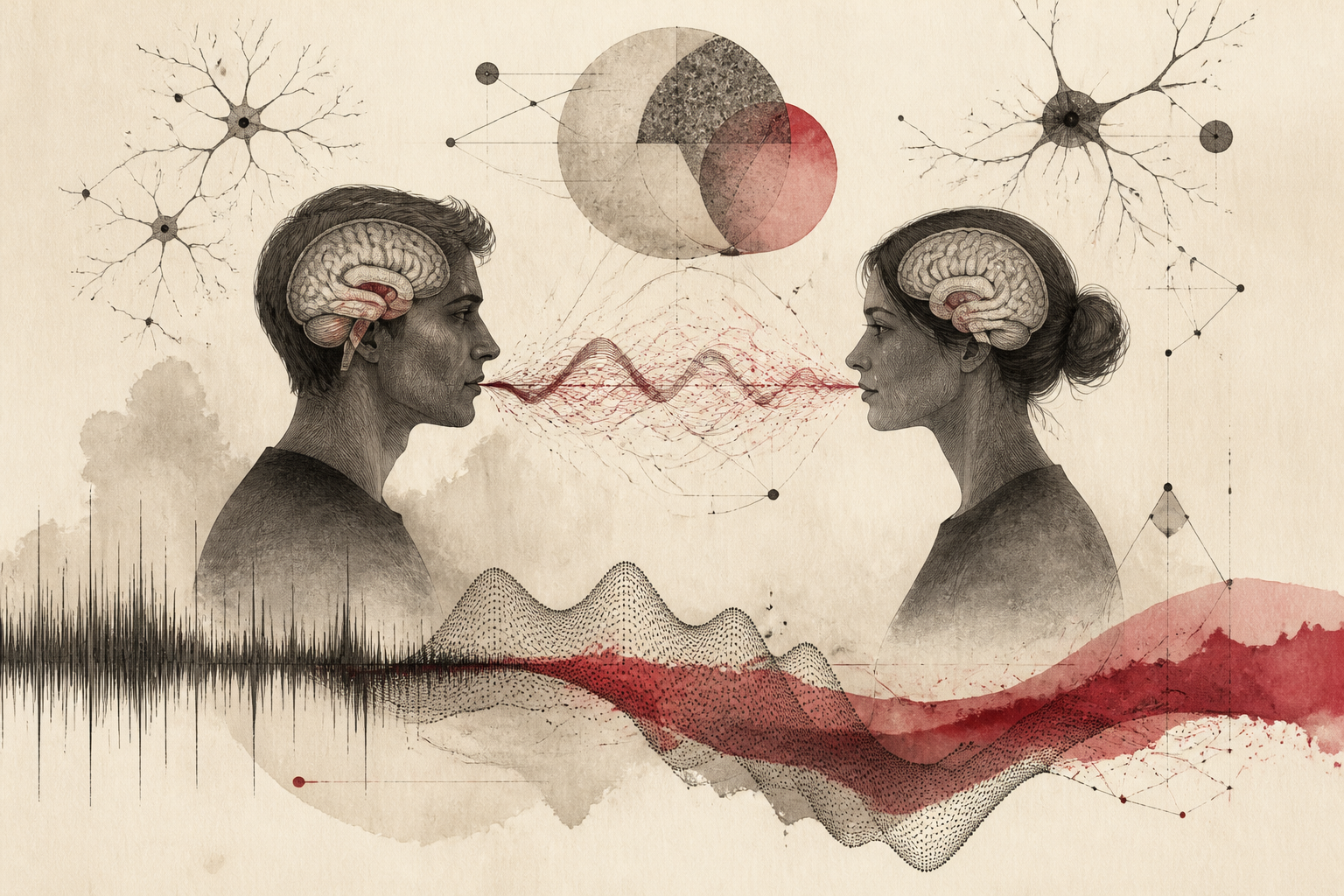
The elusive sensation of 'clicking' with another person during a conversation has long been a subject of anecdotal fascination, yet it has remained remarkably difficult to quantify within the cognitive sciences. Individuals often describe a state of flow or an effortless synchronization when a dialogue succeeds, but the underlying mechanisms that govern these high-quality interactions have remained opaque. Recent research published in a study covered by NeuroscienceNews.com suggests that the secret to engaging conversation lies not in constant agreement or perfect mirroring, but in a specific mathematical rhythm known as pink noise. This pattern of semantic alignment and divergence provides a structural framework for understanding how human beings build rapport and experience social chemistry through verbal exchange.
At its core, the study investigates the temporal dynamics of how ideas evolve between two speakers. By analyzing a diverse range of interactions—from controlled laboratory settings to high-stakes speed dating scenarios and even public-facing media like podcasts—researchers have identified a recurring fractal pattern in the way we share information. This discovery shifts the academic focus away from the content of what is said and toward the structural rhythm of the exchange itself, suggesting that our brains are tuned to find pleasure in a specific balance of predictability and novelty.
The Fractal Nature of Semantic Alignment
To understand why pink noise is significant, one must first distinguish it from other forms of mathematical noise. In acoustics and signal processing, 'white noise' represents a completely random distribution of frequencies, while 'brown noise' describes a more heavily correlated, slower-moving signal. Pink noise, or 1/f noise, occupies a critical middle ground. It is characterized by a fractal structure where the signal is neither entirely random nor entirely predictable; it possesses enough self-similarity to feel coherent but enough variability to remain interesting.
When applied to human conversation, researchers measured 'semantic alignment'—the degree to which speakers are talking about the same concepts or using similar linguistic frameworks. The data revealed that the most enjoyable and successful conversations were those that exhibited a pink noise distribution in this alignment. This means that successful chats do not involve two people saying the same thing back and forth indefinitely, nor do they involve two people talking past each other on unrelated topics. Instead, they involve a rhythmic ebb and flow where participants move closer together in their understanding and then drift apart to introduce new ideas, creating a dynamic tension that sustains interest over time.
This pattern mirrors other natural phenomena found in biological systems, from the rhythm of a healthy human heartbeat to the firing patterns of neurons. The presence of pink noise in conversation suggests that social interaction is a biological process that thrives on a specific type of organized complexity. When a conversation exhibits this fractal quality, participants report higher levels of chemistry and connection, indicating that our internal reward systems may be calibrated to recognize and prefer this mathematical signature.
Quantifying Connection Across Social Contexts
The methodology employed in this research was notably robust, utilizing computational tools to analyze the semantic trajectories of thousands of conversational turns. By mapping the 'distance' between topics as a conversation progressed, the researchers could calculate the power spectrum of the semantic shifts. In speed-dating scenarios, for example, pairs who exhibited a pink noise pattern in their dialogue were significantly more likely to report a mutual attraction and a desire to see each other again. This suggests that the 'spark' often attributed to romantic chemistry may, in fact, be the result of successful semantic coordination following a 1/f distribution.
Further analysis of podcasts and long-form interviews showed that this phenomenon is not limited to intimate or one-on-one personal interactions. Even in a format designed for an audience, the most engaging episodes were characterized by this same mathematical signature. The speakers would converge on a point of shared understanding, explore it deeply, and then diverge into new, unexplored territory before returning to a central theme. This cyclical process of alignment and divergence prevents the conversation from becoming either too stagnant or too chaotic, maintaining a level of cognitive engagement that listeners find inherently satisfying.
Theoretical Interpretations and Cognitive Mechanisms
From a cognitive perspective, the preference for pink noise in conversation may be linked to how the human brain processes information. The brain is an organ designed for predictive processing; it constantly attempts to anticipate incoming stimuli to conserve metabolic energy. However, total predictability leads to boredom and a cessation of learning. Conversely, total randomness is cognitively taxing and difficult to integrate. Pink noise provides the 'Goldilocks' zone of stimulation—offering enough structure to facilitate easy processing while introducing enough novelty to trigger dopaminergic rewards associated with discovery.
This suggests that rapport is not merely a social construct but a state of cognitive synchrony. When two people are 'in the zone,' their semantic shifts are occurring at a rate that allows both brains to remain optimally engaged. The researchers propose that this alignment allows for a more efficient transfer of information, as the participants develop a shared linguistic shorthand that makes communication feel 'frictionless.' This state of flow is what many describe as 'clicking,' and the 1/f signature serves as the primary metric for this achievement.
Limitations and Future Directions in Social Dynamics
While the discovery of pink noise in conversation represents a significant leap forward, the researchers acknowledge several limitations that warrant further investigation. One primary question involves the direction of causality: does the pink noise rhythm create the feeling of chemistry, or do two people who already share an affinity naturally fall into this rhythm? It is also unclear how cultural differences, language barriers, or neurodivergence might impact the manifestation of these patterns. For instance, individuals with differing communication styles may find rapport through different mathematical distributions, or the 'ideal' rhythm may vary depending on the cultural context of the interaction.
Additionally, the study primarily focused on semantic alignment—the 'what' of the conversation. Future research could expand this to include prosody, body language, and micro-expressions to see if a multi-modal pink noise effect exists. Understanding whether this rhythm can be consciously modulated is another area of great interest. Could individuals be trained to listen and respond in a way that encourages a 1/f distribution, thereby improving their social outcomes and professional relationships?
Implications for Human Connection and AI
The implications of these findings extend far beyond the laboratory. In an era where digital communication often lacks the nuance of face-to-face interaction, understanding the mathematical basis of rapport could lead to better-designed social platforms and communication tools. Furthermore, this research has profound consequences for the development of artificial intelligence. If engineers can program conversational agents to follow a pink noise distribution in their semantic output, it may be possible to create AI that feels significantly more 'human' and engaging, moving beyond the often-stilted nature of current large language models.
Ultimately, the work highlighted by NeuroscienceNews.com reaffirms that human connection is a complex, emergent property of biological and mathematical systems. By identifying the rhythm of pink noise as the heartbeat of good conversation, we gain a deeper appreciation for the subtle, invisible structures that bind us together. Chemistry is no longer just a metaphor; it is a measurable, rhythmic dance of ideas that allows us to feel truly seen and understood by another person.
Quick answers
- What is pink noise in the context of conversation?
- Pink noise, or 1/f noise, refers to a mathematical rhythm of semantic alignment that balances predictability and novelty, signaling high-quality social connection.
- How does semantic alignment affect conversational chemistry?
- Conversations that follow a pink noise pattern—meaning they ebb and flow between shared understanding and new topics—are perceived as more enjoyable and indicate better rapport.
- Can the 'click' felt during a date be measured?
- Yes, researchers found that the presence of pink noise rhythms in dialogue predicts mutual attraction in speed-dating scenarios.
Rewritten by Zeit editorial AI. Based on original reporting at NeuroscienceNews.com.