The Legacy of Susumu Tonegawa: Mapping the Physical Architecture of Memory
Academic reflection on the career of Susumu Tonegawa, whose transition from immunology to neuroscience revolutionized our understanding of engram cells and memory storage.
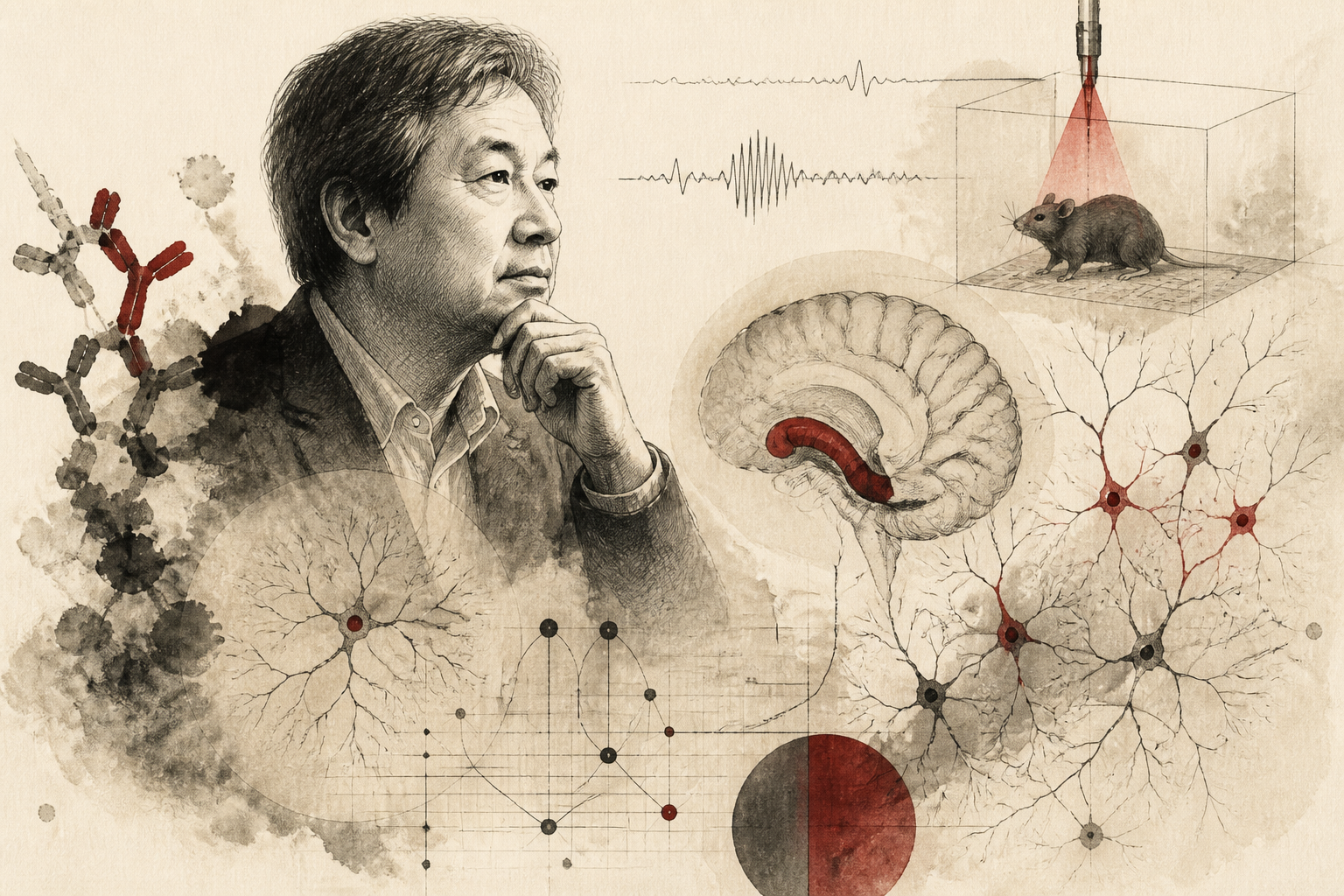
The scientific community recently marked the passing of Susumu Tonegawa, a polymath whose intellectual trajectory fundamentally altered two distinct fields of biological inquiry. While his early career was defined by a Nobel Prize-winning discovery in immunology regarding antibody diversity, his subsequent decades were dedicated to what many consider the final frontier of biology: the physical nature of the human mind. Through his leadership at the Picower Institute for Learning and Memory at the Massachusetts Institute of Technology, Tonegawa moved the study of memory from the realm of abstract psychological theory into the concrete domain of molecular biology and optogenetics. His work provided the first definitive evidence that memories are not merely ephemeral patterns of activity but are instead housed in specific, identifiable clusters of neurons known as engrams.
From Genetic Diversity to Neural Circuitry
Tonegawa’s entry into neuroscience was characterized by the same rigorous genetic approach he applied to the immune system. In the 1970s, he solved the long-standing mystery of how a limited number of genes could produce an almost infinite variety of antibodies, a feat that earned him the Nobel Prize in Physiology or Medicine in 1987. However, rather than remaining within the established bounds of immunology, he transitioned his focus toward the mechanisms of learning and memory. This shift was predicated on his belief that the complexity of the brain could be decoded using the tools of molecular genetics. By the late 1990s and early 2000s, his laboratory began producing a series of landmark studies that utilized transgenic mice to isolate the functions of specific hippocampal regions, such as the CA3 and dentate gyrus. This methodological shift allowed researchers to observe how the deletion of a single gene could impair a specific type of memory, such as spatial recognition or pattern separation, without affecting the animal’s overall cognitive health.
The Discovery and Manipulation of the Engram
The most significant contribution of Tonegawa’s later career, as documented in Nature Neuroscience and related primary literature, was the empirical validation of the engram. For nearly a century, scientists had hypothesized that memories must leave a physical trace in the brain, yet these traces remained elusive. Using a combination of transgenic labeling and optogenetics—a technique that uses light to control neurons—Tonegawa’s team demonstrated that they could not only identify the specific neurons activated during the formation of a memory but could also reactivate that memory artificially. By shining blue light onto a specific population of neurons in the hippocampus, they were able to trigger a fear response in mice even when the mice were in a safe environment. This experiment proved that the activation of a specific neural ensemble is both necessary and sufficient to evoke a behavioral memory, providing a biological anchor for what was previously a philosophical concept.
Mechanisms of False Memory and Retroactive Interference
Beyond the mere activation of existing memories, Tonegawa’s research explored the malleability of the brain’s storage systems. In a series of provocative experiments, his lab successfully created "false memories" in rodents. By labeling the engram for a neutral environment and then activating those cells while the animal received a mild shock in a different environment, the researchers induced the animal to fear the original, safe location. This finding had profound implications for our understanding of human memory distortions, suggesting that the physical substrate of memory is inherently dynamic and susceptible to interference during the process of retrieval and reconsolidation. These studies shifted the academic consensus, highlighting that memory is not a static recording but a biological process that is updated and occasionally corrupted by new experiences. This work provided a biological framework for understanding clinical phenomena such as Post-Traumatic Stress Disorder (PTSD) and the unreliability of eyewitness testimony.
Limitations and Theoretical Constraints
While Tonegawa’s work provided the "where" and "how" of memory storage at a cellular level, he was always careful to acknowledge the limitations of the current neuroscientific paradigm. One significant challenge remained the scalability of these findings from rodent models to the human brain, which contains billions more neurons and significantly more complex cortical interactions. Critics and colleagues alike noted that while hippocampal engrams are essential for episodic memory, the long-term storage of these traces likely involves a broader, more distributed network involving the prefrontal cortex and other neocortical regions. Furthermore, the question of "silent engrams"—memories that exist physically but cannot be retrieved due to neurological conditions like Alzheimer’s disease—remains an area of active debate. Tonegawa’s later research suggested that these memories might be recoverable through direct neural stimulation, but the transition from optogenetic mouse models to human therapeutic applications faces significant ethical and technical hurdles.
The Future of Memory Research
The enduring impact of Susumu Tonegawa lies in his transformation of neuroscience into a predictive, manipulative science. By bridging the gap between molecular genetics and cognitive psychology, he established a roadmap for future generations to explore how the brain constructs a sense of self through the accumulation of experience. His legacy is not merely the discovery of specific genes or neural pathways, but the proof that the mind, in all its complexity, is ultimately accessible to scientific inquiry. As researchers continue to investigate the mechanisms of memory consolidation, the role of sleep in neural pruning, and the potential for treating cognitive decline, they do so on the foundation laid by Tonegawa. His work ensures that the study of the engram will remain at the center of neuroscience for decades to come, as we move closer to understanding how a collection of cells can give rise to the richness of human history and consciousness.
Quick answers
- What is an engram cell in neuroscience?
- An engram cell is a physical trace or biological change in the brain's neural tissue that represents a specific memory, first empirically validated by Susumu Tonegawa's lab.
- How did Susumu Tonegawa prove the existence of memories?
- He used optogenetics to reactivate specific hippocampal neurons in mice, showing that stimulating these cells could trigger the recall of a previously learned behavior.
- Can memories be manipulated according to Tonegawa's research?
- Yes, his research demonstrated that activating certain neural ensembles during new experiences could create false memories or alter the emotional valence of existing ones.
Rewritten by Zeit editorial AI. Based on original reporting at Nature Neuroscience.