Systemic Infiltration: Stanford Study Challenges the Brain's Immune Isolation
Stanford University researchers have identified a significant influx of peripheral immune cells into the aging brain, challenging long-held theories regarding the blood-brain barrier.
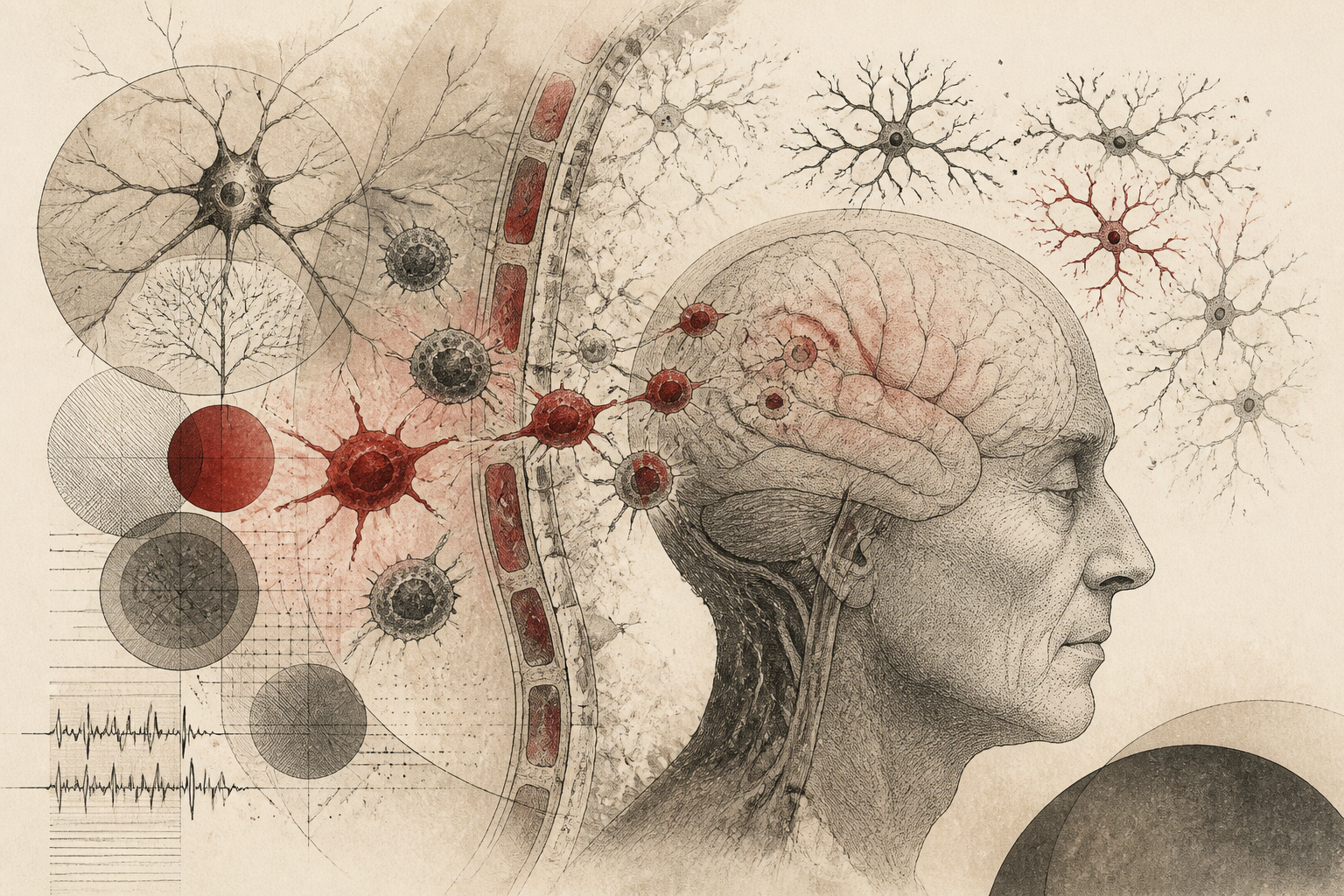
The traditional understanding of the human brain as an immune-privileged sanctuary is undergoing a fundamental revision following new evidence from Stanford University. For decades, the neurological community operated under the premise that the brain remained largely sequestered from the peripheral immune system, protected by the formidable blood-brain barrier. This separation was thought to be a critical evolutionary adaptation, ensuring that the sensitive neural architecture remained undisturbed by the fluctuating inflammatory responses of the body. However, new research published in the journal Science reveals that this barrier is significantly more permeable to systemic immune cells than previously suspected, particularly as an individual progresses into middle age and beyond.
Researchers at Stanford have discovered that a specific population of immune cells, originating in the blood, begins to flood the brain's parenchyma in numbers that increase dramatically with age. This infiltration marks a departure from the physiological baseline of youth, where the brain relies almost exclusively on its resident immune cells, known as microglia, to perform housekeeping duties and protect against local pathogens. The arrival of these outsiders suggests that the aging process is not merely a localized decline of neural efficiency, but a systemic integration of the body’s inflammatory state into the central nervous system. This discovery has profound implications for our understanding of neurodegeneration, cognitive decline, and the very definition of a healthy aging brain.
The Breakdown of Neural Sequestration
Historically, the blood-brain barrier was viewed as a static wall, a physiological sieve that allowed nutrients and oxygen to pass while blocking the entry of larger proteins and peripheral cells. Under this model, the brain's immunity was considered internal and self-contained. The resident microglia were thought to be the sole sentinels, originating from embryonic precursors and maintaining their population through local self-renewal rather than recruitment from the blood. The Stanford study, however, utilizes advanced lineage tracing and single-cell sequencing to demonstrate that this isolation is temporary. As the body enters middle age, the boundary between the systemic circulation and the neural environment begins to blur.
Data gathered from both human tissue samples and longitudinal animal models suggest that the infiltration of peripheral immune cells is not a sudden catastrophic failure but a progressive accumulation. These cells, primarily monocytes and T-cells, do not merely pass through the brain; they settle within it. Once they cross the vascular interface, they undergo a phenotypic transformation, adopting characteristics that make them nearly indistinguishable from native microglia. This process, often referred to as 'microglial replacement,' suggests that the aging brain is essentially being repopulated by cells that were born in the bone marrow and traveled through the bloodstream.
Mechanisms of Cellular Infiltration
To understand why this influx occurs, the Stanford team investigated the molecular signals that facilitate the movement of cells across the blood-brain barrier. The researchers identified a specific set of inflammatory markers that increase in the systemic circulation as the body ages. These markers appear to act as a homing signal for peripheral immune cells, essentially inviting them to penetrate the neural space. The researchers noted that this process accelerates significantly during the transition from early middle age to seniority, coinciding with the period when many individuals first begin to experience subtle changes in cognitive processing speed and memory.
Once inside the brain, these peripheral recruits don the mantle of microglia, but they may not behave with the same precision as the original resident cells. The study indicates that these 'infiltrator' cells tend to exhibit a more aggressive inflammatory profile. While native microglia are highly attuned to the specific needs of the neural environment, these systemic newcomers may bring with them a history of exposure to peripheral infections and metabolic stress. This 'immunological memory' could cause them to overreact to minor stimuli within the brain, potentially triggering chronic low-grade inflammation that damages neurons and synapses over time.
The Functional Impact on Neurodegeneration
The discovery that the brain is flooded with outside immune cells provides a new lens through which to view neurodegenerative conditions such as Alzheimer’s and Parkinson’s disease. In these contexts, the presence of peripheral cells may act as a double-edged sword. On one hand, the recruitment of new cells could be a desperate attempt by the brain to clear away toxic protein aggregates that the aging native microglia can no longer manage. On the other hand, the influx of these cells may exacerbate the very conditions they are meant to solve, contributing to a cycle of neuroinflammation that hastens cognitive decline.
Stanford researchers emphasize that the transformation of blood cells into microglia-like entities represents a significant shift in the brain's biological identity. If a substantial portion of the brain's immune system is replaced by cells from the blood, the health of the brain becomes inextricably linked to the health of the systemic immune system. Factors that influence peripheral inflammation—such as diet, exercise, and chronic infection—may therefore have a more direct and physical impact on the brain's cellular composition than previously recognized. This bridge between the body and the brain suggests that neurological health cannot be treated in isolation from systemic physiology.
Limitations and Future Directions
While the findings are groundbreaking, the researchers caution that many questions remain unanswered. One primary limitation of the study is the difficulty in determining exactly when this infiltration crosses the line from a normal feature of aging to a pathological driver of disease. It is currently unclear whether every individual undergoes this process at the same rate or if certain genetic or environmental factors can stabilize the blood-brain barrier for longer periods. Additionally, while the cells resemble microglia, further functional assays are required to determine if they can perform all the complex tasks of their native counterparts, such as synaptic pruning and the secretion of specific neurotrophic factors.
Future research will likely focus on whether this process can be modulated or even reversed. If the infiltration of peripheral cells is indeed a driver of cognitive decline, developing therapies that reinforce the blood-brain barrier or reprogram the incoming cells could offer new pathways for intervention. Conversely, if these cells are found to be beneficial, scientists might look for ways to enhance their recruitment or improve their integration into the neural circuit. The Stanford study has opened a new frontier in neuroimmunology, one where the brain is no longer seen as a castle with closed gates, but as a dynamic landscape constantly interacting with the rest of the organism.
Quick answers
- What did Stanford researchers discover about the aging brain?
- They found that immune cells from the blood begin entering the brain in large numbers starting in middle age, contradicting the idea that the brain is isolated from the body's immune system.
- What happens to blood cells once they enter the brain?
- Once these peripheral immune cells cross the blood-brain barrier, they transform into cells that closely resemble microglia, the brain's specialized resident immune cells.
- Why is the infiltration of immune cells into the brain significant?
- It suggests that the brain's health is closely linked to the body's systemic immune system and that this influx may contribute to neuroinflammation or age-related cognitive decline.
Rewritten by Zeit editorial AI. Based on original reporting at ScienceDaily — Mind & Brain.