Stalled Trajectories: Cannabis Use Linked to Diminished Cognitive Maturation in Teens
Recent findings published via ScienceDaily suggest that adolescent cannabis use disrupts the typical developmental curve of critical executive functions and linguistic processing.
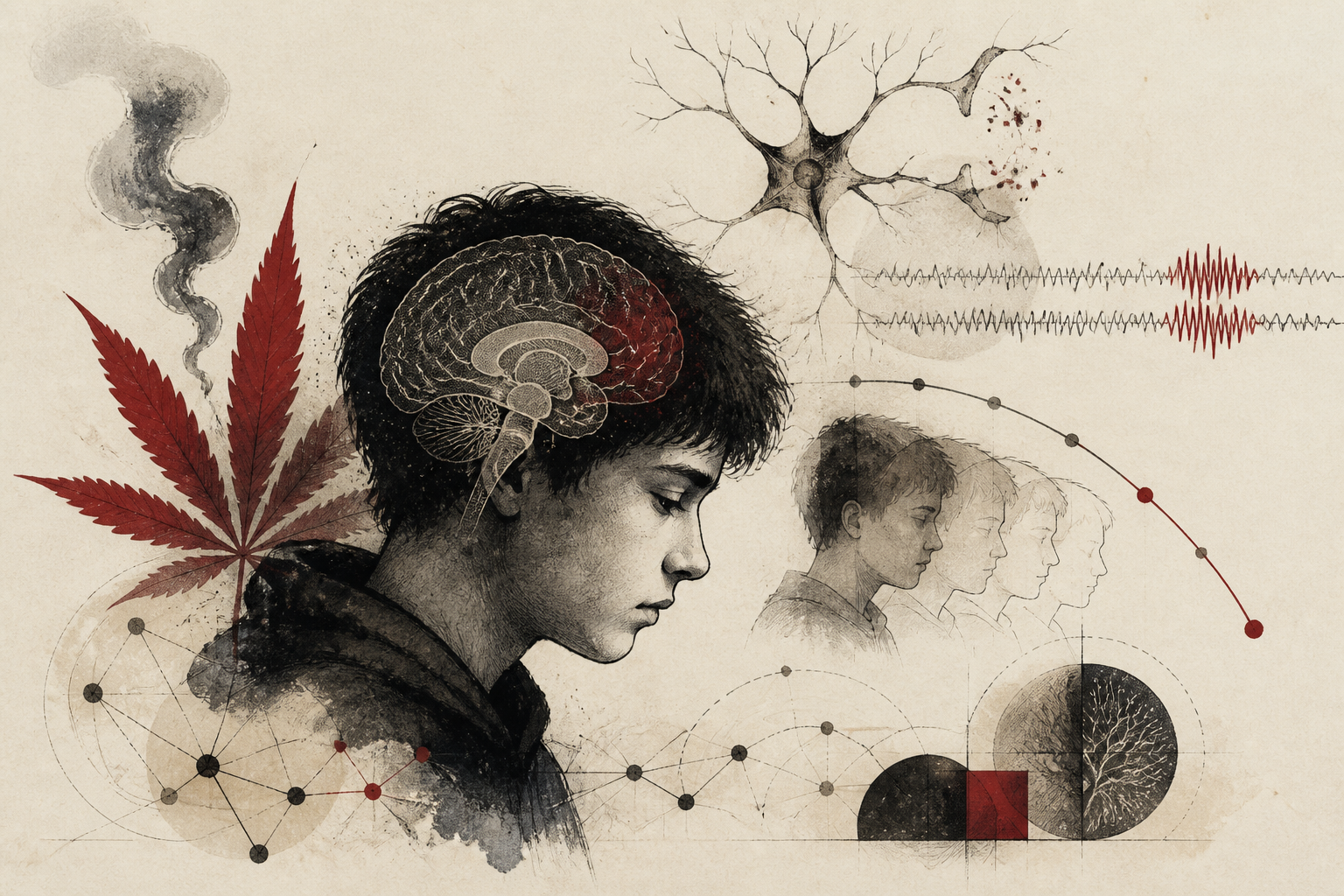
The transition from adolescence to early adulthood represents a critical window of neurobiological refinement characterized by significant synaptic pruning and the maturation of the prefrontal cortex. While this period is traditionally marked by a steady upward trajectory in cognitive capabilities, new research indicates that external chemical influences may prematurely flatten this growth curve. According to a study reported by ScienceDaily, teenagers who initiate cannabis use experience a demonstrable deceleration in the development of essential mental faculties, including memory, attention, and linguistic fluency. Unlike previous assumptions that cannabis might cause an immediate and sharp decline, these findings suggest a more insidious mechanism: the stagnation of normal cognitive gains that their non-using peers continue to achieve well into their twenties.
Historically, research into substance use during the teenage years has focused on acute impairment or permanent neurological damage. However, the current data emphasizes the concept of 'missed potential' rather than just active deficit. As the adolescent brain strives to reach its peak operational efficiency, the introduction of cannabinoids appears to act as a developmental anchor. The research suggests that while users may initially exhibit cognitive profiles indistinguishable from their peers, the divergence begins once regular cannabis use is established. While non-users show a sustained increase in processing speed and executive control throughout their late teens, those using cannabis show a plateau, effectively ending their cognitive development before it reaches its natural zenith.
The Mechanisms of Developmental Stagnation
The physiological underpinnings of these findings center largely on Delta-9-tetrahydrocannabinol (THC), the primary psychoactive component of the cannabis plant. Researchers identified THC as the most likely driver behind the observed developmental disruptions, noting its specific impact on the hippocampus and the prefrontal regions. These areas are dense with cannabinoid receptors and are responsible for memory formation and complex decision-making. The study highlights that the presence of THC during this sensitive period interferes with the brain's ability to refine its neural pathways. Instead of the brain becoming more efficient at processing information—a hallmark of late-stage adolescent development—it remains static.
This plateau effect was most pronounced in the domains of verbal memory and processing speed. Memory, in particular, showed the most direct correlation with THC exposure. As the adolescent brain attempts to consolidate learning mechanisms, the exogenous stimulation of the endocannabinoid system appears to disrupt the natural homeostasis required for these upgrades. The result is not necessarily a loss of previously acquired knowledge, but a failure to develop the more sophisticated mnemonic strategies and rapid-fire processing capabilities that characterize the transition to adult cognition. This stagnation suggests that the brain’s 'software updates' are effectively cancelled or delayed by the presence of the drug.
Longitudinal Tracking and Comparative Growth
Methodologically, the study provides a compelling look at the comparative growth between users and non-users by tracking cognitive performance over time rather than relying on a single snapshot. Initially, both groups—those who would eventually use cannabis and those who would remain abstinent—demonstrated similar levels of performance in language and attention tasks. This baseline parity is crucial as it rules out the possibility that lower cognitive ability was a pre-existing condition that led to drug use. Instead, the data supports a causal direction where the behavior influences the biological outcome.
As the study progressed, a clear divergence emerged. In tasks requiring sustained attention and complex linguistic processing, the non-user group showed the expected year-over-year improvements. Their brains were becoming more specialized and faster at navigating complex problems. In contrast, the group using cannabis began to trail behind, not because they were losing their abilities in a traditional sense, but because their 'growth engine' had slowed. This indicates that the adolescent brain requires a specific chemical environment to complete its maturation, and that cannabis alters this environment sufficiently to impede the final stages of neurodevelopmental refinement.
Interpretations of the Cognitive Gap
The interpretation of these findings has significant implications for educational and clinical psychology. If cannabis use leads to a leveling off of cognitive growth, the long-term impact on a young person's socio-economic potential could be substantial. Education systems are designed around the assumption of continued cognitive expansion during the high school and university years. A student who experiences a plateau in processing speed or verbal memory may find themselves increasingly ill-equipped to handle the escalating complexity of higher education or specialized vocational training. The 'gap' created is cumulative; every year the non-user continues to improve, the user falls further behind their projected potential.
Furthermore, the findings regarding language and attention suggest that the impacts are not localized to just one area of life. Language development is integral to social integration and professional success, while attention is the gateway to all other forms of learning. By slowing the growth of these foundational pillars, cannabis use may exert a broad-spectrum dampening effect on a young person’s overall trajectory. The research underscores that the risk is not just about 'getting high' in the moment, but about the permanent lowering of the ceiling for one's intellectual and functional capacity in adulthood.
Limitations and Future Directions
While the link between THC and slowed growth is robust, the study acknowledges certain limitations that necessitate further inquiry. One primary question involves the concept of reversibility. It remains unclear whether the cognitive development can be 'restarted' if a teenager ceases cannabis use, or if the window for these specific developmental gains closes permanently after a certain age. Additionally, while THC was identified as the primary culprit, the role of other cannabinoids like CBD remains less understood in this specific developmental context. Future research will need to disentangle the dosage, frequency, and potency of cannabis products to determine if there is a 'safe' threshold or if any level of exposure during adolescence triggers this developmental plateau.
Another open question concerns the role of environmental and genetic factors. While the study controlled for many variables, the interplay between a teenager’s genetic predisposition to cognitive growth and the environmental stress of substance use is complex. Researchers are also interested in whether specific interventions, such as cognitive remediation therapy, could help bridge the gap for those who have already experienced a slowdown in their mental development. Understanding the molecular triggers that lead to this leveling off will be essential for developing targeted prevention strategies.
Implications for Public Health and Education
The importance of these findings cannot be overstated in an era of increasing cannabis legalization and social normalization. As the perception of risk among adolescents declines, the scientific evidence points toward a unique vulnerability during the teenage years that does not exist for adult users. Public health messaging may need to shift from focusing on the dangers of addiction to the more nuanced danger of cognitive stagnation. For parents, educators, and policymakers, the message is clear: the adolescent brain is a work in progress, and protecting its growth trajectory is vital for ensuring that the next generation reaches its full cognitive potential.
Ultimately, this research serves as a reminder of the fragility of human development. The transition from child to adult is a finely tuned process that requires a specific sequence of biological events. By identifying cannabis as a disruptor of this sequence, the scientific community provides a clearer picture of the risks involved. It is not simply a matter of avoiding harm, but of fostering the environment necessary for the brain to achieve its most sophisticated form. As we continue to study the long-term effects of cannabis, the focus must remain on how we can support the unimpeded growth of the developing mind.
Quick answers
- How does cannabis affect a teenager's memory development?
- Research indicates that cannabis use, particularly THC exposure, causes memory growth to level off or plateau during adolescence, while non-users continue to show improvements.
- Is the cognitive decline from teen cannabis use immediate?
- No, the study suggests it is not an immediate decline but rather a 'slowing down' of normal developmental gains in areas like language, attention, and processing speed.
- What is the primary substance in cannabis linked to slowed brain growth?
- THC (Delta-9-tetrahydrocannabinol) was identified as the most likely driver for the worsening of memory and the stagnation of cognitive faculties in teens.
Rewritten by Zeit editorial AI. Based on original reporting at ScienceDaily — Mind & Brain.