Sparse Neural Architecture Facilitates Regional Autonomy and Clock Synchronization
Researchers identify a delicate balance between local processing and global timing in the human cortex.
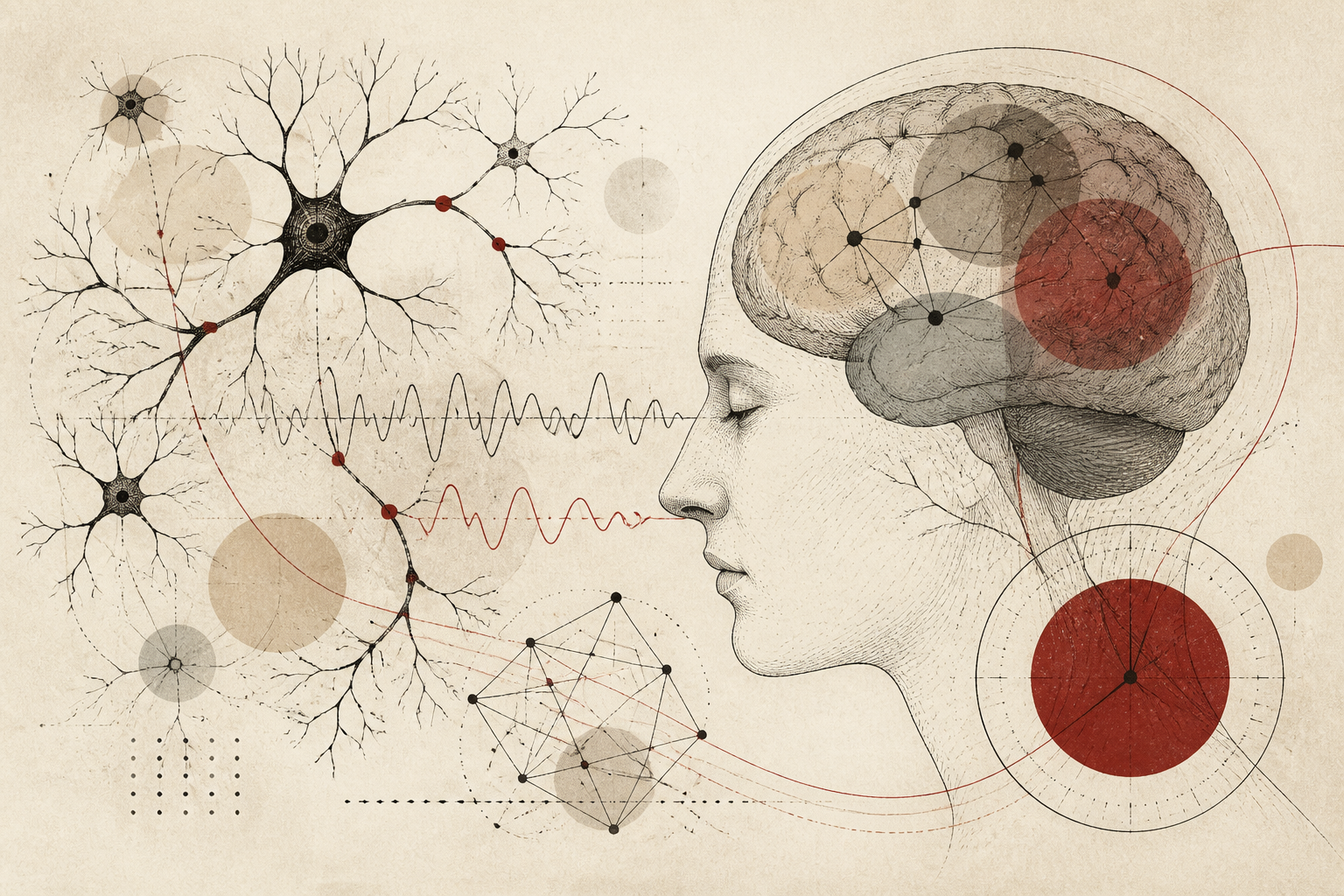
New research published in *Nature Communications* and reported by *NeuroscienceNews.com* has illuminated the architectural principles governing how the brain manages time across different cortical regions. The study addresses a fundamental paradox in neuroscience: how the brain’s internal clocks maintain enough independence to perform localized tasks while remaining synchronized to ensure cohesive behavior.
The human cortex is comprised of multiple specialized areas, each functioning as a semi-autonomous 'internal clock.' To understand how these disparate regions coordinate, researchers utilized computational modeling to examine the density and arrangement of neural connections. Their findings suggest that the brain employs a strategy of 'sparse connectivity' rather than high-density linkages to maintain temporal order.
According to the study, if cortical regions were too densely interconnected, the entire system would collapse into a state of total synchronization, stripping individual regions of the autonomy required to process specific sensory inputs. Conversely, if connections were too weak, the regions would drift out of sync, leading to cognitive fragmentation. The researchers discovered that the brain’s actual structural configuration exists at a critical tipping point. This sparse network allows for 'rhythmic entrainment'—where one region can nudge another into a shared timing—without overriding the unique functional signatures of local circuits.
These insights provide a new framework for understanding how the brain transitions between states of focused local processing and large-scale integration. The results emphasize that the sparsity of long-range neural projections is not a limitation, but a sophisticated evolutionary feature designed to optimize the trade-off between independence and cooperation. Future research may explore how disruptions in this balance contribute to neurological conditions characterized by timing deficits, such as Parkinson’s disease or schizophrenia.
Quick answers
- How does the brain synchronize different internal clocks?
- The brain uses sparse long-range neural connections to allow regions to influence each other's rhythms without sacrificing their individual processing power.
- What happens if neural regions are too interconnected?
- Excessive connectivity leads to over-synchronization, which prevents specific regions from performing autonomous, specialized functions.
- Why is timing important in the cortex?
- Coordinated timing allows the brain to integrate information from different senses and execute motor actions with precision.
Rewritten by Zeit editorial AI. Based on original reporting at NeuroscienceNews.com.