Smart Nanoparticles Offer Dual-Action Precision Against Glioblastoma Recurrence
Researchers have developed a light-activated nanoparticle system that visualizes microscopic brain tumor cells and destroys them post-surgery to prevent recurrence.
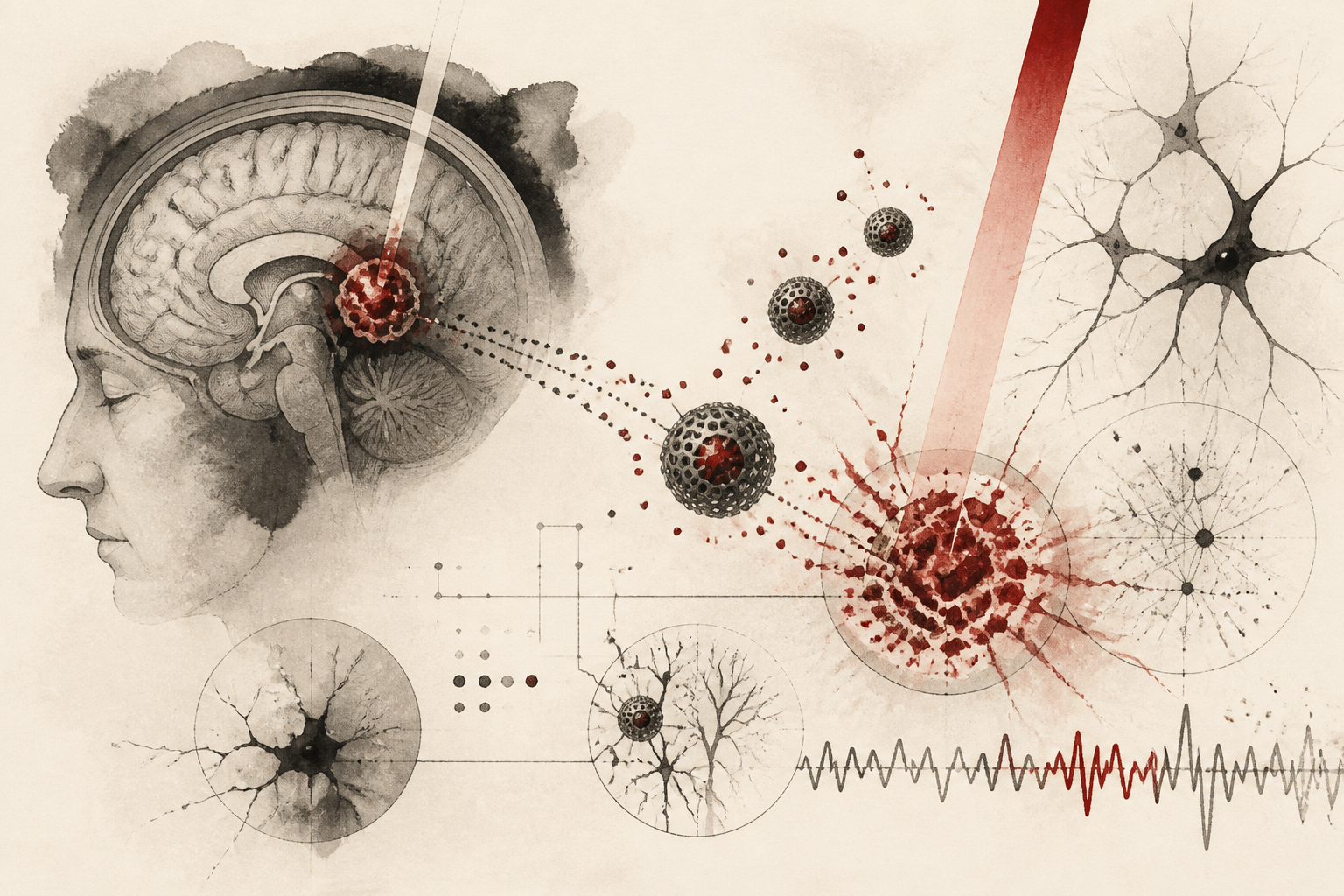
The clinical management of glioblastoma multiforme remains one of the most formidable challenges in modern neuro-oncology. Despite aggressive surgical resection followed by radiotherapy and chemotherapy, the median survival rate for patients remains discouragingly low. The primary driver of this failure is the infiltrative nature of the tumor; microscopic filaments of cancerous tissue often extend into healthy brain matter, remaining invisible to the surgeon’s eye and conventional imaging. However, a significant advancement published in recent research, and reported via ScienceDaily, highlights a novel technological intervention that may bridge this gap. A team of scientists has engineered 'smart' nanoparticles designed to perform a dual function: providing real-time illumination of hidden cancer cells during the operative window and subsequently acting as a localized therapeutic agent to eliminate residual disease. While currently limited to animal models, the results suggest a paradigm shift in how localized brain cancers are treated.
The Challenge of Microscopic Tumor Resection
The fundamental difficulty in treating glioblastoma lies in the delicate balance of the neurosurgical margins. Unlike tumors in less critical organs, where a surgeon can remove a wide buffer of healthy tissue to ensure complete eradication, the brain offers no such luxury. Every millimeter of tissue removed represents a potential loss of motor function, cognition, or personality. Consequently, surgeons often leave behind 'micrometastases' or infiltrating cells to preserve neurological integrity. These residual cells are the seeds of inevitable recurrence, usually occurring within centimeters of the original site. Traditional post-operative treatments, such as systemic chemotherapy, often struggle to cross the blood-brain barrier in sufficient concentrations to kill these remaining cells without causing systemic toxicity. The newly developed nanoparticles aim to address these limitations by focusing both diagnostic and therapeutic power directly at the site of the tumor margin, ensuring that what cannot be seen can still be neutralized.
Mechanisms of Near-Infrared Fluorescence and Phototherapy
The innovation centers on the biochemical engineering of nanoparticles that react to specific wavelengths of light. When administered, these particles are designed to accumulate preferentially within the glioblastoma cells, exploiting the leaky vasculature and metabolic demands of the tumor. Once the surgeon opens the surgical field, a specific frequency of near-infrared light is applied. This light penetrates the surface of the brain tissue, causing the nanoparticles to fluoresce. This 'lighting up' of the tumor provides the surgical team with a high-contrast map of the malignancy, allowing for a more precise and comprehensive resection than was previously possible under standard white-light conditions. However, the most significant breakthrough occurs after the visible tumor mass has been removed. By adjusting the wavelength or intensity of the light, the researchers can trigger a second reaction within the particles. These 'smart' agents then produce heat or reactive oxygen species—a process known as photodynamic or photothermal therapy—which effectively destroys the microscopic cells that the scalpel could not reach.
Experimental Outcomes and Survival Metrics
The efficacy of this dual-action approach was tested in a rigorous murine model, as detailed in the source report. The researchers treated mice afflicted with aggressive glioblastoma using the nanoparticle-guided surgery followed by light-activated therapy. The results were remarkably consistent. In the control groups receiving standard surgery, recurrence was rapid and fatal. In contrast, the experimental group showed a 100% survival rate at the 60-day mark, a period that represents a significant longevity milestone in rodent cancer studies. More importantly, the researchers observed no signs of tumor recurrence in the subjects treated with the nanoparticles. This suggests that the phototherapeutic phase was successful in eradicating the residual microscopic clusters that typically drive the return of the disease. The precision of the light activation also meant that surrounding healthy neurons remained largely unaffected, demonstrating a high degree of biocompatibility and localized safety.
Clinical Limitations and Translational Hurdles
Despite the promising data, the transition from murine models to human clinical application involves substantial hurdles. As the original source notes, this technology has not yet been tested in humans. The human brain is significantly larger and more complex than the mouse brain, raising questions about light penetration depth. Near-infrared light can only travel a certain distance through dense tissue; therefore, ensuring that the light reaches every potential pocket of hidden cancer in a human-sized resection cavity will require further engineering of fiber-optic delivery systems. Additionally, the long-term toxicity of the nanoparticles themselves must be evaluated. The human body must be able to clear or safely sequester these synthetic materials once their job is complete. Regulatory approval by bodies such as the FDA will require multi-phase trials to ensure that the 'smart' particles do not cause unintended neuroinflammation or long-term cognitive deficits.
Future Implications for Neuro-Oncology
The potential for this technology extends beyond just glioblastoma. If the platform of light-activated nanoparticles proves safe and effective, it could be adapted for a variety of other difficult-to-treat solid tumors, such as those found in the pancreas or the liver, where clear margins are equally difficult to achieve. The marriage of diagnostics and therapeutics into a single 'theranostic' agent represents the cutting edge of personalized medicine. For the students and faculty at Zeit Psychology Online University, this development underscores the vital intersection of biotechnology and patient outcomes. Reducing recurrence not only extends life but also reduces the psychological trauma and cognitive decline associated with multiple brain surgeries and chronic chemotherapy. As the scientific community awaits human trials, this research stands as a beacon of hope for transforming a terminal diagnosis into a manageable condition through the power of nanomedicine.
Quick answers
- How do smart nanoparticles help in brain cancer surgery?
- They accumulate in tumor cells and glow under near-infrared light, allowing surgeons to see and remove hidden cancer margins that are invisible to the naked eye.
- What happens to the cancer cells that surgery cannot remove?
- The nanoparticles can be activated by specific light wavelengths to generate heat or reactive oxygen, killing the remaining microscopic cancer cells without damaging healthy brain tissue.
- Has this new brain cancer treatment been tested on people?
- No, the treatment has currently only been tested in mice, where it resulted in a 100% survival rate at 60 days. Human clinical trials are still required.
Rewritten by Zeit editorial AI. Based on original reporting at ScienceDaily — Mind & Brain.