Sleep as Synthesis: New Study Deciphers the Mechanisms of Dream Architecture
Researchers have identified that dreaming is a structured cognitive process that synthesizes personality traits and external stimuli into original scenarios rather than mere data replays.
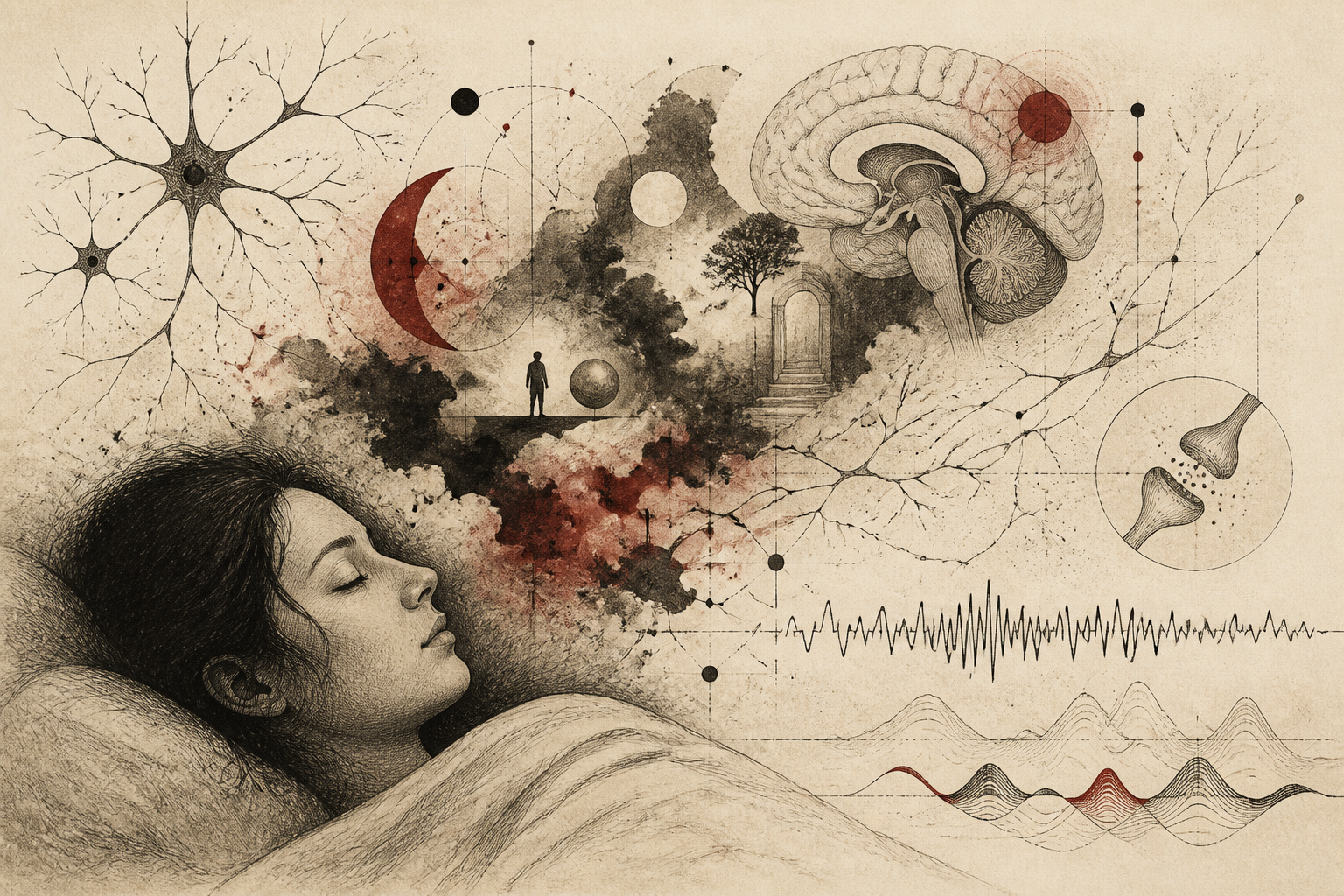
Recent findings published in *ScienceDaily* challenge the historical assumption that dreaming represents a form of random neurological noise. By investigating a massive dataset of over 3,700 dream and waking-state reports, researchers have demonstrated that the dreaming brain functions as a sophisticated engine for rewriting reality. The study suggests that nocturnal cognition is a deliberate synthesis of individual personality, environmental factors, and stored memories.
Contrary to the 'replay' theory—which posits that dreams are simple loops of recent biographical events—this research clarifies that the human brain engages in active creative processing during sleep. The mechanism involves integrating various disparate elements: emotional states, hypothetical possibilities, and recognizable geographic or social settings are woven into entirely new, vivid narratives. This synthesis allows the brain to simulate novel experiences that, while grounded in the dreamer's reality, do not strictly mirror any single past event.
The findings highlight the predictive and integrative nature of the human subconscious. By analyzing the correlation between a subject's personality and their dream content, the study found that individual temperament significantly influences how the brain reformulates waking experiences. This suggests that dreaming serves as a cognitive workspace for evaluating the world and projecting potential future scenarios.
For the academic community at Zeit Psychology Online University, this research underscores the importance of longitudinal dream analysis in understanding cognitive health. It shifts the focused inquiry from 'what' we dream to 'how' and 'why' the brain selects specific memory fragments to construct nocturnal narratives. As researchers continue to map these neurological pathways, the link between personality and sleep architecture becomes an essential pillar of contemporary psychological studies.
Quick answers
- Is dreaming just a replay of things that happened during the day?
- No, research indicates that the brain does not merely replay events but instead mixes memories, emotions, and imagination to create entirely new, vivid scenarios.
- What factors influence the content of our dreams?
- According to the study, both an individual's unique personality traits and their external environment heavily influence how the brain constructs dreams.
- Why is this study of 3,700 dream reports significant?
- The large scale of the study provides robust evidence that dreams are structured cognitive processes rather than random mental static, offering deeper insight into sleep architecture.
Rewritten by Zeit editorial AI. Based on original reporting at ScienceDaily — Mind & Brain.