Psilocybin Modulates Escalating Aggression in Kryptolebias marmoratus
Recent research reveals that low doses of psilocybin specifically inhibit aggressive escalation in mangrove rivulus fish, offering new insights into the neurobiology of social behavior.
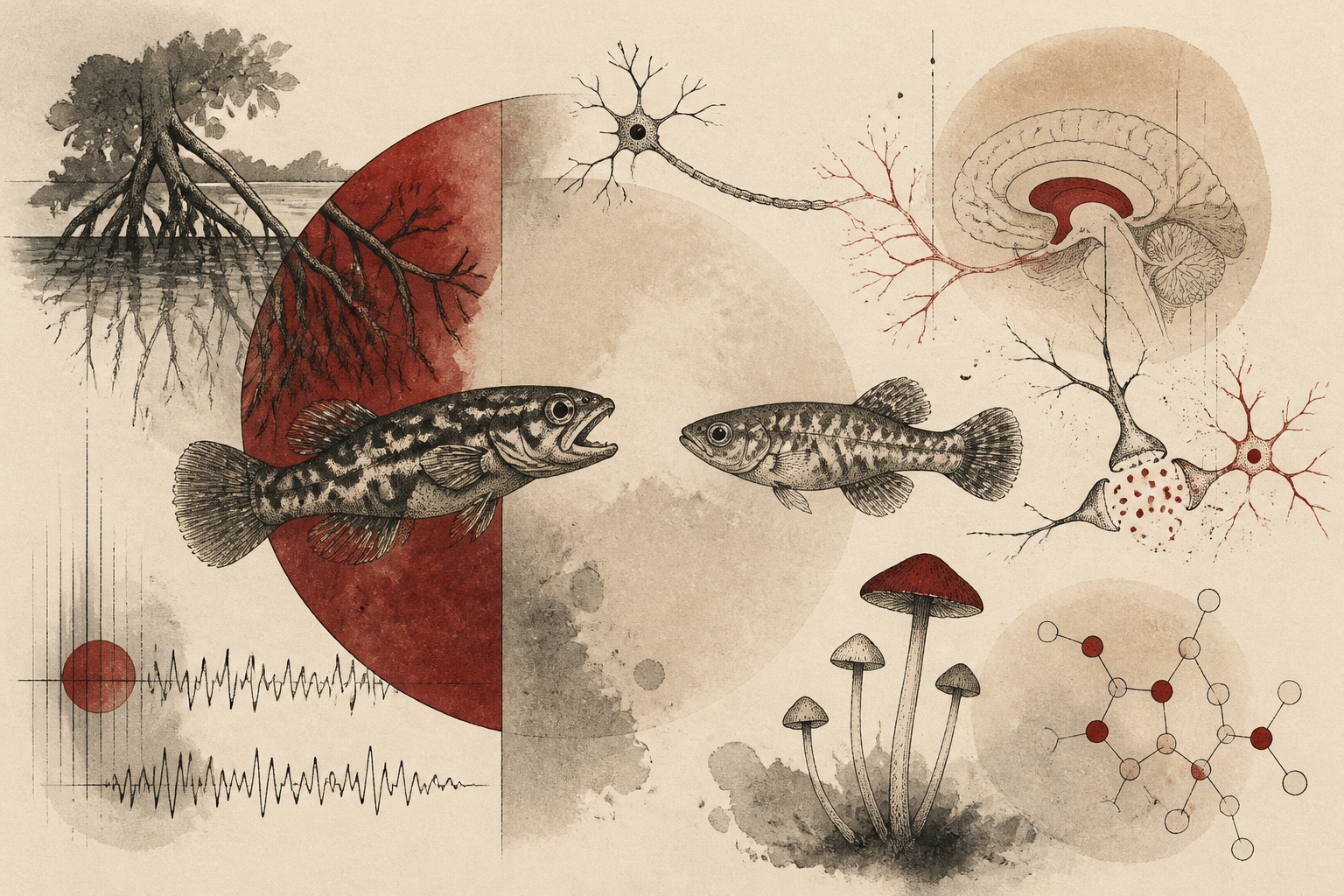
In the complex landscape of behavioral neuroscience, the quest to understand the mechanisms of aggression often leads researchers to unexpected chemical interventions. A recent study, as reported by ScienceDaily, has identified a significant behavioral shift in *Kryptolebias marmoratus*, commonly known as the mangrove rivulus, following the administration of psilocybin. This psychedelic compound, traditionally associated with its hallucinogenic properties in humans, appears to exert a stabilizing effect on the social dynamics of this specific fish species. The findings suggest that instead of acting as a general sedative, psilocybin may selectively target the pathways responsible for the escalation of conflict, providing a nuanced perspective on how serotonergic agonists influence vertebrate social structures.
The mangrove rivulus is a unique model for behavioral studies due to its high levels of natural aggression and its unusual reproductive biology. In their natural habitats, these fish are known for their territoriality and their propensity for intense physical confrontations. Understanding what triggers these attacks—and what can mitigate them—has long been a priority for ethologists. Previous research into aggression has often utilized pharmacological agents that result in a broad suppression of activity, making it difficult to distinguish between a reduction in hostility and a general state of lethargy. This recent investigation sought to determine if psilocybin could offer a more surgical approach to behavioral modification, dampening the drive for combat without diminishing the organism’s overall engagement with its environment.
Quantitative Reduction in Agonistic Encounters
The primary findings of the study indicate that low-dose psilocybin administration leads to a statistically significant decrease in both the frequency and intensity of aggressive attacks among the fish. During the experimental phase, researchers observed that individuals treated with the compound were less likely to initiate lunges or bites when confronted with a rival. Perhaps the most compelling aspect of these findings is the specificity of the response. The reduction in aggression was not accompanied by a decrease in motor activity or a failure to respond to environmental stimuli. The fish remained active, swimming and interacting with their surroundings, yet the specific trigger for violent escalation appeared to be muted.
This distinction is critical for the field of behavioral pharmacology. When evaluating the efficacy of any psychoactive substance, researchers must differentiate between systemic toxicity—which might manifest as slowed movement or lack of appetite—and targeted behavioral modulation. The data gathered from the mangrove rivulus suggest that psilocybin operates on a level that preserves the functional integrity of the fish's social repertoire. In the controlled setting of the study, treated fish were capable of recognizing their peers and engaging in typical non-combative social behaviors, yet the transition from recognition to physical assault was significantly delayed or entirely prevented. This suggests that the compound may be interfering with the neurological 'tipping point' that converts social tension into physical violence.
Serotonergic Pathways and the Mechanism of Calm
To understand why a psychedelic compound would have this effect, one must look toward the serotonin system, which is conserved across many vertebrate species. Psilocybin is known to act primarily on the serotonin 2A (5-HT2A) receptors, though it interacts with other subtypes as well. In many animals, serotonin levels are inextricably linked to social hierarchy and the regulation of impulse control. High levels of aggression are often associated with imbalances in these serotonergic pathways. By introducing a compound that mimics or enhances certain aspects of serotonin signaling, the researchers likely stabilized the neural circuits that manage the inhibition of aggressive impulses.
The methodology employed in this study involved precise dosing to ensure that the effects observed were not the result of hallucinogenic overload, which could lead to disorientation. By focusing on sub-perceptual or low-level doses, the research team was able to isolate the compound's impact on social behavior specifically. The use of the mangrove rivulus allowed for a high degree of control, as these fish are genetically similar due to their self-fertilizing capabilities, reducing the noise that genetic variation often introduces into behavioral data. Through detailed video analysis and behavioral coding, the team was able to quantify the exact moments where aggression was either triggered or suppressed, providing a clear map of the compound's influence over time.
Interpretations of Selective Behavioral Inhibition
The interpretation of these results points toward a functional role for psilocybin as a selective anti-aggressive agent in certain biological contexts. If the compound selectively targets escalating aggression, it implies that the neurobiological roots of 'reactive' aggression are distinct from those of general social interaction. For the mangrove rivulus, which must balance territorial defense with survival, the ability to remain socially aware while avoiding costly physical battles is an evolutionary advantage. The study suggests that psilocybin may temporarily recalibrate the fish's perception of threat or its internal threshold for physical response.
Furthermore, the findings challenge the traditional view of psychedelics solely as agents of cognitive disruption. Instead, they frame these substances as potential modulators of social homeostasis. By lowering the intensity of agonistic encounters, psilocybin might be allowing for a more stable social environment, even in species predisposed to conflict. This aligns with a growing body of literature suggesting that serotonergic hallucinogens, when administered in controlled, low doses, may facilitate social bonding or reduce social anxiety in various models, although the transition from fish to other vertebrates requires careful consideration and further empirical evidence.
Limitations and Future Avenues of Inquiry
Despite the promising nature of these results, the study is not without its limitations. First and foremost, the research was conducted on a teleost fish, and while the serotonin system is highly conserved, the complexity of the mammalian brain presents a much more challenging environment for behavioral prediction. One cannot directly translate the behavioral effects observed in *Kryptolebias marmoratus* to human social behavior without extensive further study. Additionally, the long-term effects of repeated low-dose exposure to psilocybin remain unknown. It is unclear if the fish would develop a tolerance to the anti-aggressive effects or if there might be delayed physiological consequences to the treatment.
Open questions also remain regarding the specific receptor subtypes involved. While 5-HT2A is the most likely candidate, the role of other serotonin receptors in this process has not been fully mapped. Future research will likely focus on using selective antagonists to block specific receptors to see if the calming effect is negated. There is also the question of environmental context: would psilocybin have the same effect in a high-stress environment with limited resources, or does the calming effect depend on a certain baseline level of stability? Answering these questions will be essential for moving the research forward into broader pharmacological applications.
Significance for Behavioral Science
The broader implications of this study are profound for the field of psychology and neurobiology. By demonstrating that a well-known psychedelic can specifically target and reduce aggression, the research opens new doors for investigating the chemical basis of social conflict. It highlights the potential for developing new classes of treatments for conditions characterized by pathological aggression or lack of impulse control. Moreover, it underscores the importance of revisiting substances that were previously categorized solely as recreational or hallucinogenic, recognizing their potential as sophisticated tools for neurological modulation.
At Zeit Psychology Online University, we view these developments as a testament to the evolving nature of behavioral medicine. The ability to 'take the fight out' of a naturally aggressive species without compromising its functional capacity represents a significant step forward. As researchers continue to peel back the layers of how psilocybin interacts with the brain, we may find that the keys to managing social harmony are hidden in the very molecules that once defined the periphery of pharmacological science. This study, originally reported via ScienceDaily, serves as a foundation for a new era of research where the goal is not just to treat symptoms, but to understand the fundamental chemical triggers of behavior.
Quick answers
- How does psilocybin affect aggressive behavior in fish?
- Low doses of psilocybin significantly reduce the frequency and intensity of physical attacks in mangrove rivulus fish while allowing them to maintain normal, non-aggressive social interactions.
- Does psilocybin act as a sedative for the fish?
- No, the research indicates that the fish remained active and engaged with their environment, suggesting the compound selectively inhibits aggression rather than causing general lethargy.
- What is the biological mechanism behind this effect?
- The effect is likely linked to the serotonin system, specifically the 5-HT2A receptors, which help regulate impulse control and social hierarchy in vertebrates.
Rewritten by Zeit editorial AI. Based on original reporting at ScienceDaily — Mind & Brain.