Psilocybin and Synaptic Restoration: Mechanisms Beyond Hallucinogenic Signaling
Recent research published via NeuroscienceNews.com details how psilocybin promotes neuroplasticity in Layer 5 pyramidal neurons independently of the classic hallucinogenic 'trip'.
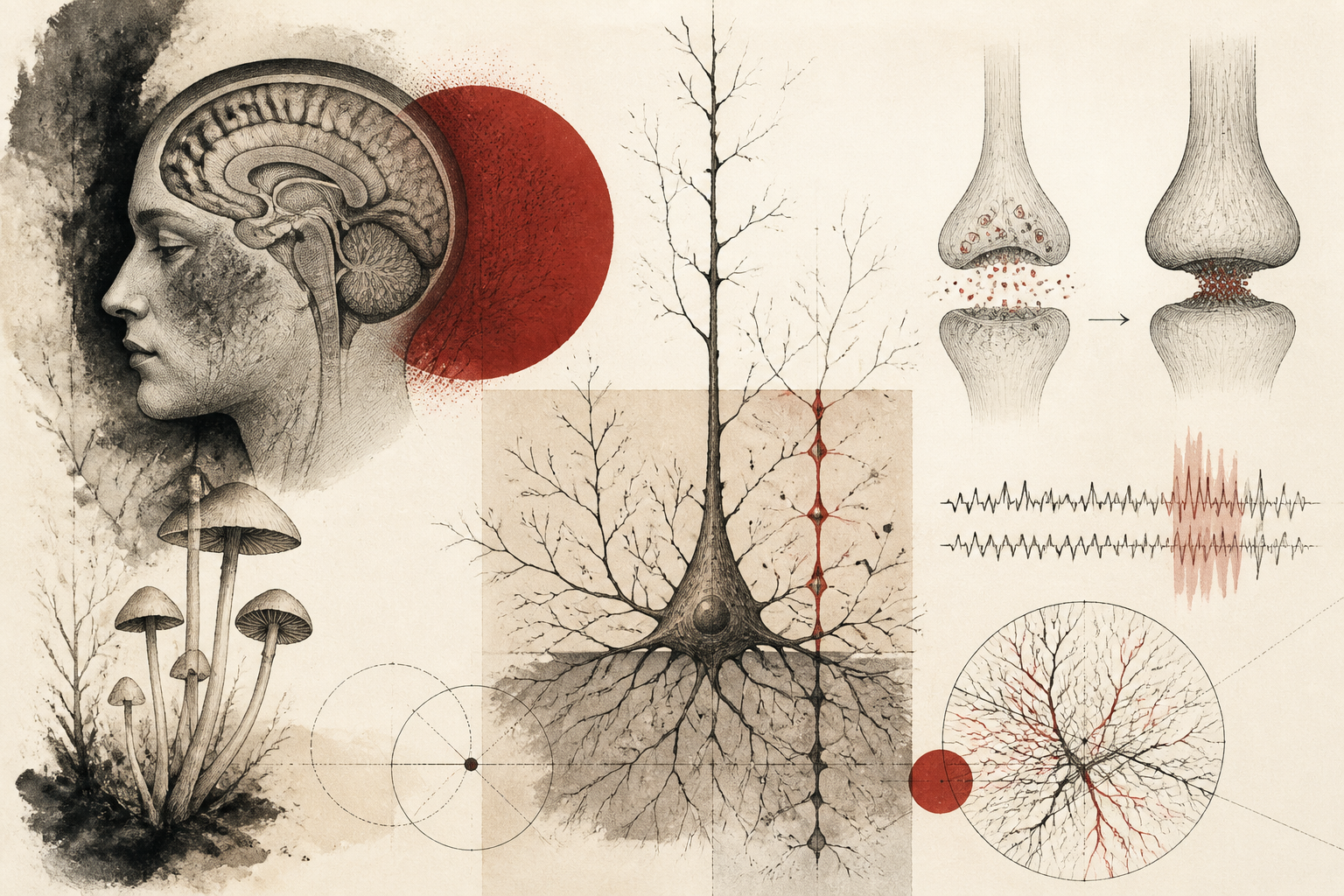
In the evolving landscape of neuropsychopharmacology, the therapeutic potential of psychedelic compounds has moved from the fringes of counterculture into the center of clinical inquiry. For decades, the primary hurdle in utilizing substances like psilocybin—the active compound in certain fungi—has been the intense, often unpredictable hallucinogenic experience accompanying its administration. However, a significant study recently detailed by NeuroscienceNews.com suggests a paradigm shift in our understanding of how these molecules interact with the human brain. The research indicates that psilocybin’s ability to repair and replace lost synapses in the brains of individuals suffering from depression may not be inextricably linked to the sensory distortions typically associated with the drug. By identifying the specific cellular pathways responsible for synaptic regrowth, researchers are paving the way for a new generation of antidepressant treatments that offer the structural benefits of psychedelics without the necessity of a psychological 'trip.'
The Neurobiological Foundations of Depressive Atrophy
To appreciate the significance of this discovery, one must first understand the structural pathology of major depressive disorder. Contemporary neuroscience characterizes depression not merely as a chemical imbalance of neurotransmitters like serotonin or dopamine, but as a condition defined by the loss of synaptic density. Specifically, the prefrontal cortex—the region of the brain responsible for executive function, emotional regulation, and complex cognition—suffers a reduction in dendritic spines. These spines are the physical junctions where neurons communicate. When they wither away due to chronic stress or biological predisposition, the brain’s circuitry becomes less flexible, leading to the rigid, negative thought patterns and emotional numbness characteristic of clinical depression.
Traditional antidepressants, such as Selective Serotonin Reuptake Inhibitors (SSRIs), aim to alleviate symptoms by increasing the availability of serotonin in the synaptic cleft. While effective for some, these medications often take weeks to produce results and frequently fail to address the underlying structural degradation of the neural network. Psilocybin has emerged as a radical alternative because of its rapid onset and its apparent ability to stimulate 'synaptogenesis'—the birth of new synapses. Until recently, it was widely assumed that the profound psychological shift during a psychedelic experience was the primary driver of this healing. The subjective 'ego death' or mystical experience was thought to be the catalyst for the brain to reorganize itself. The new findings challenge this assumption, suggesting that the structural repair is a distinct biological process occurring at the molecular level.
Decoupling Perception from Plasticity
The core of the recent research involves the specific targeting of Layer 5 pyramidal neurons. These neurons are essential components of the cortex, acting as major integrators of information and primary output sources for the brain's processing centers. The study found that psilocybin drives synaptic plasticity through these specific neurons by engaging intracellular pathways that do not necessarily trigger hallucinogenic signaling. In the traditional model, psilocybin’s metabolites bind to the 5-HT2A serotonin receptors on the surface of neurons. This binding is known to cause the vivid visual and auditory hallucinations associated with the drug. However, the researchers discovered that the compound also interacts with internal signaling mechanisms within Layer 5 neurons that promote the growth of dendritic spines.
By isolating the pathways responsible for structural growth from those responsible for altered perception, the study demonstrates that the 'trip' may be a side effect rather than the curative mechanism. This distinction is critical for the future of psychiatric medicine. If the hallucinogenic properties can be bypassed or suppressed while maintaining the synaptogenic effects, psilocybin-derived treatments could be administered more widely, including to patients who might be at risk for psychosis or those who simply cannot undergo an intense eight-hour psychological ordeal. The findings suggest that the brain's ability to rewire itself is a direct physical response to the compound's presence in the neural architecture, functioning independently of the user’s conscious experience.
Methodological Insights and Cellular Mechanisms
The methodology employed in this research focused on high-resolution imaging and molecular tracing to observe the behavior of Layer 5 pyramidal neurons in response to psilocybin exposure. Researchers utilized advanced neuroimaging techniques to track the formation of new dendritic spines in real-time. By using pharmacological inhibitors to block specific signaling pathways, the team was able to determine which specific chemical cascades were responsible for the hallucinogenic effects versus the plastic effects. They observed that even when the traditional 'hallucinogenic' pathway was inhibited, the structural growth of the neurons continued unabated.
This suggests that psilocybin acts as a powerful 'psychoplastogen'—a term used to describe small molecules capable of promoting rapid and sustained neural plasticity. The study highlights that the regrowth of synapses occurs within hours of a single dose and can persist for days or even weeks. This rapid physical change correlates with the sustained antidepressant effects observed in clinical trials. The ability to observe these changes at the cellular level provides a robust biological explanation for why psilocybin appears to be more effective and longer-lasting than traditional psychiatric medications for certain patient populations. It emphasizes the importance of Layer 5 neurons as a primary site for therapeutic intervention in mood disorders.
Limitations and Future Directions in Clinical Application
While these findings represent a breakthrough, they are not without limitations. Most of the fundamental research regarding Layer 5 pyramidal neurons and synaptic regrowth has been conducted in controlled laboratory environments, often using animal models or specialized cell cultures. Translating these molecular insights into a human clinical setting requires rigorous testing. Furthermore, while the study shows that hallucinogenic signaling is not required for synaptic growth, it does not necessarily mean that the subjective experience is worthless. Many psychologists argue that the insights gained during a psychedelic session provide a framework for patients to integrate their biological healing into their daily lives.
Open questions remain regarding the long-term stability of these new synapses. While psilocybin can trigger the growth of dendritic spines, the brain must also maintain these connections to prevent a relapse into depressive states. It is also unclear how age, genetics, and the severity of illness might influence the efficacy of this non-hallucinogenic plasticity. Future research must determine whether a 'non-trip' version of psilocybin would be as effective in treating the complex psychological facets of depression as the full experience has proven to be in recent Phase II and Phase III trials.
The Future of Neuroplasticity-Based Therapy
The implications of this study for the field of psychiatry are profound. By identifying the specific cellular targets—Layer 5 pyramidal neurons—and the independent nature of synaptic repair, the research moves us closer to a future where depression is treated as a structural injury that can be repaired through targeted molecular intervention. This shifts the focus from managing symptoms to actively restoring the brain's connectivity. As we move toward the development of non-hallucinogenic analogs of psilocybin, the potential for these treatments to become mainstream medical tools increases significantly.
For the millions of people worldwide suffering from treatment-resistant depression, this research offers a message of hope grounded in hard science. It suggests that the brain possesses an inherent capacity for renewal, and that we are unlocking the keys to triggering that renewal more efficiently. As academic institutions like Zeit Psychology Online University continue to monitor these developments, it becomes clear that the intersection of traditional pharmacology and psychedelic research is defining the next era of mental health care. The goal is no longer just to alter the mind’s chemistry, but to rebuild the mind’s physical foundation.
Quick answers
- Does psilocybin require a hallucinogenic trip to treat depression?
- According to research reported by NeuroscienceNews.com, psilocybin promotes synaptic plasticity and the growth of new connections in Layer 5 pyramidal neurons independently of the signaling that causes hallucinations.
- How does depression affect the physical structure of the brain?
- Depression is associated with the loss of synaptic density and the atrophy of dendritic spines in the prefrontal cortex, which impairs the brain's ability to regulate emotions and process information effectively.
- What are Layer 5 pyramidal neurons?
- These are essential neurons in the cerebral cortex that act as primary integrators and output sources for neural communication, making them key targets for restoring brain connectivity in mood disorders.
Rewritten by Zeit editorial AI. Based on original reporting at NeuroscienceNews.com.