Psilocybin and Neural Embeddedness: Mapping Functional Changes in Brain Architecture
Researchers at the University of Zurich have utilized advanced neuroimaging to demonstrate how psilocybin fundamentally reshapes functional connectivity across the human brain.
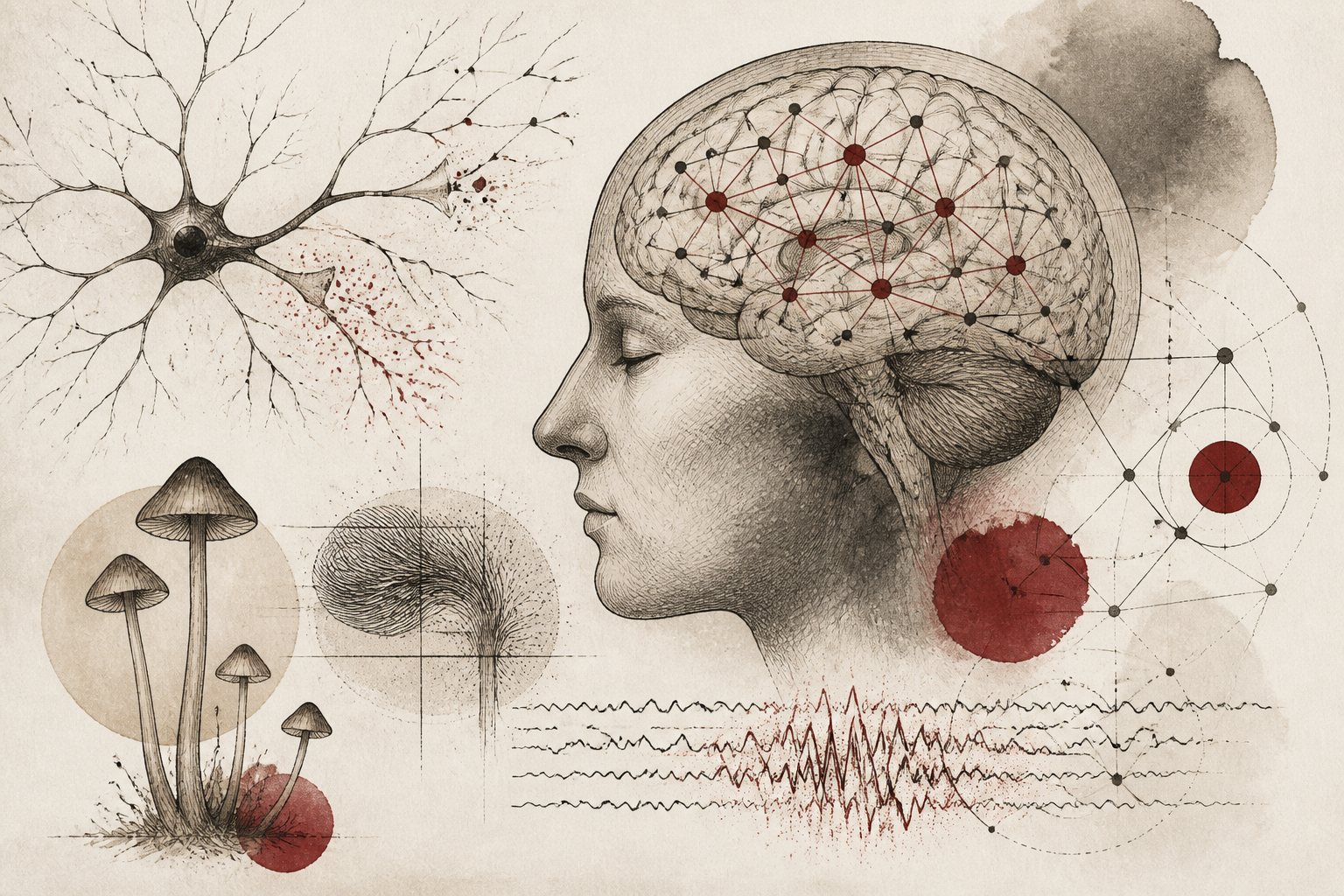
Recent developments in pharmacological neuroimaging have begun to dismantle long-held assumptions regarding how psychedelic compounds alter human consciousness. A landmark study published in Nature Neuroscience by researchers from the University of Zurich investigates the concept of 'embeddedness' within the human brain under the influence of psilocybin. This research represents a significant pivot in the field of neuropsychopharmacology, moving beyond simple observations of regional activity toward a systemic understanding of how global brain networks reorganize. By examining the brain as a dynamic, integrated system, the authors provide a rigorous framework for understanding the profound subjective experiences reported by individuals under the influence of serotonergic psychedelics.
The Framework of Neural Embeddedness and Connectivity
To understand the implications of the Nature Neuroscience findings, one must first grasp the concept of neural embeddedness. In the context of functional magnetic resonance imaging (fMRI), embeddedness refers to the degree to which individual brain regions or networks are integrated into the global functional architecture. Historically, the brain has been viewed as a modular system where specific regions—such as the visual cortex or the motor cortex—perform specialized tasks with a high degree of autonomy. However, contemporary neuroscience increasingly recognizes that cognition is the result of 'flexible integration,' where these modules communicate through high-order hubs to create a unified conscious experience.
The study conducted at the University of Zurich utilized a double-blind, placebo-controlled design to investigate how psilocybin, a classic psychedelic that acts primarily as an agonist at the serotonin 2A (5-HT2A) receptor, modulates these integrative properties. By administering psilocybin to healthy participants and recording their neural activity during the peak of the drug's effects, the research team was able to map the transition from a highly structured, modular state to one characterized by increased global connectivity and a breakdown of traditional boundaries. This process, often referred to as 'de-segregation,' is thought to be the neurological underpinning of the altered states of consciousness that define the psychedelic experience.
Findings in Functional Reorganization
The core findings of the study reveal that psilocybin induces a profound shift in the brain's macroscale organization. Specifically, the researchers observed a significant decrease in the functional distance between traditionally distinct networks. In a baseline or placebo state, the brain maintains a clear hierarchy; sensory systems operate somewhat independently from high-order cognitive systems like the default mode network (DMN), which is associated with self-referential thought and internal reflection. Under psilocybin, this hierarchy is flattened. The researchers found that regions typically associated with sensory processing began to show increased 'embeddedness' within the global network, while high-order associative regions lost their usual dominance over the system.
This reorganization is not random. The study highlights that the changes in connectivity are closely tied to the density and distribution of 5-HT2A receptors across the cortex. The regions with the highest receptor density showed the most significant changes in their functional profile. This provides a direct link between molecular pharmacology and system-level neural dynamics. By utilizing advanced topological metrics, the study demonstrated that psilocybin effectively 'shrinks' the functional space of the brain, allowing for communication between regions that do not typically interact. This increased global integration is believed to facilitate the novel associations and 'synesthetic' experiences frequently reported by subjects, where sensory boundaries become blurred.
The Mechanism of Serotonergic Modulation
Central to the researchers' methodology was the use of pharmacological blocking agents to verify the mechanism of action. By administering ketanserin—a 5-HT2A receptor antagonist—prior to the psilocybin, the researchers were able to prevent the neurobiological and subjective effects of the drug. This confirms that the observed shifts in neural embeddedness are specifically mediated by the activation of the 5-HT2A receptor. This specific receptor is known to be expressed heavily on the apical dendrites of pyramidal neurons in the cortex, which play a crucial role in integrating information across different cortical layers.
When psilocybin binds to these receptors, it increases the excitability of these pyramidal neurons, leading to a state of 'cortical desynchrony.' This desynchrony disrupts the usual rhythmic firing patterns that maintain network boundaries. As these boundaries dissolve, the brain enters a state of higher entropy, or disorder. However, the University of Zurich study suggests that this is not merely 'noise.' Instead, it is a transition to a more flexible state of neural communication. The data indicates that the brain becomes more 'interconnected' in a way that allows for a greater variety of functional states to emerge, which may explain the therapeutic potential of these compounds in treating rigid psychiatric conditions like depression or obsessive-compulsive disorder.
Interpretations, Limitations, and Open Questions
The interpretation of these findings suggests that psilocybin acts as a 'state-dependent' modulator of brain function. By increasing global embeddedness, the drug allows the brain to escape its usual patterns of activity. For patients suffering from clinical depression, whose brain activity is often characterized by pathologically high levels of connectivity within certain DMN nodes and a lack of flexibility, this temporary 'reset' of neural architecture could be the mechanism that enables long-term therapeutic change. However, the researchers are careful to note several limitations. The study was conducted in a controlled laboratory environment with healthy volunteers, and the neural dynamics observed during a peak psychedelic experience may differ significantly in a clinical population over time.
Furthermore, while fMRI provides excellent spatial resolution for mapping these changes, it lacks the temporal resolution to capture the millisecond-by-millisecond firing patterns of neurons. Future research will need to combine these findings with electroencephalography (EEG) or magnetoencephalography (MEG) to understand the temporal dynamics of embeddedness. Additionally, an open question remains regarding the 'afterglow' effect—the period of improved mood and cognitive flexibility that persists after the drug has left the system. It is currently unclear if the changes in embeddedness persist in a subtle form or if they trigger a secondary process of neuroplasticity that accounts for long-term benefits.
Why Systemic Neuroscience Matters
The significance of this research extends beyond the niche of psychedelic science. It contributes to a broader understanding of how the human brain maintains a balance between specialized processing and global integration. By showing how a single molecule can fundamentally reconfigure the entire brain's topology, the study provides a roadmap for future interventions in psychiatry. If researchers can understand how to safely modulate neural embeddedness, they may be able to develop new treatments that target the structural rigidity of the brain rather than just localized chemical imbalances.
In conclusion, the work published in Nature Neuroscience serves as a sophisticated validation of the 'network' view of the brain. It demonstrates that the subjective intensity of the psilocybin experience is a direct reflection of a measurable, physical reorganization of neural connectivity. As we move toward a new era of biological psychiatry, studies like these from the University of Zurich will be essential in bridging the gap between the molecular mechanisms of drugs and the complex, emergent properties of the human mind. The findings remind us that consciousness is not a static state but a dynamic process of integration, one that is highly sensitive to the neurochemical environment in which it resides.
Quick answers
- What does neural embeddedness mean in the context of psilocybin research?
- It refers to the degree to which different brain regions are integrated into a global functional network, showing how psilocybin breaks down modular boundaries to increase overall brain connectivity.
- Which brain receptor is responsible for the effects of psilocybin?
- The serotonin 2A (5-HT2A) receptor is the primary mediator of psilocybin's effects on brain organization and subjective experience.
- How did researchers verify that psilocybin caused the observed brain changes?
- Researchers used a double-blind, placebo-controlled study and administered ketanserin, a 5-HT2A antagonist, which successfully blocked the drug's neural and subjective effects.
Rewritten by Zeit editorial AI. Based on original reporting at Nature Neuroscience.