Predictive Processing and Reactive Control in the Human Superior Colliculus
Recent research in Nature Neuroscience clarifies how the superior colliculus distinguishes between immediate sensory reactions and anticipatory motor planning across different modalities.
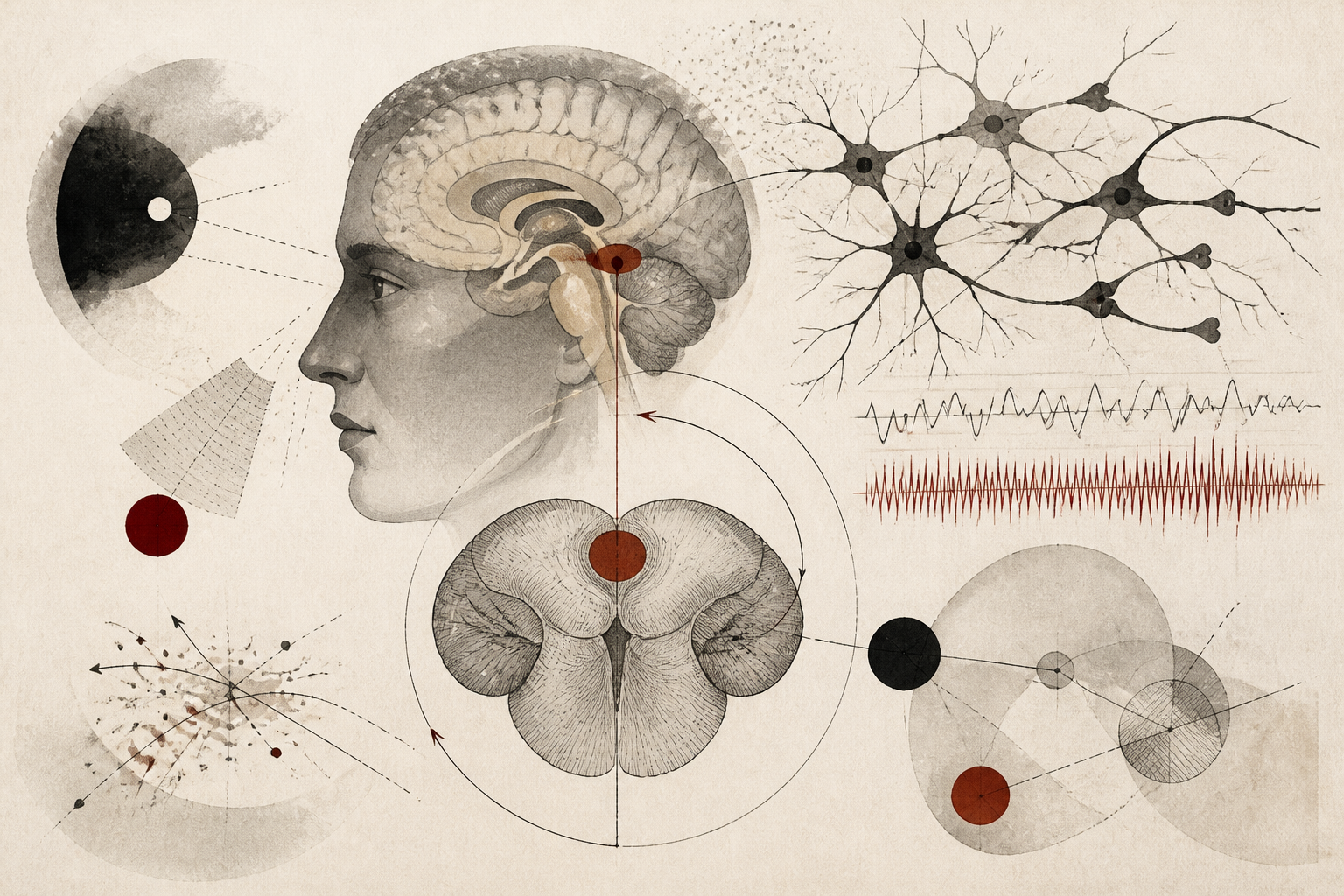
In the complex hierarchy of the human central nervous system, the superior colliculus has long been categorized primarily as a primitive structure responsible for reflexive visual orienting. However, an emerging body of evidence suggests that this midbrain nucleus performs far more sophisticated computations than previously recognized. A significant study recently published in Nature Neuroscience, titled "Modality-specific reactive and predictive responses in the human superior colliculus," provides a rigorous examination of how this structure facilitates both reactive and predictive motor responses. By utilizing high-resolution neuroimaging, researchers have demonstrated that the superior colliculus is not a monolithic relay station but rather a nuanced hub that differentiates between sensory-driven reactions and internal, anticipatory models of the environment. This distinction is critical for understanding how humans navigate dynamic spaces where sensory information may be intermittent or delayed.
Evolutionary Foundations and Multimodal Integration
The superior colliculus is evolutionarily conserved across vertebrates, serving as a vital node for integrating sensory inputs and translating them into motor commands. In lower vertebrates, it is the primary visual processor; in mammals, while the visual cortex takes on more complex analysis, the colliculus remains essential for directing eye movements and shifts in attention. Historically, neuroscientific models focused on its role in visual processing, often overlooking its capacity to handle other sensory modalities such as audition. The study in Nature Neuroscience addresses this gap by investigating how the human colliculus responds to both visual and auditory stimuli in the context of predictive behavior. This shift in focus acknowledges that survival often depends on the ability to anticipate a stimulus before it reaches the senses, a process known as predictive coding. The researchers sought to determine if the superior colliculus maintains distinct pathways for reactive responses—those triggered by an immediate external event—and predictive responses, which are generated internally based on learned patterns or expectations.
Experimental Mechanisms and High-Resolution Imaging
To probe these subcortical mechanisms, the researchers employed high-field functional magnetic resonance imaging (fMRI) to achieve the spatial resolution necessary to isolate signals within the small volume of the human midbrain. The experimental design involved participants performing tasks that required both reactive and predictive responses. In reactive trials, participants responded to stimuli presented at random intervals, forcing the brain to rely on immediate sensory detection. In contrast, predictive trials used rhythmic or patterned stimuli, allowing participants to anticipate the timing and location of the next event. By comparing these two conditions, the study could isolate the neural correlates of anticipation. Crucially, the researchers utilized both visual and auditory cues to test the modality-specificity of these responses. This approach allowed the team to observe how different sensory inputs converged or remained segregated within the collicular layers. The methodology emphasized the temporal precision of these responses, mapping how the colliculus transitions from a state of waiting to an active motor command.
Distinct Pathways for Reaction and Prediction
The findings revealed a sophisticated functional organization within the superior colliculus. The data suggests that reactive responses are characterized by a direct influx of sensory information that triggers a rapid motor output, consistent with the classical view of the colliculus. However, the predictive responses showed a remarkably different profile. When participants anticipated a stimulus, the superior colliculus exhibited activity patterns prior to the actual onset of the sensory event. This pre-emptive activity was not merely a low-level mirror of the sensory input but represented a top-down preparatory signal. Furthermore, the study identified that these responses are modality-specific. While the colliculus integrates various inputs, the specific neural populations involved in visual prediction differed from those involved in auditory prediction. This suggests that the midbrain maintains a degree of sensory segregation to ensure that predictive models are accurately aligned with the specific nature of the expected input. The researchers observed that these predictive signals were localized in ways that suggest a hierarchical communication between the colliculus and higher-order cortical areas, such as the frontal eye fields and the parietal cortex.
Limitations and Future Inquiries
While the study provides groundbreaking insights into midbrain function, several limitations must be considered. The use of fMRI, despite its high spatial resolution in this context, lacks the temporal resolution of electrophysiology. Consequently, the exact millisecond-by-millisecond timing of the transition from prediction to action remains difficult to pin down. Additionally, the study focused on healthy adult participants, leaving open the question of how these predictive mechanisms develop in children or how they might be altered in neurodivergent populations. For instance, conditions such as autism or schizophrenia often involve disruptions in predictive coding; understanding the colliculus's role in these states could be a fertile ground for future clinical research. Another open question involves the specific neurotransmitter systems that modulate these predictive signals. While the current study maps the 'where' and 'what' of these responses, the biochemical 'how'—involving dopamine or acetylcholine pathways—requires further investigation through pharmacological interventions or PET imaging.
Implications for Cognitive Science and Robotics
The discovery that the human superior colliculus handles sophisticated predictive modeling has profound implications for both theoretical and applied sciences. In the realm of psychology, it challenges the dichotomy between "low-level" subcortical reflexes and "high-level" cortical cognition. It suggests that the foundations of expectation and anticipation are deeply embedded in the brain's ancient architecture. This has significant ramifications for understanding motor control disorders, where the failure to accurately predict sensory consequences of movement can lead to debilitating symptoms. Beyond biology, these findings offer a blueprint for the development of more responsive artificial intelligence and robotics. Modern robots often struggle with the latency between sensing and acting in unpredictable environments. By mimicking the dual-pathway architecture of the superior colliculus—combining rapid reactive loops with modality-specific predictive models—engineers may be able to create systems that navigate the world with human-like fluidity. Ultimately, the work published in Nature Neuroscience underscores the importance of looking beneath the cortex to find the roots of complex behavior, revealing a midbrain that is as much a forward-looking strategist as it is a rapid responder.
Quick answers
- What is the primary function of the superior colliculus according to this study?
- The study indicates that the superior colliculus serves as a hub for both immediate reactive responses to sensory stimuli and internal predictive modeling to anticipate future events.
- How does the brain differentiate between visual and auditory predictions in the midbrain?
- Research shows that these responses are modality-specific, meaning distinct neural populations within the superior colliculus are activated depending on whether the anticipated stimulus is visual or auditory.
- What technology was used to study the human superior colliculus?
- Researchers used high-field functional magnetic resonance imaging (fMRI) to achieve the high spatial resolution required to monitor activity in the small, deep structures of the human midbrain.
Rewritten by Zeit editorial AI. Based on original reporting at Nature Neuroscience.