Postural Alignment Linked to Enhanced Mood and Strategic Risk-Taking
Recent findings suggest that maintaining an upright seated position significantly influences psychological states and decision-making performance.
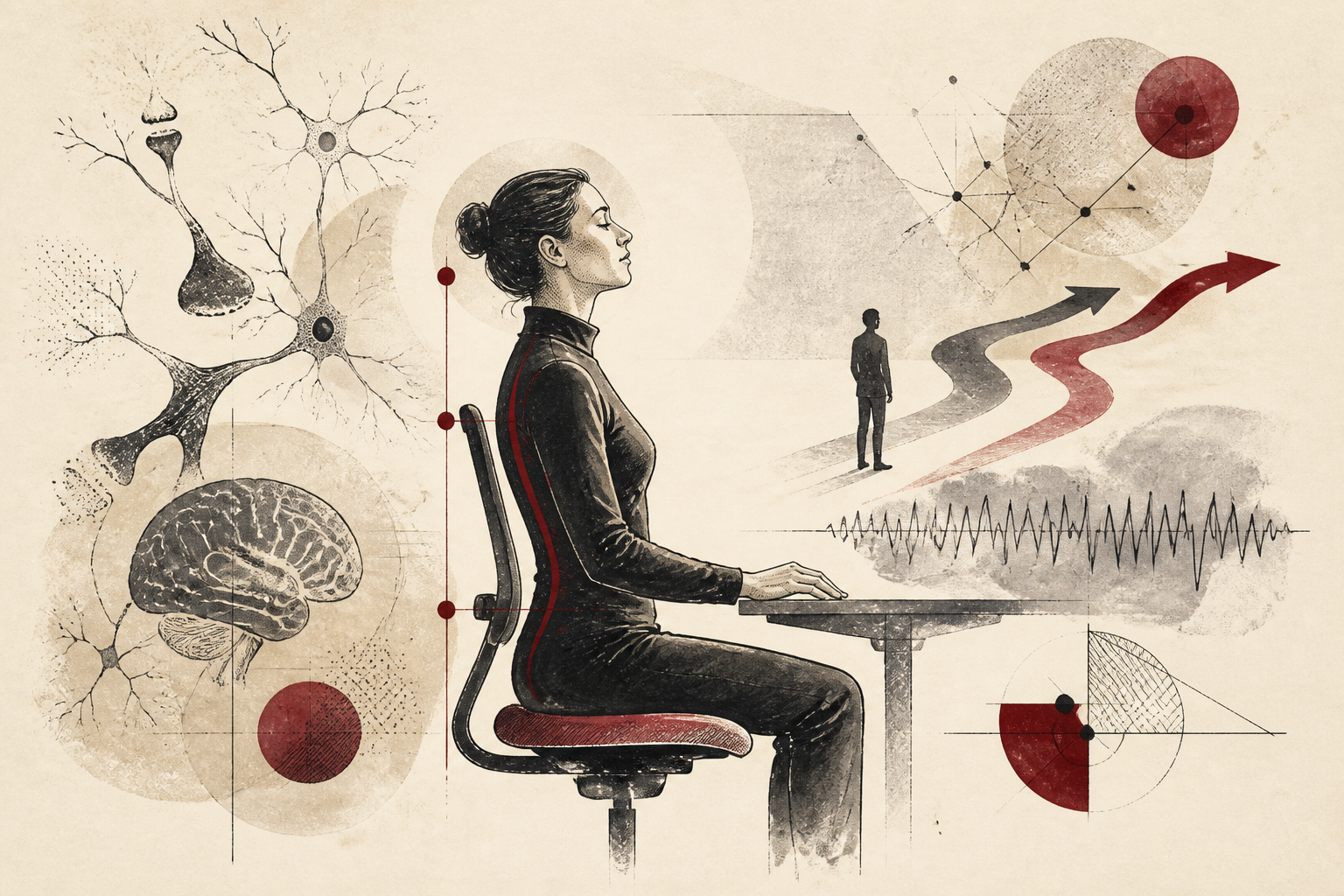
Recent scientific inquiry has unveiled a fascinating interplay between physical posture and an individual's psychological landscape, offering a compelling extension to our understanding of embodied cognition. Emerging findings indicate that the simple act of maintaining an upright seated position can significantly influence both subjective emotional states and objective decision-making performance. This research challenges traditional views of mental processes as purely cerebral, instead positing a dynamic connection where physical alignment subtly yet powerfully shapes our internal experience and strategic choices.
The Postural Link to Mood and Risk-Taking
The core of this investigation lies in the observation that individuals adopting an upright seated posture report heightened feelings of pride and exhibit enhanced performance in tasks requiring nuanced risk assessment. This contrasts markedly with those who maintain a slumped or hunched position, suggesting a direct and measurable impact of physical ergonomics on cognitive-emotional processing. The implications stretch beyond mere comfort, hinting at a deeper, more fundamental mechanism through which the body communicates with and influences the mind.
To meticulously probe this relationship, researchers employed a virtual balloon-analog risk task. This widely recognized experimental paradigm is designed to quantify an individual's balance between the allure of potential rewards and the prudence of risk aversion. Participants were subtly assigned to either an upright or a hunched posture, often without conscious awareness that their physical positioning constituted a key experimental variable. This methodological choice was critical, aiming to mitigate potential confounds such as participant expectation or social desirability bias. The results were striking: the group maintaining an upright posture not only reported a more positive emotional state, consistent with increased pride, but also demonstrated superior strategic navigation within the virtual risk game. Their enhanced success in this task underscores a tangible improvement in decision-making under conditions of uncertainty.
Embodied Cognition in Action
The subtle nature of the postural intervention warrants particular attention. The fact that most participants did not perceive any manipulation of their physical positioning strengthens the conclusion that the observed behavioral and emotional changes were not products of conscious awareness or demand characteristics. Instead, this suggests an implicit, automatic influence of bodily state on mental function. These findings strongly reinforce theories of embodied cognition, which propose that the mind is not an isolated, disembodied processor, but rather an entity profoundly integrated with and influenced by the body’s physical state and interactions with its environment. Our physical posture, according to this perspective, is not merely a passive container for mental processes but an active participant in shaping them.
This research aligns with a growing body of evidence supporting the notion that physiological states, including seemingly minor physical adjustments, can have profound top-down effects on perception, emotion, and cognition. The observed link between an upright posture and increased pride, for instance, suggests a bidirectional relationship where common physical expressions of an emotion can also serve to elicit or amplify that emotion. Similarly, improved performance in risk-assessment tasks points to a potential enhancement of executive functions or an altered cognitive bias towards strategic engagement rather than cautious withdrawal, all initiated by a simple postural shift.
Broader Implications and Future Directions
The implications of these findings extend far beyond foundational psychological inquiry, touching directly upon practical domains such as occupational health and environmental design. While the field of ergonomics has historically concentrated on preventing musculoskeletal disorders and optimizing physical comfort to enhance productivity, this research illuminates a previously underappreciated dimension: the direct consequence of spinal alignment on an individual's mood and professional decision-making capabilities. The design of workstations, seating, and even personal habits related to posture could therefore have a more pervasive influence on cognitive and emotional well-being than previously understood.
For students and clinicians in psychology and neuroscience, this research offers several critical insights. It underscores the importance of a holistic perspective, integrating physical and mental states in assessment and intervention. For psychologists, understanding how posture influences mood and decision-making can inform therapeutic strategies, particularly in areas like anxiety, depression, or self-efficacy. Encouraging an upright posture might serve as a simple, non-pharmacological adjunct to improve emotional states. Neuroscientists, in turn, can explore the underlying neural mechanisms linking proprioception and somatosensory input from the spine to areas of the brain involved in emotion regulation, reward processing, and executive function. It opens avenues for investigating how cortical and subcortical networks integrate postural information to shape complex cognitive tasks. Clinicians might consider incorporating postural awareness into treatments for various psychological conditions, or even as a preventive measure in high-stress occupations.
While this research provides compelling evidence, it also opens several avenues for further investigation. Future studies might explore the duration of these effects, the optimal degree of uprightness, and whether similar effects are observed across different cultures or age groups. Investigating the specific neural pathways involved in this embodied influence would also be a critical next step. Furthermore, understanding individual differences in susceptibility to postural effects, and the potential for long-term training to improve posture and its associated cognitive benefits, remains an open question.
In essence, these results underscore the significant potential for simple, non-invasive environmental and behavioral adjustments to bolster psychological resilience and strategic thinking in various high-stakes environments. By demonstrating that body positioning serves as an implicit driver of cognitive and emotional states, this research not only enriches our understanding of embodied cognition but also offers tangible, actionable insights for enhancing human performance and well-being in an increasingly demanding world. As our understanding deepens, the integration of ergonomic principles with psychological science promises innovative solutions for optimizing human potential.
Quick answers
- How does posture affect decision-making according to the study?
- Participants sitting upright took more successful risks in virtual tasks and reported higher feelings of pride compared to those who hunched.
- Were the participants aware that their posture was being studied?
- No, most participants were unaware that their posture was being influenced, suggesting the effects were subconscious rather than a reaction to expectations.
- What is the significance of this research for the modern workplace?
- It suggests that ergonomics affects more than physical health; workstation design may actively influence employee mood and cognitive performance.
Rewritten by Zeit editorial AI. Based on original reporting at ScienceDaily — Mind & Brain.