Optimizing Neural Manifolds: A Modern Computational View of Olfactory Learning
Recent research in Nature Neuroscience explores how the brain employs geometric optimization within neural manifolds to refine sensory representations during memory formation.
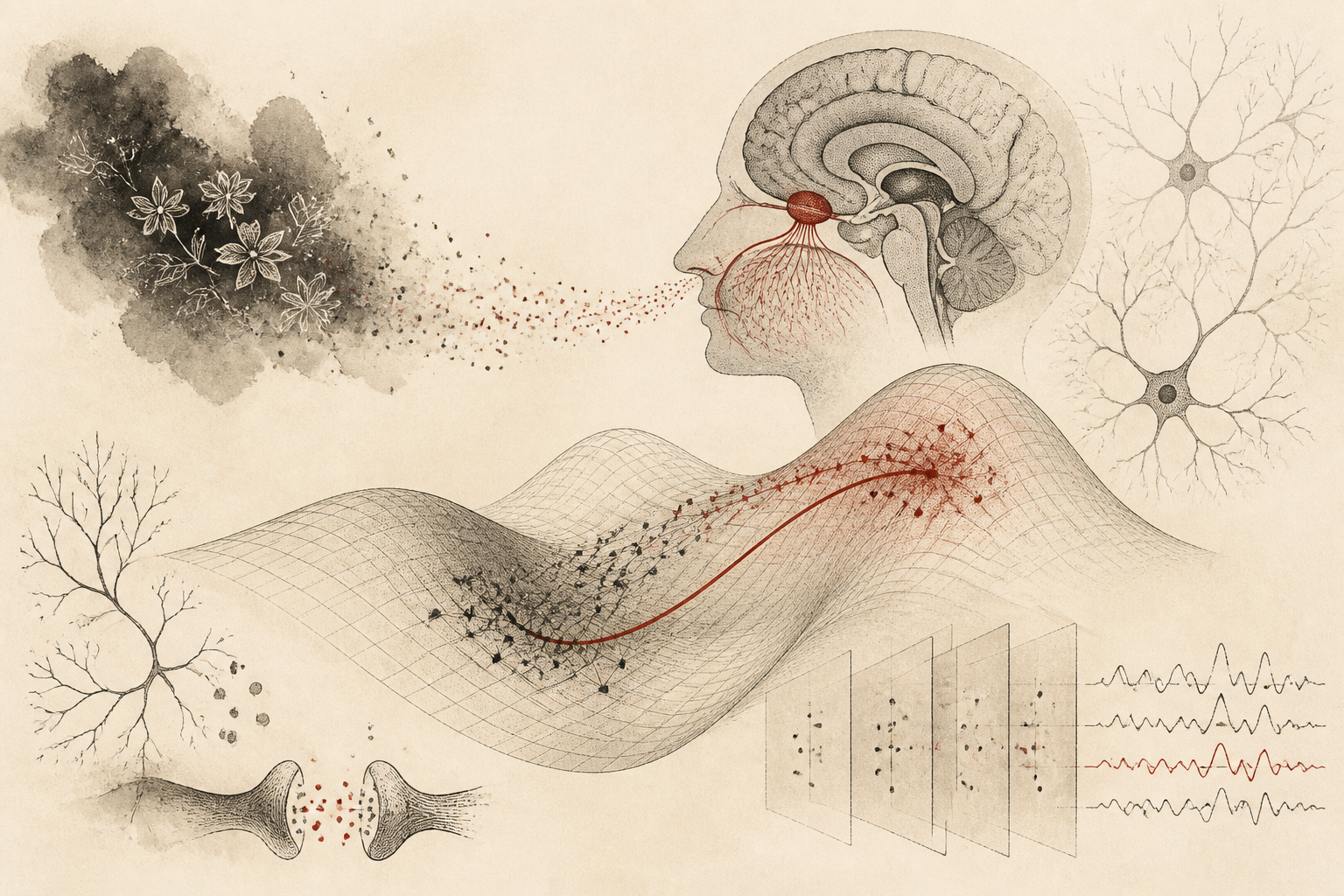
In the complex landscape of cognitive neuroscience, few questions remain as evocative as how sensory experiences are transformed into stable, retrievable memories. Recent findings published in Nature Neuroscience, under the title "Representational learning by optimization of neural manifolds in an olfactory memory network," provide a significant advancement in our understanding of this process. The study shifts the focus from simple synaptic connectivity to the geometric organization of neural activity, suggesting that the brain functions by optimizing the low-dimensional structures, or manifolds, that represent information. By examining the olfactory system, researchers have identified a sophisticated mechanism where neural populations reorganize their collective firing patterns to maximize the efficiency and accuracy of memory retrieval. This work offers a computational framework that bridges the gap between biological observation and mathematical models of learning.
The Geometric Structure of Sensory Representation
To understand the implications of this research, one must first consider the concept of a neural manifold. In a high-dimensional state space where each dimension represents the firing rate of a single neuron, the activity of a large population is often constrained to a much smaller, lower-dimensional surface. This surface is the manifold. The researchers behind the Nature Neuroscience study posited that learning is not merely a change in which neurons fire, but a fundamental reshaping of these manifolds to ensure that different sensory inputs are distinct and identifiable. In the context of olfaction, this means the brain must take the vast, noisy input of chemical signals and organize them into a structured representation that can be filed away as a specific memory. The study highlights that representational learning is an active process of optimization, where the geometry of these neural states is refined through experience to reduce overlap between similar stimuli while maintaining the integrity of the original signal.
Mechanisms of Neural Optimization and Learning
The investigation focused on the olfactory memory network, a system known for its high degree of plasticity and its ability to store vast arrays of distinct scents. The researchers utilized advanced neuroimaging and computational modeling to track how neural activity evolved as subjects learned to associate specific odors with outcomes. The findings suggest that the optimization process involves two primary transformations: the expansion of distance between representations of different stimuli and the contraction of variability within a single stimulus representation. Essentially, the neural manifold becomes more "sharpened." This dual mechanism ensures that the brain can distinguish between two very similar smells—such as two different varieties of the same fruit—while still recognizing a familiar scent even when environmental conditions vary slightly. This optimization reflects a sophisticated balance between sensitivity and robustness, achieved through the iterative adjustment of synaptic weights across the olfactory network.
Computational Interpretations and Biological Parallels
One of the most compelling aspects of this study is the alignment between biological neural networks and artificial intelligence models. The authors draw a parallel between the brain's manifold optimization and the gradient descent algorithms used in machine learning. In both cases, the system seeks to minimize an error function by adjusting its internal parameters. In the biological olfactory system, this optimization appears to be driven by the need to maximize the information capacity of the network. The study demonstrates that by organizing neurons into these optimized manifolds, the brain can store significantly more memories than would be possible if the representations were randomly distributed. This suggests that the architecture of the olfactory cortex is biologically predisposed to favor geometric efficiency, providing a potential universal principle for how other sensory systems, such as vision or audition, might handle high-density information loads.
Limitations and Theoretical Challenges
Despite the robustness of the findings, the researchers acknowledge several limitations that warrant further investigation. First, while the study establishes a clear link between manifold optimization and memory formation, the precise cellular mechanisms that execute this geometric reshaping remain partially elusive. It is not yet fully understood how individual neurons “know” how to adjust their activity to contribute to a global manifold optimization. Furthermore, the study primarily focused on the early stages of memory acquisition. Whether these optimized manifolds remain stable over long periods or undergo further transformation during the consolidation process—moving from the olfactory bulb to higher-order cortical regions—is a question that remains open. Additionally, the researchers noted that while their computational models were highly predictive, biological systems are subject to metabolic constraints and noise that are difficult to fully replicate in a theoretical framework.
Implications for Future Neuroscience Research
The significance of this research extends beyond the study of smell. By framing learning as an optimization of neural manifolds, the study provides a new vocabulary for discussing cognitive decline and neuroplasticity. If memory is a function of geometric organization, then conditions such as Alzheimer’s disease or other dementias could be re-examined as a breakdown in the structural integrity of these manifolds. From a technological perspective, these insights could inform the development of more efficient artificial neural networks that mimic the brain's ability to learn from sparse data. As we continue to bridge the gap between mathematics and biology, the work published in Nature Neuroscience serves as a cornerstone for a new era of representational learning research, suggesting that the secrets of the mind may well be written in the language of geometry.
Quick answers
- What is a neural manifold in the context of brain research?
- A neural manifold is a low-dimensional surface within a high-dimensional space of neural activity that represents organized patterns of information, such as sensory memories.
- How does the brain improve memory according to the Nature Neuroscience study?
- The brain improves memory by optimizing the geometry of neural manifolds, increasing the distance between different representations and reducing the variability within a single representation.
- Is the process of olfactory learning similar to machine learning?
- Yes, the study suggests that the brain's method of refining neural representations parallels optimization algorithms like gradient descent used in artificial intelligence.
Rewritten by Zeit editorial AI. Based on original reporting at Nature Neuroscience.