Neural Encoding of Uncertainty: How Claustrum Neurons Manage Aversive Learning Errors
Researchers identify specific claustrum neuron populations that signal prediction errors and environmental uncertainty during fear-based conditioning.
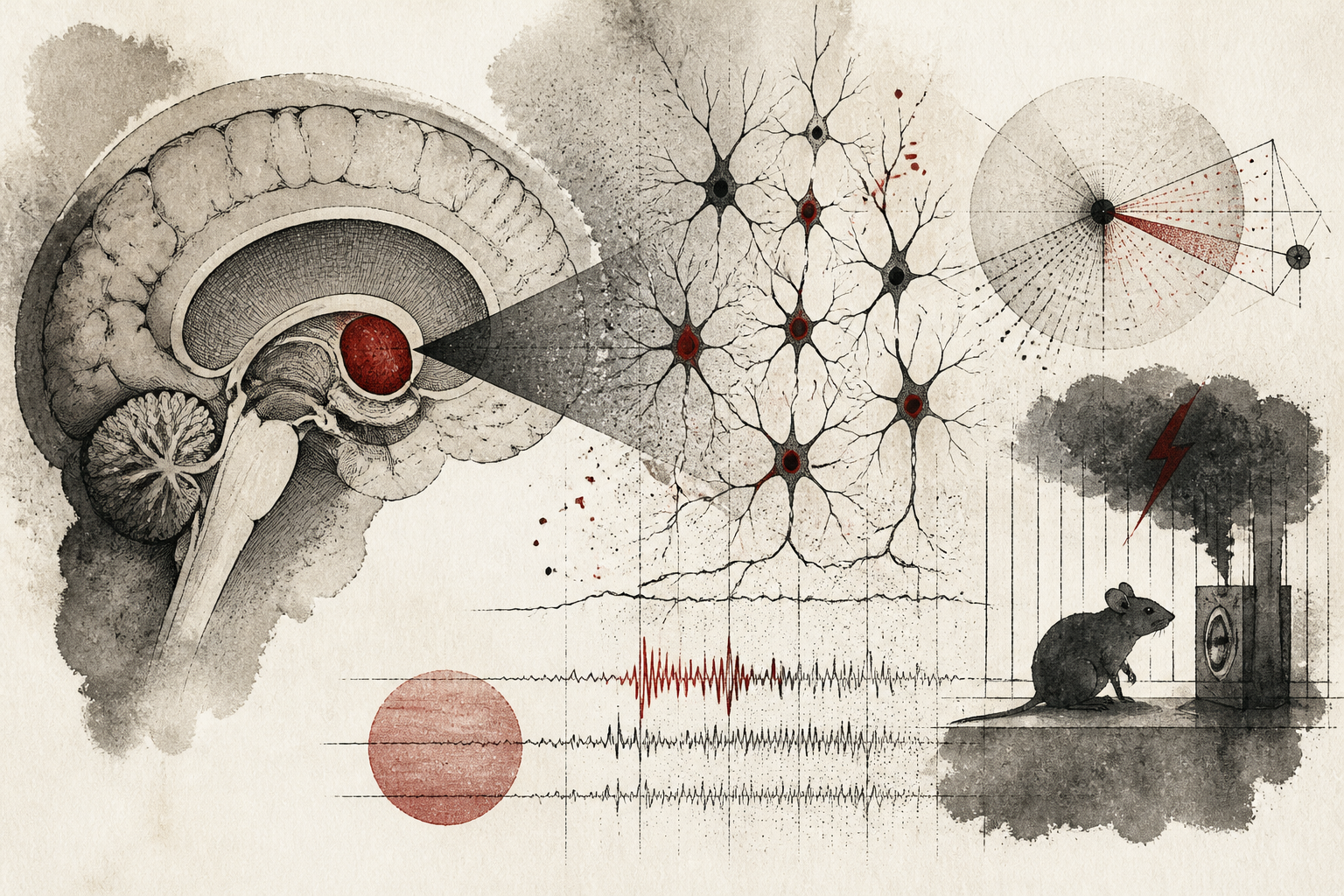
The ability to accurately predict threats and adjust behavior in response to environmental volatility is fundamental to human survival. This cognitive flexibility relies on the brain's capacity to process both expected outcomes and the discrepancies between those expectations and reality, known as prediction errors. While extensive research has focused on the roles of the amygdala and prefrontal cortex in these processes, a new study published in Nature Neuroscience has turned the spotlight toward a more enigmatic structure: the claustrum. By monitoring human claustrum neurons during aversive learning tasks, researchers have uncovered evidence that this thin sheet of subcortical gray matter plays a pivotal role in encoding both the uncertainty of an environment and the specific errors that occur when expectations are violated.
Traditionally, the claustrum has been a difficult area of the brain to study due to its unique anatomy. It is a thin, irregular structure tucked between the insular cortex and the putamen, making it a challenge to isolate using standard neuroimaging techniques. Historically, theories about the claustrum have ranged from it being the seat of consciousness to a coordinator of multisensory integration. However, recent advances in high-resolution recording techniques have allowed scientists to observe individual neuronal activity within this region. The latest findings suggest that rather than just integrating sensory input, the claustrum acts as a sophisticated monitoring system for learning under pressure, specifically when the stakes involve aversive or unpleasant outcomes.
Mechanisms of Aversive Learning and Prediction
The research methodology focused on how individuals learn to associate specific cues with negative stimuli. In the context of aversive learning, the brain must perform two distinct but related tasks. First, it must estimate the probability of an event occurring—this is the level of uncertainty. Second, it must respond to the outcome. If a predicted shock or unpleasant sound occurs as expected, the prediction error is low. If an unexpected event occurs, or if a predicted event fails to materialize, the prediction error is high. The study monitored neuronal spikes in the claustrum while participants engaged in tasks where the relationship between a cue and an outcome was periodically shifted, creating a volatile and uncertain environment.
Data revealed that claustrum neurons do not respond uniformly to all stimuli. Instead, the researchers identified distinct populations of cells that appear to specialize in different aspects of the learning process. One group of neurons showed heightened activity specifically in response to prediction errors. These neurons fired most intensely when a participant’s expectations were proven wrong, suggesting that the claustrum is deeply involved in the "surprise" signal that prompts the brain to update its internal models. Another subset of neurons tracked the overall uncertainty of the environment. When the rules of the task became unpredictable, these neurons maintained a higher baseline of activity, potentially signaling to other brain regions that the current strategy for avoiding aversive outcomes might need to be revised.
The Role of Uncertainty in Neural Computations
Understanding how the brain computes uncertainty is critical because it dictates the rate of learning. In a stable environment, a single mistake might be dismissed as an outlier. In a volatile environment, however, that same mistake might signal a fundamental change in the rules of survival. The Nature Neuroscience report indicates that the claustrum facilitates this distinction. By encoding the level of uncertainty, the claustrum may act as a gain control mechanism, determining how much weight the brain should give to new information. This suggests a hierarchical role for the claustrum in the brain's architecture, situated as a bridge between high-level cognitive expectations and low-level sensory feedback.
The findings also highlight a temporal aspect to claustrum activity. The responses were not merely reactive; in some instances, the activity patterns suggested a preparatory state. As participants learned to navigate the aversive tasks, the claustrum neurons began to reflect the statistical probability of the outcomes before they actually occurred. This anticipatory encoding indicates that the claustrum is not just a relay station but an active participant in the computational work of the brain, processing complex variables related to risk and reward in real-time. This level of granular encoding at the single-neuron level provides a much clearer picture of why the claustrum is so extensively connected to the rest of the cortex.
Interpretations and Comparative Neurobiology
The interpretation of these results places the claustrum at the center of the brain's "salience" and "attention" networks, but with a specific focus on the negative reinforcement learning cycle. While previous studies in animal models have suggested the claustrum is involved in attentional shifting, this human-centric data provides a nuanced view of how these shifts occur during emotional or aversive states. By signaling both the error and the uncertainty, the claustrum ensures that the organism remains focused on the most relevant environmental cues. In the face of danger, being able to quickly identify that your current predictions are failing is a vital evolutionary advantage.
Furthermore, the study suggests that the claustrum’s vast connectivity allows it to distribute these uncertainty signals across various cortical regions. This widespread communication could be what allows the brain to coordinate a holistic response to a threat—adjusting motor plans, increasing sensory sensitivity, and updating long-term memory simultaneously. The researchers posit that the claustrum acts as a hub that translates the abstract mathematics of probability and error into a functional neural signal that the rest of the brain can use to guide behavior.
Limitations and Future Directions
Despite the significance of these findings, several limitations remain. The study primarily focused on aversive learning, meaning the researchers have yet to determine if the claustrum encodes prediction errors and uncertainty in the same way for positive, reward-based learning. It is possible that the claustrum has a valence-specific role, perhaps being more attuned to threats than to benefits. Additionally, while the study captured the activity of individual neurons, the exact downstream effects of this activity—how exactly these signals change the behavior of the prefrontal cortex or the amygdala—remain an open question for future investigation.
Another challenge lies in the generalizability of these findings. The study used specific aversive stimuli in a controlled laboratory setting. Real-world uncertainty is often much more complex and less binary than a task-based environment. Future research will need to explore how the claustrum handles multiple, overlapping sources of uncertainty and how it prioritizes which errors are the most important to resolve. There is also the question of individual differences; how might the claustrum function differently in individuals with anxiety disorders, where the perception of uncertainty and threat is often heightened?
Clinical and Cognitive Implications
The identification of the claustrum as a key player in processing uncertainty and prediction errors has significant implications for our understanding of psychiatric conditions. Disorders such as post-traumatic stress disorder (PTSD) and generalized anxiety are characterized by a failure to accurately assess threat or to update one’s beliefs when an environment becomes safe. If the claustrum is the engine that drives these updates, it could become a primary target for future therapeutic interventions. Understanding the specific neural code used by the claustrum to signal aversive errors could lead to more precise treatments for those who are "stuck" in a state of high-uncertainty distress.
Ultimately, this research from Nature Neuroscience shifts our perspective on the claustrum from a mysterious anatomical curiosity to a vital computational node. By proving that human claustrum neurons are capable of such sophisticated encoding, the study opens a new chapter in cognitive neuroscience. It underscores the complexity of the human brain's learning systems and highlights the importance of subcortical structures in managing the delicate balance between what we expect and what we actually experience. As we move forward, the claustrum will likely be recognized not just as a connector of the brain, but as one of its most essential evaluators of reality.
Quick answers
- What is the function of the claustrum in the human brain?
- Recent research indicates the claustrum encodes environmental uncertainty and prediction errors, helping the brain update its expectations during aversive learning.
- How does the brain process prediction errors?
- The brain processes prediction errors by detecting discrepancies between expected and actual outcomes; claustrum neurons specifically spike when these expectations are violated.
- Why is the claustrum difficult to study?
- Its thin, irregular structure located deep within the brain makes it difficult to isolate using standard imaging, requiring high-resolution single-neuron recording techniques.
Rewritten by Zeit editorial AI. Based on original reporting at Nature Neuroscience.