Neotenic Maturation of Adult-Born Neurons Shapes GABAergic Circuits in Social Memory
Recent research in Nature Neuroscience reveals how the slow maturation of adult-born dentate granule cells facilitates the long-term consolidation of social recognition in the mammalian brain.
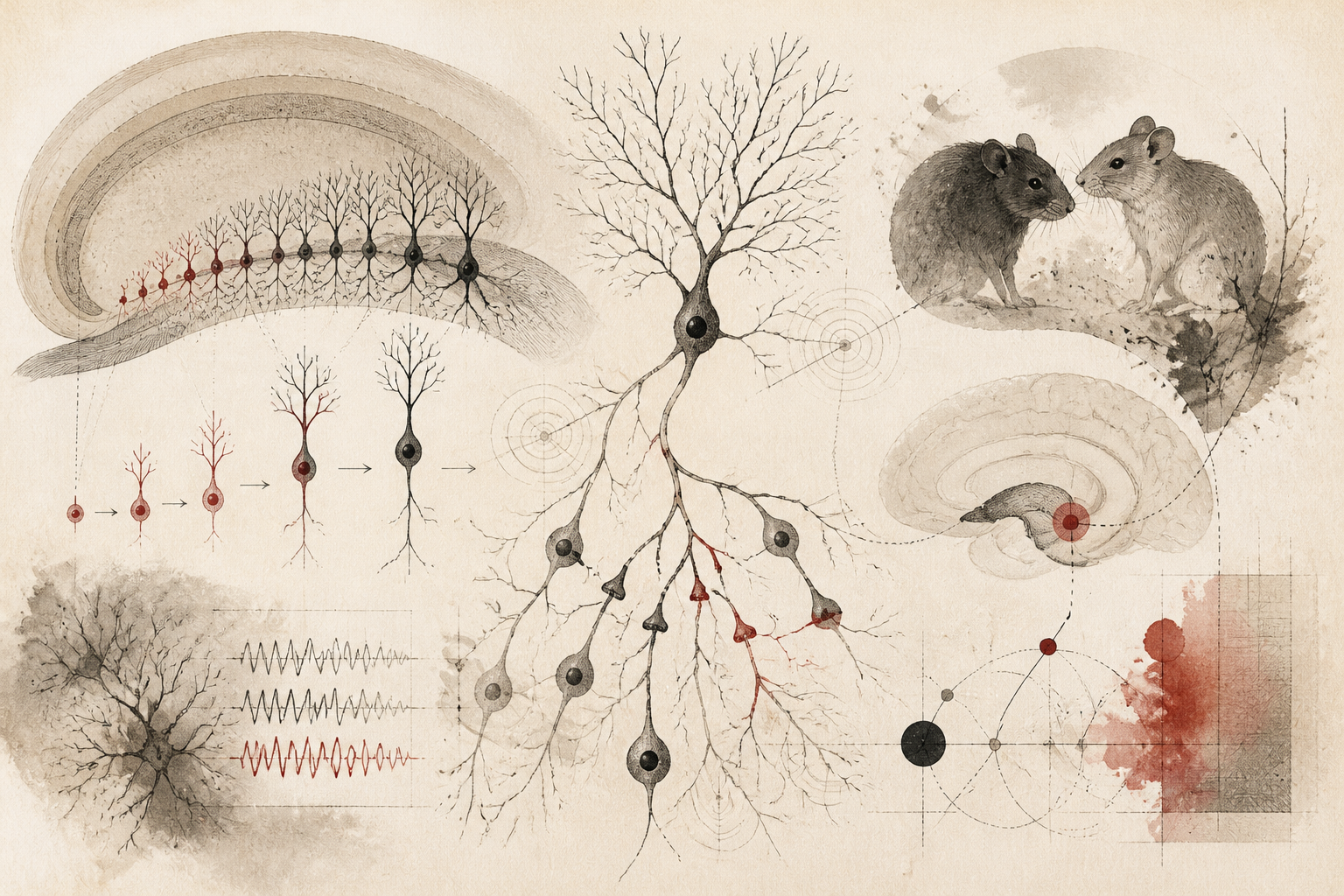
The capacity to distinguish a familiar peer from a stranger is fundamental to the survival and social cohesion of mammalian species. While the hippocampus has long been established as a primary locus for memory processing, the specific mechanics of how the brain stabilizes social information over time remain an active area of investigation. Recent research published in Nature Neuroscience identifies a specific cellular catalyst for this stability: adult-born dentate granule cells (abDGCs). The study demonstrates that these neurons do not merely integrate into existing circuits, but undergo a prolonged, or neotenic, maturation process that specifically reconfigures inhibitory signaling to enable the consolidation of social memories.
The Role of Adult Neurogenesis in Social Cognition
Unlike many regions of the brain where neuron production ceases shortly after birth, the dentate gyrus within the hippocampus maintains the ability to generate new neurons throughout adulthood. This process, known as adult neurogenesis, has been implicated in spatial navigation and pattern separation—the ability to distinguish between similar experiences. However, the specific contribution of these nascent cells to the social domain has historically been less clear. Social memory presents a unique computational challenge; it requires the brain to store complex, multi-sensory information about another individual and retrieve that information after significant delays. Typical hippocampal circuits are highly plastic but can be prone to interference, making the long-term "storage" of a specific social identity difficult.
In the study reported by Nature Neuroscience, researchers explored the hypothesis that abDGCs provide a specialized window of plasticity. The investigators focused on the maturation timeline of these cells, noting that they do not become fully functional immediately. Instead, they undergo a multi-week transition from excitable, immature states to integrated, stable components of the hippocampal network. This slow transition appears to be more than a biological byproduct of development; it is a functional feature that allows the brain to adjust its inhibitory architecture in response to social stimuli. By tracking these cells in animal models, the research team was able to observe how the gradual integration of abDGCs directly correlates with the animal's ability to remember a social encounter 24 hours later, a standard benchmark for long-term memory consolidation.
Mechanisms of GABAergic Reconfiguration
Central to the study’s findings is the concept of GABAergic inhibition. Most neurons in the hippocampus communicate via excitatory signals, but the stability of the system is maintained by inhibitory neurons that use the neurotransmitter gamma-aminobutyric acid (GABA). The researchers found that as abDGCs mature, they engage in a reciprocal dialogue with these inhibitory interneurons. Rather than simply adding more noise to the circuit, the neotenic expansion of these new cells leads to a targeted reconfiguration of the local inhibitory network. This structural change effectively lowers the threshold for signal stabilization during the critical hours following a social interaction.
The methodology employed in the Nature Neuroscience report involved sophisticated optogenetic and chemogenetic tools, allowing the researchers to selectively silence or activate abDGCs at specific stages of their development. By manipulating these cells, they discovered that the consolidation of social memory—the process of moving a memory from a short-term, fragile state to a long-term, stable one—was dependent on the presence of abDGCs that were in a specific middle-age range of maturation. If these cells were removed or their maturation was artificially accelerated, the subjects could still recognize a peer in the short term but failed to retain that recognition over longer periods. This suggests that the slow, "neotenic" pace of growth is essential for the circuit to undergo the necessary structural changes to support lasting social bonds.
Interpretation of Neotenic Expansion
The term "neoteny" typically refers to the retention of juvenile features into adulthood. In the context of this neurobiological study, it describes the remarkably slow developmental trajectory of adult-born neurons compared to those generated during embryonic stages. The researchers interpret this slow growth as a strategic delay. By remaining in a plastic, immature state for an extended period, abDGCs serve as a flexible buffer that can be molded by social experience. This allows the hippocampus to avoid the "hard-wiring" of social information too early, ensuring that only significant social encounters are consolidated into long-term storage. This reconfiguration of the GABAergic system essentially creates a "social memory trace" that is resistant to the daily interference of non-social spatial information.
Furthermore, the study highlights that this process is highly specific. While the dentate gyrus is involved in many types of memory, the reconfiguration of inhibitory circuits driven by abDGC maturation appeared particularly vital for social recognition as opposed to general object recognition. This suggests that the mammalian brain has evolved specialized cellular pathways to manage the unique demands of social living. The ability to recognize a kin member or a competitor requires a higher degree of stability than remembering where a specific object was placed, and the neotenic expansion of new neurons provides the biological substrate for that stability.
Limitations and Future Directions in Neurogenesis Research
While the findings published in Nature Neuroscience offer a compelling new model for social memory, several open questions remain. First, the study primarily utilizes animal models to map these cellular trajectories. While adult neurogenesis is a conserved process across many mammals, the rate and scale of neuron production in the human hippocampus remain subjects of intense academic debate. Further research is required to determine if the human social brain utilizes a similar neotenic timeline or if other mechanisms compensate for potentially lower rates of neurogenesis in older humans. Additionally, the study focuses on the dentate gyrus, but social memory involves a distributed network including the prefrontal cortex and the amygdala. How the changes in hippocampal GABAergic inhibition communicate with these other regions remains to be fully elucidated.
Another consideration involves the factors that influence the rate of neurogenesis and maturation. Stress, exercise, and environmental enrichment are all known to impact the production of new neurons. If social memory consolidation is tethered to the health and maturation of abDGCs, then environmental factors that suppress neurogenesis may have direct, deleterious effects on social cognition. This opens a new avenue for investigating social withdrawal or social memory deficits in neuropsychiatric conditions. Understanding the molecular triggers that signal a new neuron to begin its inhibitory reconfiguration could eventually lead to therapeutic interventions for disorders characterized by social cognitive impairment.
Why Social Memory Consolidation Matters
The implications of this research extend beyond the laboratory. By identifying the specific cellular and inhibitory changes required for social memory, the study provides a biological framework for understanding how we build a history of social interactions. In an academic and clinical context, this research underscores the importance of the "maturation period" in brain health. It suggests that the brain’s ability to learn and remember is not just about the birth of new cells, but about the patience of those cells as they slowly weave themselves into the existing neural fabric. For Zeit Psychology Online University, these findings reinforce the integration of biological rhythm and cognitive function, demonstrating that the pace of cellular development is as critical as the development itself in shaping the social mind.
Quick answers
- What are adult-born dentate granule cells (abDGCs)?
- They are new neurons produced in the dentate gyrus region of the hippocampus during adulthood, contributing to brain plasticity and memory.
- How does neotenic maturation affect the brain?
- Neotenic maturation refers to a slow developmental pace, allowing new neurons to remain flexible longer and effectively reshape inhibitory circuits for stable memory storage.
- Why is GABAergic inhibition important for social memory?
- GABAergic inhibition balances excitatory signals; its reconfiguration by new neurons helps create a stable, interference-resistant trace for social recognition.
Editorial Team