Modular Neural Architecture as a Framework for Flexible Cognition
Recent research in Nature Neuroscience identifies a reusable modular architecture in mouse brains and AI that enables the performance of diverse cognitive tasks through shared neural blocks.
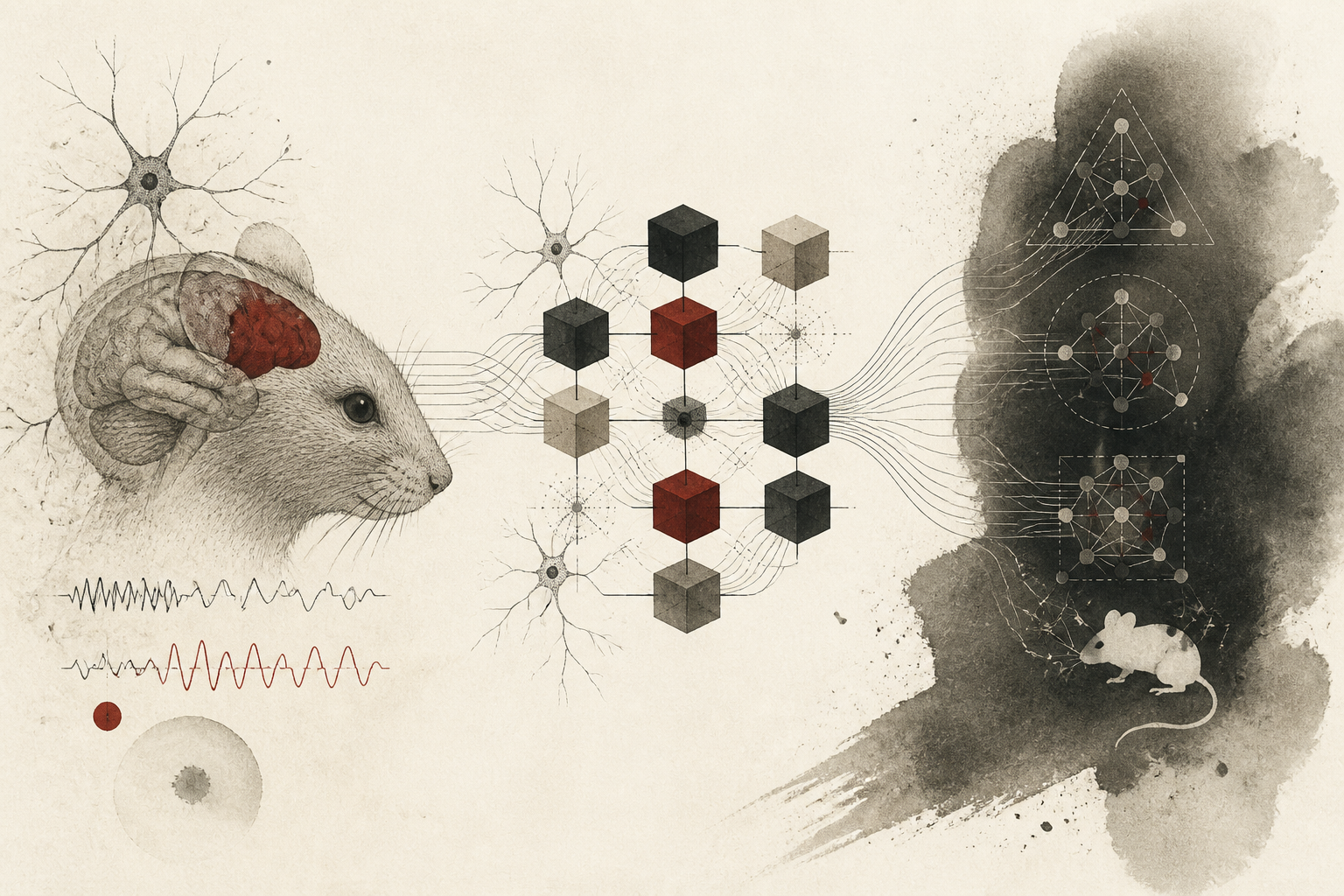
The capacity to transition fluidly between distinct mental tasks represents a cornerstone of mammalian intelligence. Whether a human is switching from driving a car to engaging in a complex conversation, or a mouse is alternating between sensory discrimination and navigation, the brain must manage a diverse repertoire of cognitive operations without losing the specialized efficiency required for each. A recent study published in Nature Neuroscience, titled "Reusable modular architecture enables flexible cognitive operations in the mouse brain and artificial recurrent networks," provides a rigorous examination of how the biological brain and artificial recurrent neural networks (RNNs) solve the problem of cognitive flexibility. By investigating the structural underpinnings of multi-tasking, the research team suggests that the brain does not rely on a series of independent, isolated circuits for every unique behavior. Instead, it utilizes a sophisticated modular architecture where reusable components are reconfigured to meet the demands of the moment.
Historically, neuroscience has grappled with the tension between localization and integration. While specific brain regions are often associated with particular functions, such as sensory processing or motor control, the mechanism that allows these regions to collaborate across a wide array of tasks has remained elusive. The findings presented in the recent Nature Neuroscience paper suggest that the solution lies in a "LEGO-like" modularity. By breaking down complex behaviors into smaller, functional units, the brain can achieve high levels of computational efficiency while maintaining the plasticity necessary to learn new tasks without overwriting existing knowledge. This discovery has profound implications for both our understanding of biological neurobiology and the future development of more adaptable artificial intelligence systems.
Computational Principles of Multi-Tasking Networks
To explore the intersection of biological and artificial cognition, the researchers employed a dual-track methodology. They first analyzed large-scale neural recordings from mice engaged in a variety of sensory and decision-making tasks. Simultaneously, they trained artificial recurrent neural networks (RNNs) to perform analogous suites of tasks. The goal was to determine if the artificial systems, when optimized for multi-tasking, would converge on the same structural solutions observed in the biological brain. The results revealed a striking convergence: both the mouse brain and the high-performing RNNs organized their internal logic into discrete modules. These modules were not task-specific in a narrow sense; rather, they represented fundamental building blocks of computation that could be shared across different operations.
In the artificial models, the researchers observed that networks trained on a single task often developed highly specialized, rigid structures. However, when the networks were required to master a diverse set of twenty or more tasks, they spontaneously organized into a modular architecture. These modules functioned as functional units that could be activated in different combinations depending on the input requirements. For example, a module responsible for maintaining working memory might be recruited during a delayed-response task but remained dormant during a simple sensory-motor reflex. This reusable nature allows the system to conserve resources and simplifies the learning process for new, related tasks. The researchers noted that this modularity is essential for preventing "catastrophic forgetting," a common failure mode in AI where learning a new task causes the system to erase the parameters necessary for previous tasks.
Neural Dynamics and the Logic of Reusability
The study utilized advanced neuroimaging and electrophysiological techniques to map these dynamics in the murine brain. By observing the firing patterns of large populations of neurons, the researchers identified distinct "subspaces" of activity. Each subspace corresponded to a specific computational operation, such as the encoding of a stimulus or the preparation of a motor response. Crucially, these subspaces were found to be remarkably consistent across different tasks. When a mouse transitioned from one behavioral paradigm to another, the brain did not reorganize its entire connectivity; it simply shifted its activity between these pre-existing functional modules. This suggests that the brain maintains a library of operational tools that it can deploy as needed, rather than building a new tool for every specific scenario.
The researchers further investigated the role of inhibitory and excitatory balance in maintaining these modular boundaries. In both the biological and artificial models, the ability to selectively activate or suppress specific modules was key to preventing interference. Without this precise control, the signals from different tasks would blend, leading to cognitive confusion and errors. The modular architecture provides a form of structural scaffolding that keeps different information streams segregated until they need to be integrated for a final decision. This finding aligns with established theories of executive function, which emphasize the importance of gating mechanisms in the prefrontal cortex and related structures.
Implications for Artificial Intelligence and Pathology
The parallels between the mouse brain and the artificial networks offer significant insights for the field of machine learning. Current AI systems, while powerful, often lack the generalized flexibility of mammalian brains. By incorporating the modular principles identified in this study, engineers may be able to design neural networks that are more robust, energy-efficient, and capable of lifelong learning. The concept of "reusable modules" provides a blueprint for creating systems that can generalize knowledge from one domain to another, moving closer to the goal of artificial general intelligence. Furthermore, the study highlights the importance of training environments; the modular structure only emerged when the networks were challenged with a diverse set of problems, suggesting that cognitive complexity is a driver of structural sophistication.
From a clinical perspective, understanding the modularity of the brain could shed light on various neuropsychiatric conditions. Disorders characterized by cognitive rigidity or the inability to switch between mental sets—such as obsessive-compulsive disorder or certain executive function deficits in autism—might be understood as failures in modular reconfiguration. If the boundaries between functional modules become too rigid or too porous, the individual may struggle to adapt to changing environmental demands. The research provides a baseline for investigating how these neural modules are formed during development and how they might be disrupted by disease or trauma. By mapping the "parts list" of cognitive operations, scientists can better identify which specific modules are failing in different pathological states.
Limitations and the Future of Modular Neuroscience
While the study offers a compelling framework for understanding cognitive flexibility, several open questions remain. The researchers acknowledge that while the mouse brain and RNNs show similar modular tendencies, the scale of human cognition is vastly larger and more complex. It is not yet clear if the specific modules identified in rodents have direct analogs in the human brain, or if humans possess a significantly larger library of reusable components. Additionally, the study primarily focused on relatively simple sensory-motor and decision-making tasks. Future research will need to explore how modularity supports higher-order functions like language, abstract reasoning, and social cognition. The temporal dynamics of how these modules are assembled in real-time also require further investigation.
Another limitation lies in the current understanding of how these modules are physically mapped onto the brain's anatomy. While the study identified functional modules in the activity patterns of neurons, these do not always correspond to neatly defined anatomical regions. The relationship between the functional "software" of the modules and the structural "hardware" of the brain's white and gray matter remains a subject of intense study. As neurotechnologies continue to improve, allowing for even higher-resolution recordings of neural populations, researchers hope to pin down the exact biological mechanisms that enable this flexible modularity. The work published in Nature Neuroscience serves as a vital step in this journey, bridging the gap between computational theory and biological reality, and redefining our understanding of how the brain manages the diverse demands of the modern world.
Quick answers
- What is modular neural architecture?
- It is a structural design where the brain or an AI uses discrete, reusable functional units to perform different tasks, rather than having a single, rigid circuit for each action.
- How does this study link mouse brains and AI?
- Researchers found that when both mouse brains and artificial recurrent neural networks (RNNs) are required to multi-task, they both spontaneously develop similar modular patterns to handle the complexity.
- Why is modularity important for artificial intelligence?
- Modularity helps prevent 'catastrophic forgetting' in AI, allowing networks to learn new tasks without losing the ability to perform previously learned ones.
Rewritten by Zeit editorial AI. Based on original reporting at Nature Neuroscience.