Mechanisms of Mutualism: How Spontaneous Cooperation Emerges in Humans
Recent findings suggest that human cooperation can flourish through simple psychological adaptations rather than complex social systems.
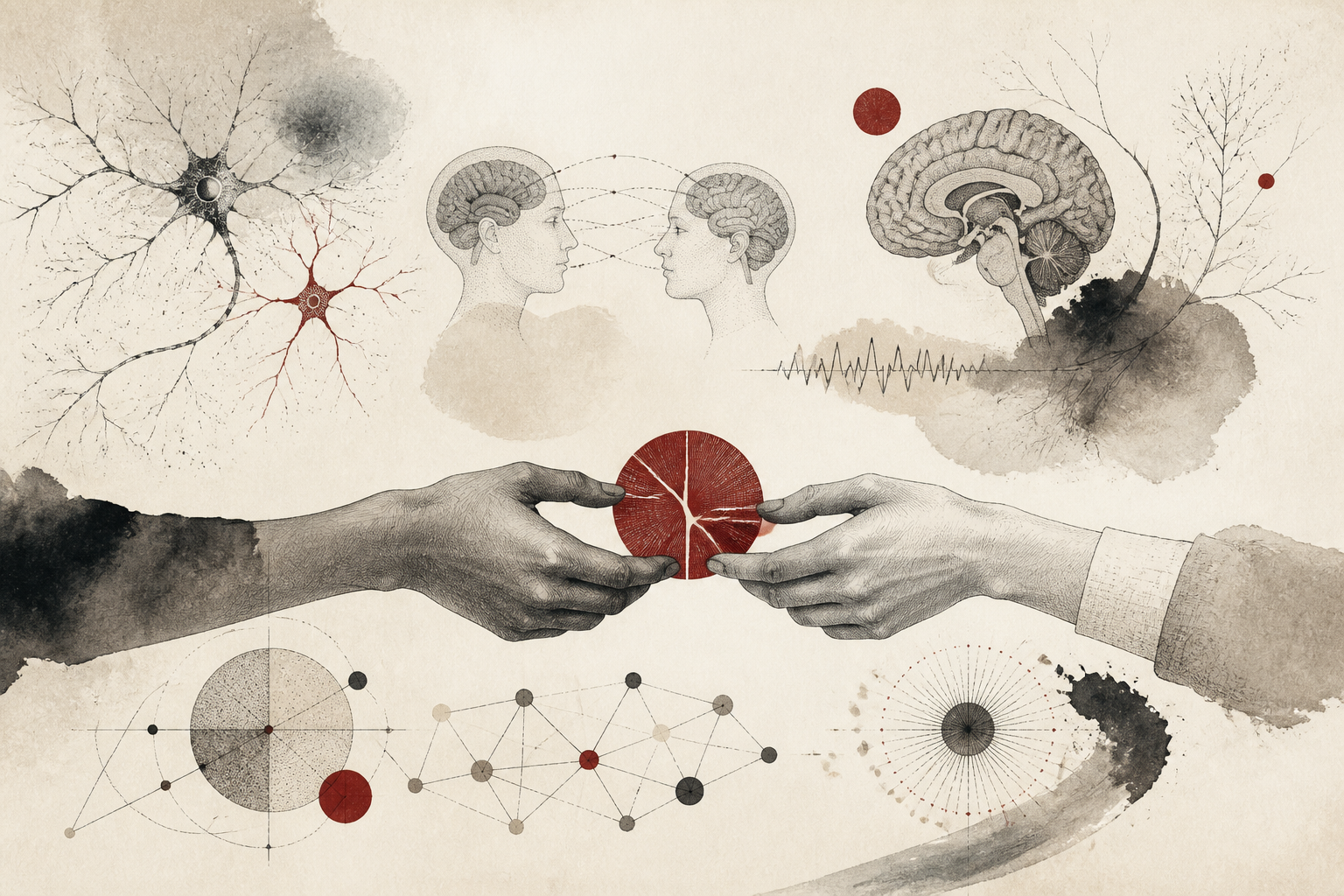
Traditional evolutionary models often posit that cooperation requires high-level social structures, legal repercussions, or close genetic ties to survive. However, new research highlights a paradigm shift in how we understand the 'Prisoner’s Dilemma,' demonstrating that mutual benefits can drive cooperation through simpler mechanisms than previously assumed.
Investigations published via NeuroscienceNews.com explore how individuals navigate competitive environments where personal gain often conflicts with collective well-being. By utilizing the Prisoner’s Dilemma—a standard game theory model—researchers observed that cooperation frequently emerges as a stable strategy through recursive interactions. Rather than relying on altruism or complex societal enforcement, participants often adopted a 'tit-for-tat' or reciprocal approach. This suggests that the human brain is wired to recognize the long-term utility of collaboration as a survivable and productive default state.
The findings challenge the cynical view of human nature that suggests selfishness is the primary biological driver. Instead, the study indicates that even in the absence of kinship or formal contracts, the psychological drive for efficiency leads to cooperative outcomes. When agents realize that defection leads to mutual loss, they naturally shift toward strategies that maximize shared rewards. This cognitive flexibility allows for the formation of stable groups and the development of intricate social networks.
These results have significant implications for both psychology and neuroscience, suggesting that our social cognition is fine-tuned to detect and maintain reciprocal relationships. By shifting the focus from complex external systems to internal psychological thresholds, the research provides a new lens through which to view human social evolution. This shift demonstrates that the foundations of modern civilization may rely less on institutional enforcement and more on the inherent psychological logic of mutual aid.
Quick answers
- What does the Prisoner's Dilemma reveal about human behavior?
- It shows that while individuals may be tempted by short-term selfish gains, they often choose cooperation because it offers better long-term stability and rewards.
- Do humans need laws to cooperate?
- While laws help, this research suggests that humans have an inherent psychological capacity for cooperation through simple reciprocity and mutual benefit.
- How does this study change our view of evolution?
- It suggests that cooperation can evolve without relying on genetic relatedness or complex institutional frameworks, expanding the range of evolutionary success strategies.
Rewritten by Zeit editorial AI. Based on original reporting at NeuroscienceNews.com.