Mapping the Prelimbic Microcircuits of Neuropathic Pain Affect
New neuroscientific research identifies distinct cortical pathways in the prelimbic cortex that independently process sensory intensity and emotional distress in neuropathic pain.
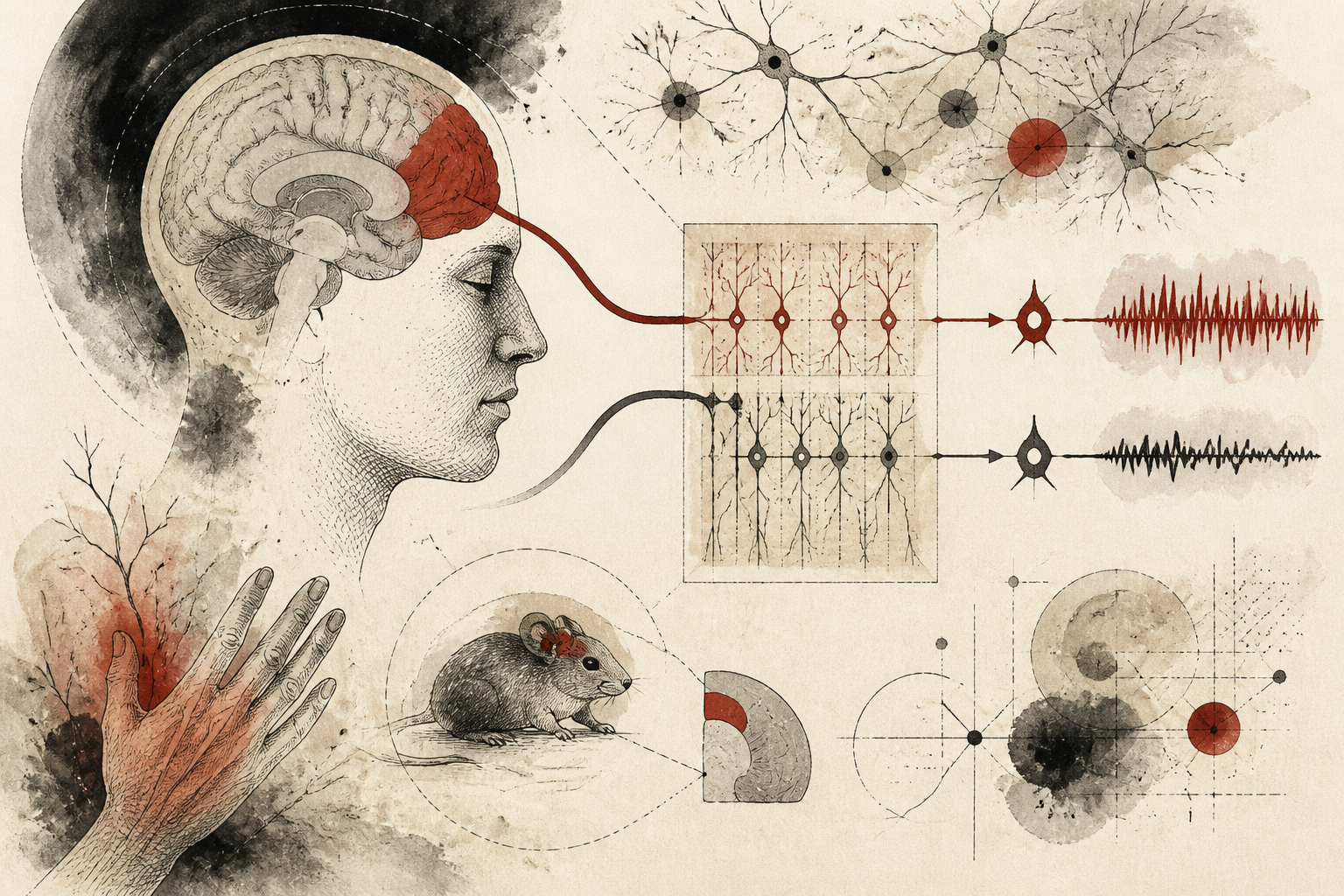
Chronic neuropathic pain has long been understood not merely as a persistent physical sensation but as a complex multidimensional experience that integrates sensory discrimination with profound emotional distress. For decades, the therapeutic challenge has been the relative inability to decouple the physical signal of pain from the affective suffering it produces. However, a groundbreaking study published in Nature Neuroscience has provided a high-resolution map of the neural architecture responsible for this divergence. By investigating the microcircuits within the prelimbic cortex, researchers have identified distinct cellular populations that control the sensory and affective dimensions of pain independently. This discovery offers a significant shift in the neurobiological understanding of chronic pain, suggesting that the 'hurt' of pain and its emotional 'burden' are governed by separate, yet parallel, cortical pathways.
Neuroanatomical Foundations of the Multidimensional Pain Experience
The perception of pain is classically categorized into two primary components: the sensory-discriminative dimension, which involves the localization and intensity of the stimulus, and the affective-motivational dimension, which encompasses the unpleasantness, anxiety, and long-term mood alterations associated with chronic suffering. While the somatosensory cortex has traditionally been linked to the former, the prefrontal cortex—specifically the prelimbic area—has emerged as a critical hub for the latter. Despite this general understanding, the specific microcircuitry within the prelimbic cortex that mediates these interactions has remained elusive. The research team sought to determine whether a single group of neurons handled both aspects of pain or if specialized circuits were at play.
Existing literature has frequently implicated the medial prefrontal cortex in the transition from acute to chronic pain states. In neuropathic conditions, where nerve damage leads to persistent hypersensitivity, the brain undergoes significant functional remodeling. The authors of the study utilized advanced neuroimaging and optogenetic techniques to observe how these neural populations respond to noxious stimuli. Their background research suggested that the prelimbic cortex acts as an integration center, receiving inputs from the thalamus and amygdala, but the internal logic of how it parses sensory data versus emotional valence required a more granular investigation. By establishing this anatomical context, the study aimed to bridge the gap between general cortical activity and specific behavioral outcomes in pain models.
Identified Pathways and Mechanistic Findings
The central findings of the study reveal a sophisticated division of labor within the prelimbic microcircuits. Through the use of calcium imaging and electrophysiological recordings, the researchers identified two distinct subpopulations of neurons that exhibited differential activity patterns during pain processing. One circuit, primarily characterized by its projections to the periaqueductal gray, was found to be more closely associated with the sensory-discriminative aspects of pain. Conversely, a second population of neurons, communicating with the basolateral amygdala, appeared to drive the affective-motivational responses. This separation is critical because it demonstrates that the brain does not process pain as a monolithic signal but rather fragments the experience into specific streams for processing.
Further mechanistic analysis showed that during the development of neuropathic pain, these circuits undergo divergent plasticity. In animal models of nerve injury, the researchers observed a marked increase in the excitability of the affective-motivating circuit, while the sensory-processing circuit showed a different temporal profile of activation. This suggests that the emotional 'weight' of pain can be amplified independently of the physical sensation. By selectively modulating these pathways using optogenetics, the team was able to decrease the emotional distress associated with pain without necessarily raising the mechanical threshold for withdrawal. This ability to dial down the suffering while leaving the sensory detection intact represents a paradigm shift in how cortical modulation might be approached in clinical settings.
Interpretations and the Role of Cortical Inhibition
Interpreting these findings requires a focus on the role of inhibitory interneurons within the prelimbic cortex. The study highlights that the balance between excitatory and inhibitory signals—specifically involving parvalbumin-positive interneurons—is essential for maintaining the boundary between sensory and affective processing. In the neuropathic state, a breakdown in this local inhibition allows for the 'crosstalk' or over-sensitization of the affective circuits. This suggests that the chronic nature of neuropathic pain is not just a result of peripheral nerve signals being too strong, but a failure of the cortical microcircuits to appropriately gate the emotional response to those signals.
From a psychological perspective, this research reinforces the idea that pain-related disability is often more closely tied to the affective dimension than the sensory one. If the prelimbic cortex is malfunctioning in a way that hyper-activates the amygdala-bound pathway, the patient may experience high levels of catastrophizing and depression even if the primary injury shows signs of healing. The researchers interpret their data as evidence that chronic pain is a disease of the brain's internal connectivity as much as it is a disease of the peripheral nervous system. This interpretation aligns with the biopsychosocial model of pain, providing it with a firm neurobiological basis in cortical microcircuitry.
Limitations and Open Questions in Translational Research
While the study provides a robust framework for understanding these circuits, several limitations must be acknowledged. First, the majority of the data was derived from rodent models, and while the prelimbic cortex has clear analogues in the human prefrontal cortex, the complexity of human emotional life and social context adds layers that cannot be fully captured in animal studies. The researchers also noted that while the two circuits are distinct, they are not entirely isolated; there remains a level of reciprocal influence that was not fully mapped in this specific paper. Future studies will need to investigate how these microcircuits interact with the 'top-down' cognitive controls that humans use to manage pain, such as mindfulness or cognitive-behavioral strategies.
Another open question involves the temporal evolution of these circuits. It is not yet clear at what exact point an acute pain signal begins to recruit the affective circuit in a way that leads to chronic remodeling. Identifying the 'tipping point' could allow for early intervention strategies that prevent the emotional pathways from becoming hyper-sensitized. Furthermore, the role of glial cells and neuroinflammation in modulating these specific microcircuits remains a fertile ground for future inquiry, as the current study focused primarily on neuronal firing and connectivity.
Implications for Future Pain Management
The significance of this research lies in its potential to inform the development of more targeted therapies for neuropathic pain. Current pharmacological treatments, such as opioids or gabapentinoids, often act systemically and produce significant side effects because they do not distinguish between the various dimensions of the pain experience. By targeting the specific prelimbic microcircuits identified in this study, it may be possible to develop 'affect-specific' analgesics. Such treatments would aim to reduce the suffering and psychological impact of chronic pain without compromising the body’s essential ability to detect and respond to physical injury.
Furthermore, this research provides a neuroscientific rationale for the integration of psychological and physical therapies. If the affective dimension of pain is controlled by a specific cortical circuit, then interventions that target the prefrontal cortex—ranging from transcranial magnetic stimulation to targeted psychotherapy—are not just 'adjuncts' but are addressing the core neurobiology of the condition. As Zeit Psychology Online University continues to explore the intersection of brain and behavior, the findings from Nature Neuroscience serve as a reminder that the most profound aspects of our sensory experience are governed by the most intricate of neural architectures.
Quick answers
- What is the difference between the sensory and affective dimensions of pain?
- The sensory dimension refers to the physical intensity and location of pain, while the affective dimension involves the emotional distress, unpleasantness, and suffering associated with the sensation.
- How does the prelimbic cortex influence chronic pain?
- The prelimbic cortex contains specific microcircuits that act as a hub, directing pain signals to different brain regions like the amygdala for emotional processing or the periaqueductal gray for sensory modulation.
- Can emotional suffering from pain be treated without affecting physical sensation?
- Research suggests that by targeting the specific neural pathways connected to the amygdala, it may be possible to reduce the emotional burden of pain while maintaining the sensory ability to detect injury.
Editorial Team