Mapping the Neural Circuitry of Persistent Remission in Treatment-Resistant Depression
Researchers identify three critical brain pathways that dictate the long-term success of deep brain stimulation for patients with intractable depressive disorders.
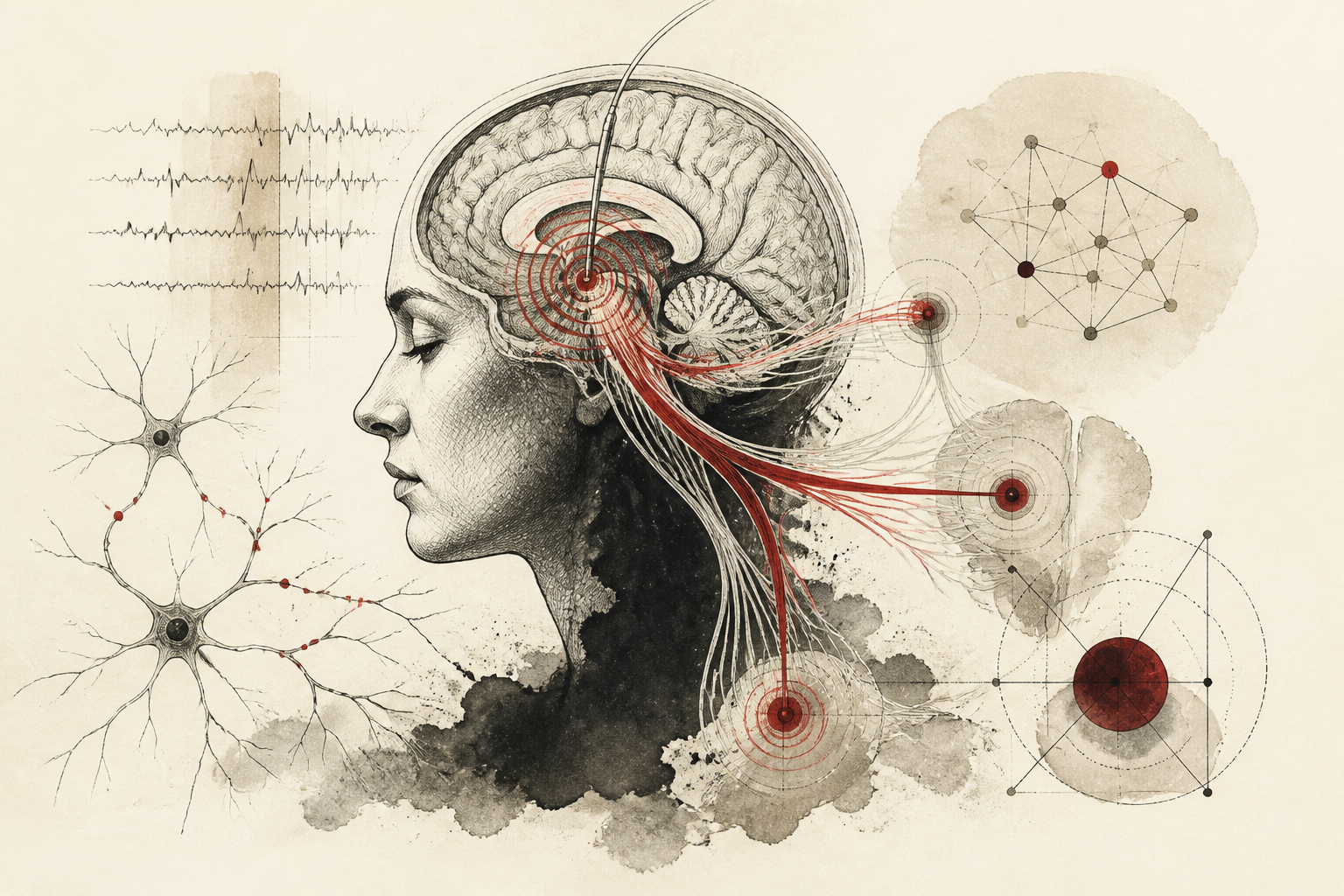
In the evolving landscape of clinical psychiatry, few interventions represent the frontier of neurotechnology as profoundly as deep brain stimulation (DBS). Originally developed to manage motor symptoms in Parkinson’s disease, DBS has increasingly been investigated as a biological corrective for treatment-resistant depression—a condition where patients have failed to respond to multiple pharmacological and psychotherapeutic interventions. While initial trials showed promise, clinical outcomes have historically been inconsistent, leaving a fundamental question for neuroscientists: why does the same procedure yield life-altering remission for some, yet offer no relief for others? A recent study published in ScienceDaily highlights a significant breakthrough in answering this question, as researchers have pinpointed three specific neural pathways that serve as the physiological architecture for lasting depression relief. The findings underscore a precision-based reality in neurosurgery, where the difference between recovery and relapse may be measured in single millimeters.
The Anatomy of Neural Connectivity in DBS
The fundamental premise of deep brain stimulation involves the surgical implantation of electrodes into specific regions of the brain, typically the subcallosal cingulate (SCC). This area acts as a traffic hub for emotional regulation, connecting the primitive limbic system with the higher-order prefrontal cortex. However, the SCC is not a monolithic structure; it is a dense intersection of white matter tracts that link various functional zones. The recent investigation revealed that the efficacy of the treatment depends less on the general placement within the SCC and more on the specific engagement of three distinct white matter pathways. These pathways function as conduits for electrical signals that modulate the brain’s mood-regulation networks. When all three pathways are successfully stimulated, patients show a high probability of sustained clinical improvement. This shift toward a connectivity-based model represents a departure from older theories that focused primarily on localized grey matter activity, moving instead toward a systems-level understanding of psychiatric health.
Identifying the Triple-Pathway Signature for Recovery
The research identified that the structural integrity and successful stimulation of three specific tracts are the primary predictors of success. The first pathway involves the forceps minor, which connects the two frontal lobes and facilitates high-level cognitive processing and emotional control. The second is the medial forebrain bundle, a critical component of the brain's reward system, which is often diminished in those suffering from anhedonia—the inability to feel pleasure. The third is the cingulum bundle, which serves as a communication highway between the frontal cortex and the limbic regions responsible for emotional memory and processing. By analyzing neuroimaging data from patients over a two-year period, the research team found that those who achieved and maintained remission had electrodes positioned at the precise intersection where these three pathways converge. This 'sweet spot' represents a nexus of connectivity that, when activated, appears to recalibrate the dysfunctional signaling characteristic of chronic depression.
The Failure Mode: Insufficient Stimulation and Electrode Precision
Perhaps the most significant revelation of the study concerns the cohort of patients who failed to improve after two years of treatment. Upon detailed retrospective analysis, researchers discovered a striking commonality among non-responders: a failure to sufficiently stimulate one particular connection within this triple-pathway network. Even when the electrodes were technically within the correct anatomical zone, they lacked the proximity required to engage the full circuit. This finding highlights the extreme sensitivity of DBS; even a discrepancy of one or two millimeters in electrode placement can lead to the neglect of a critical pathway, resulting in a lack of clinical response. This discovery provides a mechanistic explanation for why some previous large-scale DBS trials produced mixed results. Without the benefit of this connectivity mapping, surgeons were essentially operating without a complete map of the underlying wiring, leading to inconsistent target acquisition.
Methodological Implications for Personalized Psychiatry
The methodology employed in this research utilizes advanced diffusion-weighted imaging (DWI) and tractography to visualize the white matter architecture of each individual patient. This personalized approach acknowledges that human neuroanatomy is not uniform; the exact location of the forceps minor or the medial forebrain bundle can vary slightly from person to person. By using these imaging techniques to guide the surgical trajectory, the study suggests that the success rate of DBS can be significantly enhanced. The researchers emphasized that the two-year mark was crucial for observing these patterns, as the brain requires time to undergo the neuroplastic changes prompted by constant electrical stimulation. This long-term data collection allowed the team to distinguish between temporary placebo effects and the robust, structural changes associated with true neural remodeling. It confirms that psychiatric recovery via DBS is not an immediate 'switch' but a gradual process of network stabilization.
Limitations and Future Directions in Clinical Application
Despite the clarity of these findings, several limitations remain that necessitate caution and further inquiry. First, the study focuses on a specific anatomical target, the subcallosal cingulate, and it remains to be seen if similar pathway-specific rules apply to other potential DBS targets like the ventral capsule or the nucleus accumbens. Furthermore, while the physical connectivity pathways have been identified, the optimal electrical parameters—such as frequency, pulse width, and voltage—required to maximize the stimulation of these tracts are still being refined. There is also the question of patient heterogeneity; while these three pathways are critical, the underlying etiology of depression may differ among individuals, meaning a 'one size fits all' target may not exist even with perfect mapping. Future research must determine if these pathway signatures can be used to screen patients before surgery to ensure they have the necessary structural framework to benefit from the procedure.
Toward a New Standard of Interventional Care
The implications of this research extend far beyond the operating room. By defining the specific neural substrates of recovery, the study provides a biological validation of depression as a circuit-based disorder rather than a simple chemical imbalance. This shift in perspective is vital for reducing the stigma associated with treatment-resistant conditions and for the development of next-generation non-invasive treatments, such as transcranial magnetic stimulation (TMS), which might eventually be refined to target these same pathways. For now, the focus remains on refining the precision of DBS. As surgical techniques move toward this map-guided approach, the hope is that intractable depression will no longer be seen as 'untreatable,' but rather as a complex engineering challenge that can be solved through the precise modulation of the brain's internal communications. The discovery of these three pathways marks a definitive step toward that future, offering a blueprint for reclaiming lives from the depths of chronic mental illness.
Quick answers
- What are the three brain pathways identified in the DBS study for depression?
- The study identified the forceps minor, the medial forebrain bundle, and the cingulum bundle as the three critical pathways for successful depression treatment.
- Why do some patients fail to respond to deep brain stimulation for depression?
- Non-responders often lack sufficient stimulation of a crucial connection due to electrode placement being just a few millimeters away from the optimal intersection of neural pathways.
- How does this research change the way doctors perform deep brain stimulation?
- It shifts the focus from general anatomical targeting to precise, personalized connectivity mapping using tractography to ensure all three vital pathways are engaged.
Rewritten by Zeit editorial AI. Based on original reporting at ScienceDaily — Mind & Brain.