Mapping the Mathematical Mind: The Neural Topography of Fractions and Integers
Researchers at the INSERM-CEA Cognitive Neuroimaging Unit have identified a continuous spatial map in the intraparietal sulcus that organizes all numerical values along a single mental line.
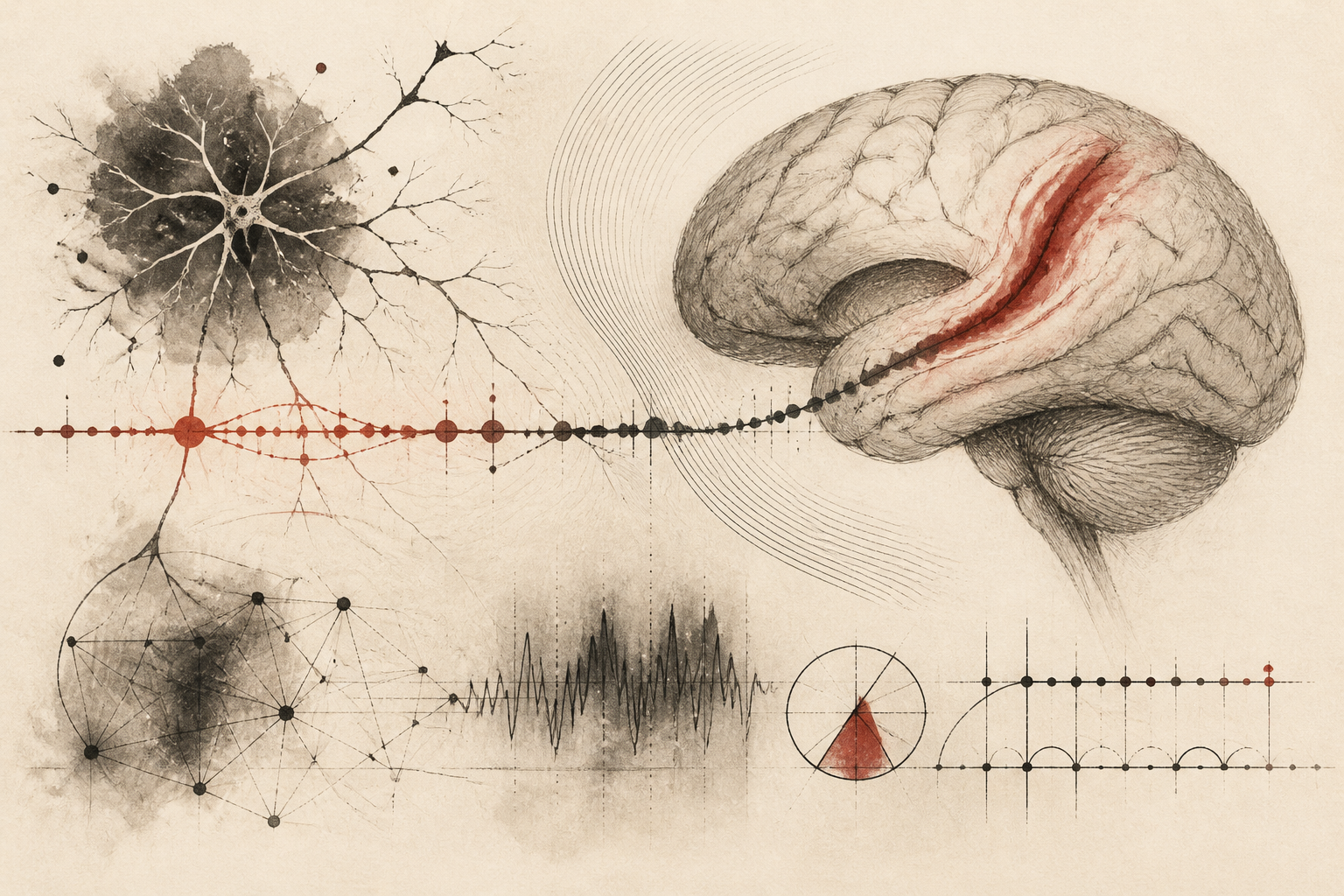
The human capacity for mathematical reasoning remains one of the most sophisticated products of cognitive evolution, allowing for the transition from concrete counting to the manipulation of abstract numerical concepts. While neuroscientists have long identified specific regions of the parietal lobe as the primary seat of mathematical processing, the specific organizational architecture of how the brain encodes different classes of numbers—such as whole integers versus fractional values—has remained a subject of intense debate. A recent investigation conducted by the INSERM-CEA Cognitive Neuroimaging Unit, and reported by Neuroscience News, provides a new resolution to this mystery. By utilizing high-resolution functional neuroimaging, researchers have demonstrated that the human brain does not segregate different numerical formats into disparate silos. Instead, it utilizes a sophisticated spatial map within the intraparietal sulcus to plot fractions and whole numbers along a unified, continuous mental number line. This finding challenges previous assumptions regarding how the brain adapts to increasingly complex mathematical structures as we move from infancy into formal education.
The Topographical Organization of the Intraparietal Sulcus
For decades, cognitive psychology has operated under the hypothesis of the "mental number line," a conceptual framework suggesting that humans perceive numerical magnitude as a spatial arrangement. However, demonstrating this spatial arrangement at a neurological level required mapping the specific neurons or neural clusters responsible for distinct values. The team at the INSERM-CEA Cognitive Neuroimaging Unit focused their investigation on the intraparietal sulcus (IPS), a region known for its involvement in processing symbolic and non-symbolic magnitudes. Through the application of advanced brain scanning techniques, the researchers were able to observe how this region responds to varying numerical stimuli. The study revealed a remarkably consistent pattern of activation that functions as a topographical map. In this map, specific locations within the IPS correspond to specific numerical magnitudes. This spatial arrangement is not random; it follows a predictable gradient where the physical location of the neural response shifts in tandem with the increase or decrease of the numerical value being processed by the participant.
Bridging the Gap Between Integers and Fractions
One of the most significant hurdles in mathematical education is the transition from whole numbers to fractions. Children and even adults often struggle with fractions because they require a departure from the counting principles used for integers. The INSERM-CEA study sought to determine if this cognitive difficulty stems from the brain having to switch between two different processing systems. Surprisingly, the neuroimaging data suggests the opposite. The brain appears to integrate fractions into the same pre-existing spatial map used for whole integers. Whether a participant viewed a whole number like '5' or a fraction like '1/2', the IPS activated along the same continuous line. This suggests that the brain possesses a singular, universal system for representing magnitude, regardless of the mathematical format. By plotting a fraction such as '0.5' between '0' and '1' on the same neural real estate, the brain maintains a consistent logic of magnitude that transcends the symbolic notation of the number itself.
The Mechanism of Neural Tuning Curves
The methodology employed by the researchers involved analyzing what are known as neural tuning curves. In sensory processing, tuning curves describe how individual neurons respond most strongly to a specific stimulus, such as a particular frequency of sound or a specific color, while responding less vigorously to similar but distinct stimuli. The researchers applied this principle to numerical cognition. They found that clusters of neurons in the IPS are 'tuned' to specific values. For instance, a group of neurons might show peak activation when the number four is presented, with decreasing levels of activity for three or five. Crucially, the study found that these tuning curves are active for both fractions and integers. When the brain processes a fraction, it does not invent a new category; it recruits the neurons that are already tuned to that specific magnitude on the mental number line. This indicates that the neural representation of number is essentially a matter of spatial positioning rather than linguistic or symbolic categorization.
Cognitive Implications and Educational Limitations
While the discovery of a unified mental number line provides a clear picture of the brain's internal architecture, it also raises questions about why fractional mathematics remains so difficult for many learners. The researchers suggest that while the IPS possesses the capacity to map fractions, the process of mapping a symbolic fraction (like 3/4) onto its corresponding magnitude (0.75) requires a higher degree of cognitive effort than mapping a whole number. The limitation may not lie in the brain’s map itself, but in the 'translation' layer where symbolic notation is converted into neural magnitude. Furthermore, the study notes that individual differences in the precision of these neural maps may correlate with general mathematical proficiency. If the neural tuning curves are 'blurry' or overlap too much, the individual may struggle to distinguish between closely related values, a condition that could potentially underlie developmental dyscalculia.
Future Directions in Numerical Neuroscience
The findings from the INSERM-CEA Cognitive Neuroimaging Unit open several new avenues for research into human cognition. One open question concerns the plasticity of the intraparietal sulcus: can targeted mathematical training sharpen the neural tuning curves and improve the precision of the mental number line? Additionally, researchers are interested in whether this unified map extends to other types of numbers, such as decimals, percentages, or even irrational numbers like Pi. Understanding the fundamental geometry of how the brain houses mathematics is more than just a matter of anatomical curiosity; it provides a roadmap for developing more effective pedagogical strategies. By aligning educational techniques with the brain's natural spatial organization, educators might be able to help students bridge the conceptual gap between whole numbers and the more complex numerical values required for advanced science and engineering. This study serves as a foundational reminder that even our most abstract intellectual achievements are ultimately grounded in the physical geography of the mind.
Quick answers
- How does the brain store different types of numbers?
- The brain uses a continuous spatial map in the intraparietal sulcus to plot both fractions and whole integers along a single mental number line.
- What is the intraparietal sulcus?
- The intraparietal sulcus (IPS) is a brain region in the parietal lobe responsible for processing symbolic and non-symbolic numerical magnitudes.
- Why are fractions difficult if the brain maps them like whole numbers?
- While the brain uses the same map, the difficulty lies in the cognitive effort required to translate symbolic fraction notation into its actual magnitude on the neural map.
Rewritten by Zeit editorial AI. Based on original reporting at NeuroscienceNews.com.