Mapping the Maternal Appetite: The Neural Basis of Pregnancy-Induced Cravings
Recent research in Nature Neuroscience identifies specific serotonergic circuits in the dorsal raphe nucleus that drive food-seeking behavior during pregnancy.
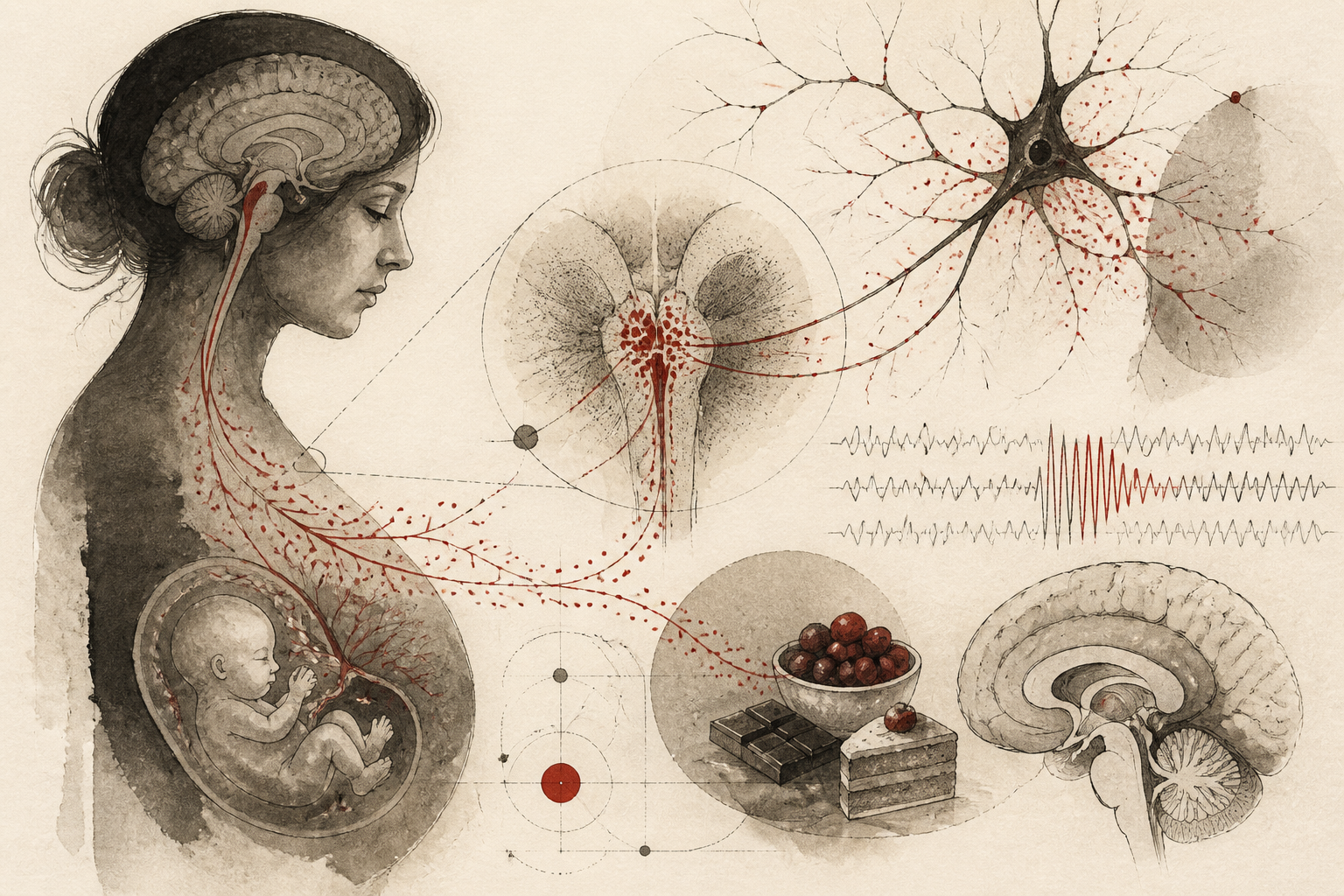
The phenomenon of gestational cravings has long been documented in both clinical literature and cultural narrative, yet the neurological drivers behind these urgent nutritional shifts have remained largely elusive. For decades, the sudden and specific preference for calorie-dense foods during pregnancy was attributed primarily to fluctuating systemic hormones like estrogen and progesterone. However, new research published in Nature Neuroscience, titled "Serotonin neurons in the dorsal raphe control food-craving-like behavior during pregnancy in mice," suggests that the mechanism is significantly more localized within the brain's reward and modulation systems. By identifying a specific population of serotonin-producing neurons, researchers have provided a granular look at how the maternal brain reorganizes its priorities to ensure sufficient caloric intake for both the mother and the developing fetus.
The Neurobiological Foundations of Gestational Appetite
Pregnancy necessitates a dramatic shift in metabolic homeostasis. As the physiological demands of a growing fetus increase, the maternal system must adapt by increasing energy intake and optimizing nutrient storage. While general hyperphagia—the overall increase in food consumption—is a well-known aspect of pregnancy, the specific "craving-like" behaviors, characterized by a heightened motivation to obtain specific, often high-fat or high-sugar foods, represent a complex intersection of metabolic need and reward-seeking behavior. The researchers sought to understand whether these behaviors were merely a byproduct of peripheral hormonal changes or if the brain underwent a fundamental functional remodeling.
Central to this inquiry is the dorsal raphe nucleus (DRN), a structure in the midbrain that serves as the primary source of serotonin for the rest of the central nervous system. Serotonin has long been implicated in the regulation of mood, anxiety, and satiety. However, its specific role in the context of pregnancy-induced dietary changes had not been fully articulated until now. By using a mouse model, which mirrors many of the hormonal and behavioral shifts seen in human gestation, the study authors were able to isolate how these serotonin neurons respond to the unique physiological state of pregnancy.
Identifying the Serotonergic Switch
The study’s findings point to a specific subset of dorsal raphe serotonin neurons that exhibit increased activity during pregnancy. This heightened activity correlates directly with the emergence of craving-like behaviors. In experimental settings, pregnant mice demonstrated a significantly higher motivation to perform tasks to receive high-fat or palatable rewards compared to their non-pregnant counterparts. This suggests that the "reward value" of certain foods is amplified during gestation, driven by the neurochemical signaling within the DRN.
Crucially, the researchers discovered that this circuit is not just a passive observer of hormonal changes but a primary driver of the behavior. By utilizing optogenetic and chemogenetic tools—techniques that allow for the precise activation or suppression of specific neurons using light or designer drugs—the team was able to manipulate these serotonin neurons. When these specific cells were artificially activated in non-pregnant mice, the animals began to exhibit the same high-motivation food-seeking behaviors typically reserved for pregnancy. Conversely, when the neurons were inhibited in pregnant mice, the intense cravings for high-calorie foods were significantly reduced, even though the animals' baseline nutritional needs remained high. This demonstrates that the serotonergic activity in the DRN is both necessary and sufficient to trigger these specific dietary preferences.
Mechanisms of Projections and Synaptic Plasticity
The research further investigated where these serotonin neurons send their signals. The study mapped the projections from the dorsal raphe to other critical brain regions involved in reward and motivation, most notably the nucleus accumbens and the hypothalamus. The nucleus accumbens is widely recognized as a hub for dopamine-mediated reward processing, while the hypothalamus acts as the central regulator of metabolic balance. The findings suggest that during pregnancy, the serotonergic input to these regions undergoes a form of functional plasticity.
The researchers observed that the sensitivity of the downstream neurons in these regions changed in response to the increased serotonin levels. This creates a feedback loop that lowers the threshold for reward activation when calorie-dense foods are present. It appears that the maternal brain is effectively "rewired" to ensure that the search for energy-dense nutrition is prioritized. This is not a malfunction of the reward system, but rather a targeted adaptation. The serotonin neurons act as a bridge between the endocrine signals of pregnancy—such as increased levels of prolactin and progesterone—and the behavioral output of food seeking.
Limitations and Theoretical Constraints
While the study provides a robust framework for understanding the neural circuitry of cravings, several limitations must be considered. First, the research was conducted using a murine model. While the dorsal raphe nucleus and serotonergic systems are highly conserved across mammalian species, human pregnancy involves a significantly more complex interplay of social, psychological, and environmental factors that cannot be fully captured in a laboratory setting. The cognitive appraisal of cravings in humans involves cortical regions that may modulate the more primitive signals coming from the midbrain.
Additionally, the study focuses heavily on the "craving" aspect—the motivation to seek specific foods—rather than the long-term metabolic consequences of satisfying those cravings. There remains an open question regarding how this circuit interacts with modern environments where high-calorie foods are unnaturally abundant. In an evolutionary context, this neural switch was likely a survival mechanism to prevent nutrient deficiency. In a modern context, if the circuit remains persistently active or over-responsive, it could potentially contribute to excessive gestational weight gain or metabolic complications.
Clinical Implications and Future Directions
Understanding the specific neural pathways responsible for pregnancy-induced cravings has significant implications for maternal health. If the dorsal raphe nucleus is the central governor of these behaviors, it may offer a target for future interventions in cases of disordered eating during pregnancy or extreme gestational weight gain, which is linked to complications such as gestational diabetes and preeclampsia.
Furthermore, this research opens the door to studying how other pregnancy-related behavioral changes, such as nesting or increased anxiety, might also be rooted in the plasticity of the serotonergic system. It shifts the perspective of pregnancy from a state of "hormonal volatility" to one of "target-driven neuroplasticity." By framing cravings as a specific neurological adaptation, the study published in Nature Neuroscience provides a more nuanced and less stigmatized understanding of the maternal experience, highlighting the sophisticated ways in which the brain ensures the survival of the next generation through the meticulous regulation of appetite and reward.
Quick answers
- What causes food cravings during pregnancy according to the latest research?
- Recent studies in Nature Neuroscience suggest that a specific group of serotonin-producing neurons in the dorsal raphe nucleus become more active, driving the motivation to seek out calorie-dense foods.
- How does the brain change during pregnancy to affect appetite?
- The brain undergoes functional plasticity where serotonin neurons increase their signaling to reward centers like the nucleus accumbens, making high-calorie foods feel more rewarding.
- Can pregnancy cravings be controlled by manipulating neurons?
- In laboratory mouse models, researchers successfully reduced cravings by inhibiting specific serotonin neurons, though this is not yet a treatment for humans.
Rewritten by Zeit editorial AI. Based on original reporting at Nature Neuroscience.