Mapping the Lexicon: How the Human Hippocampus Encodes Semantic Meaning
Recent findings published in Nature Neuroscience reveal that the hippocampus uses a population-based code to organize and retrieve the conceptual meaning of language.
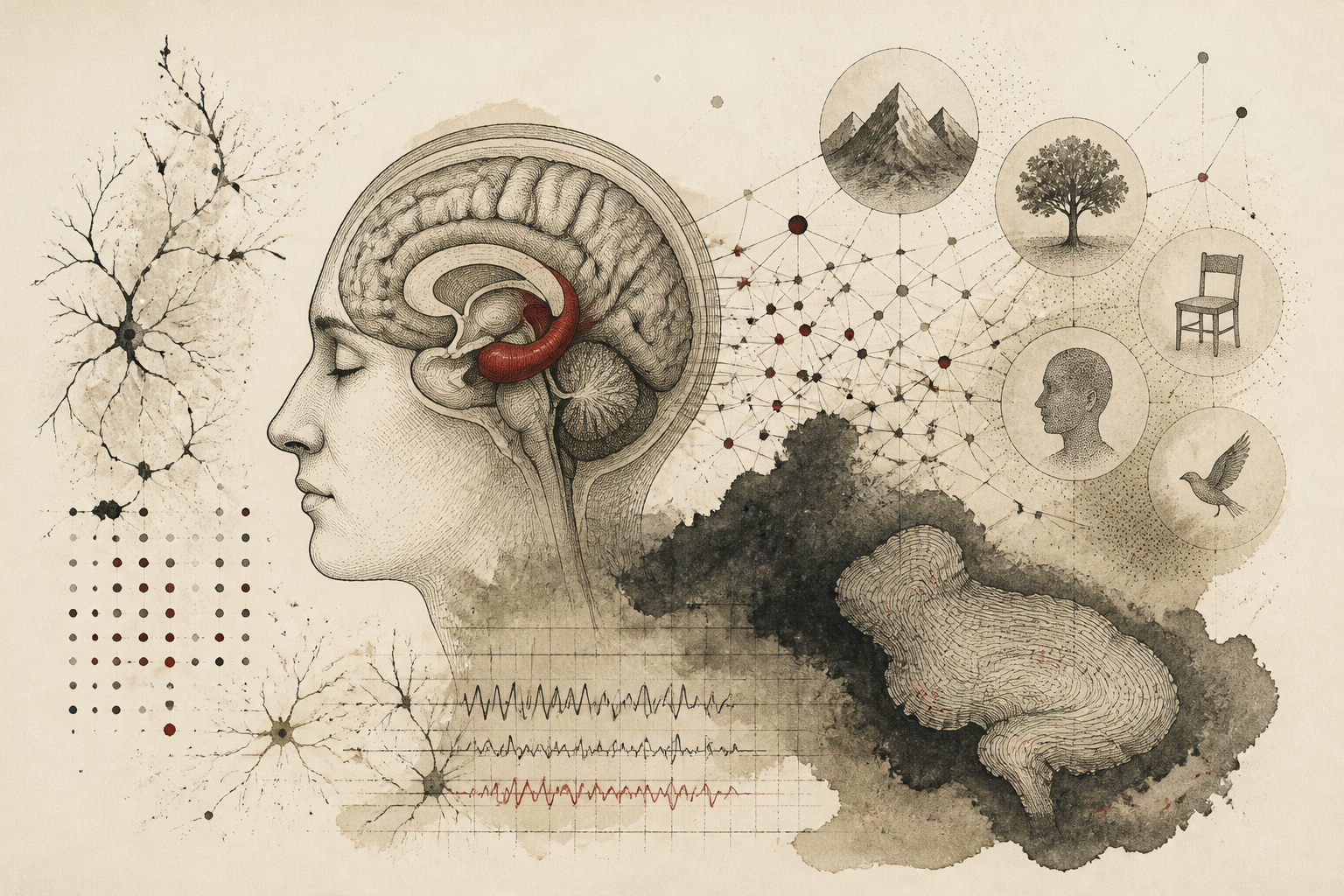
In the complex landscape of cognitive neuroscience, the hippocampus has long been celebrated as the brain’s primary architect for memory and spatial navigation. Traditional models have frequently relegated linguistic processing and semantic storage to the temporal cortex, viewing the hippocampus primarily as a gateway for episodic memories rather than a repository for the abstract meanings of words. However, groundbreaking research recently highlighted by Nature Neuroscience suggests a significant paradigm shift. Evidence now indicates that the human hippocampus employs a sophisticated population code to represent semantic information, effectively creating a conceptual map that allows us to navigate the world of ideas much like we navigate physical space.
This shift in understanding challenges the rigid compartmentalization of brain function. By examining how individual neurons and larger neural populations fire in response to specific words, researchers are uncovering a hidden layer of cognitive architecture. This semantic encoding appears to be fundamental to how we retrieve not just facts, but the interconnected meanings that define human communication. The findings suggest that the hippocampus is not merely a recorder of events but a central hub for the conceptual categorization that underpins our entire linguistic framework.
The Neural Architecture of Abstract Thought
To understand the mechanisms of semantic encoding, it is necessary to examine the foundational theories of hippocampal function. For decades, the dominant theory was centered on the 'cognitive map' hypothesis, which posited that the hippocampus uses place cells to encode spatial locations. This research, as detailed in the Nature Neuroscience report, expands this map into the realm of the abstract. Instead of physical coordinates, the hippocampus appears to map semantic distances between words and concepts. For instance, the neural representation of the word 'violin' would be located closer to 'cello' than to 'truck' within this internal conceptual space.
This population code functions through the coordinated activity of thousands of neurons. Rather than a single cell being responsible for a single concept—a theory often colloquially known as the 'Grandmother Cell' hypothesis—the hippocampus uses distributed patterns. These patterns allow for an incredible degree of flexibility and storage capacity. By utilizing a population code, the brain can represent an almost infinite variety of nuanced meanings by slightly varying the firing patterns of a shared group of neurons. This efficiency explains how humans can rapidly integrate new vocabulary and shifting contexts without overwriting existing knowledge.
Methodology and Data Synthesis
The methodologies employed in these studies typically involve high-resolution neuroimaging and electrophysiological recordings, often conducted in clinical settings with patients undergoing treatment for epilepsy. These settings provide a rare opportunity to observe single-neuron activity in real-time as participants engage in linguistic tasks. According to the data presented in the Nature Neuroscience publication, the researchers monitored neural responses as subjects were presented with various lexical stimuli. By analyzing these responses through computational models, the team could decode the 'semantic similarity' between different words based solely on the neural firing patterns recorded.
One of the most striking aspects of the method is the use of representational similarity analysis. This technique compares the distance between neural patterns to the distance between the meanings of words as defined by linguistic databases. The high degree of correlation found suggests that the hippocampus is actively organizing language based on the inherent relationships between concepts. This process occurs almost instantaneously, suggesting that semantic retrieval is a core, reflexive component of hippocampal activity during language processing.
Interpretation and Semantic Navigation
The interpretation of these findings suggests that the hippocampus acts as a high-dimensional filing system. If the temporal lobe acts as the library where books are stored, the hippocampus serves as the master catalog that understands the thematic links between every volume. This 'semantic navigation' allows the human mind to perform complex inferences. When we hear a word, our hippocampus likely activates a neighborhood of related concepts, priming the brain for expected information and allowing for the fluid transition between ideas that characterizes human conversation.
Furthermore, this research provides a biological basis for how we categorize our experiences. Because the hippocampus is also deeply involved in episodic memory—the memory of specific personal events—the presence of a semantic code suggests that our personal memories are literally woven into the fabric of our general knowledge. We do not remember an event in a vacuum; we remember it through the lens of the semantic categories identified in this study. This integration explains why certain words can trigger vivid personal recollections, as the neural pathways for the definition of the word and the memory of the event are physically and functionally linked within the same hippocampal structures.
Limitations and Future Inquiries
Despite the significance of these findings, the scientific community acknowledges several limitations. The primary challenge remains the nature of the data collection, which often relies on small sample sizes of neurosurgical patients. While these clinical environments provide unparalleled access to neural activity, the brains of patients with chronic epilepsy may function differently than the general population. Therefore, replicating these semantic population codes in broader, non-clinical cohorts using non-invasive technology is a critical next step for the field.
Additionally, there is the question of 'semantic drift.' As language evolves and personal associations change, how does the hippocampal map update itself? The current research provides a snapshot of the code but does not yet explain the longitudinal plasticity of the semantic map. Future studies will need to investigate how learning a second language or suffering from neurodegenerative diseases like Alzheimer’s affects the stability of these population codes. If the hippocampal map begins to degrade, it could explain why semantic loss is often a precursor to broader cognitive decline.
The Broader Impact on Cognitive Science
Why does the discovery of a hippocampal semantic code matter beyond the walls of the laboratory? The implications for medicine and artificial intelligence are profound. In the clinical realm, understanding how the hippocampus encodes meaning could lead to better diagnostic tools for aphasia and other language disorders. If clinicians can identify exactly where the semantic map is failing, they may be able to develop targeted therapies or neural prosthetics to bridge the gaps in a patient's conceptual retrieval.
In the field of technology, these biological insights provide a blueprint for more sophisticated natural language processing. Current AI models use mathematical vectors to represent word meanings, a method that bears a striking resemblance to the population codes identified in Nature Neuroscience. By further aligning machine learning architectures with the hippocampal model of semantic organization, developers may be able to create systems that understand context and nuance with a human-like fluidity. Ultimately, this research brings us one step closer to solving the 'binding problem' of how the brain transforms raw sensory input into the rich, meaningful world of thought and communication.
Quick answers
- What did the Nature Neuroscience study discover about the hippocampus?
- The study found that the human hippocampus uses a population code—the coordinated firing of groups of neurons—to represent the semantic meaning of words and concepts, acting as a conceptual map.
- How does the brain organize the meaning of different words?
- It uses representational similarity, where words with similar meanings trigger similar neural firing patterns in the hippocampus, placing them 'closer' together in a mental map.
- Why is the hippocampus important for language if it's known for memory?
- The research suggests the hippocampus integrates semantic knowledge with episodic memory, allowing us to navigate abstract ideas and retrieve meanings as part of our broader cognitive navigation system.
Rewritten by Zeit editorial AI. Based on original reporting at Nature Neuroscience.