Mapping the Geometric Architecture of Human Task Representation
Researchers identify how cortical network geometry facilitates the flexible transformation of information across the human brain.
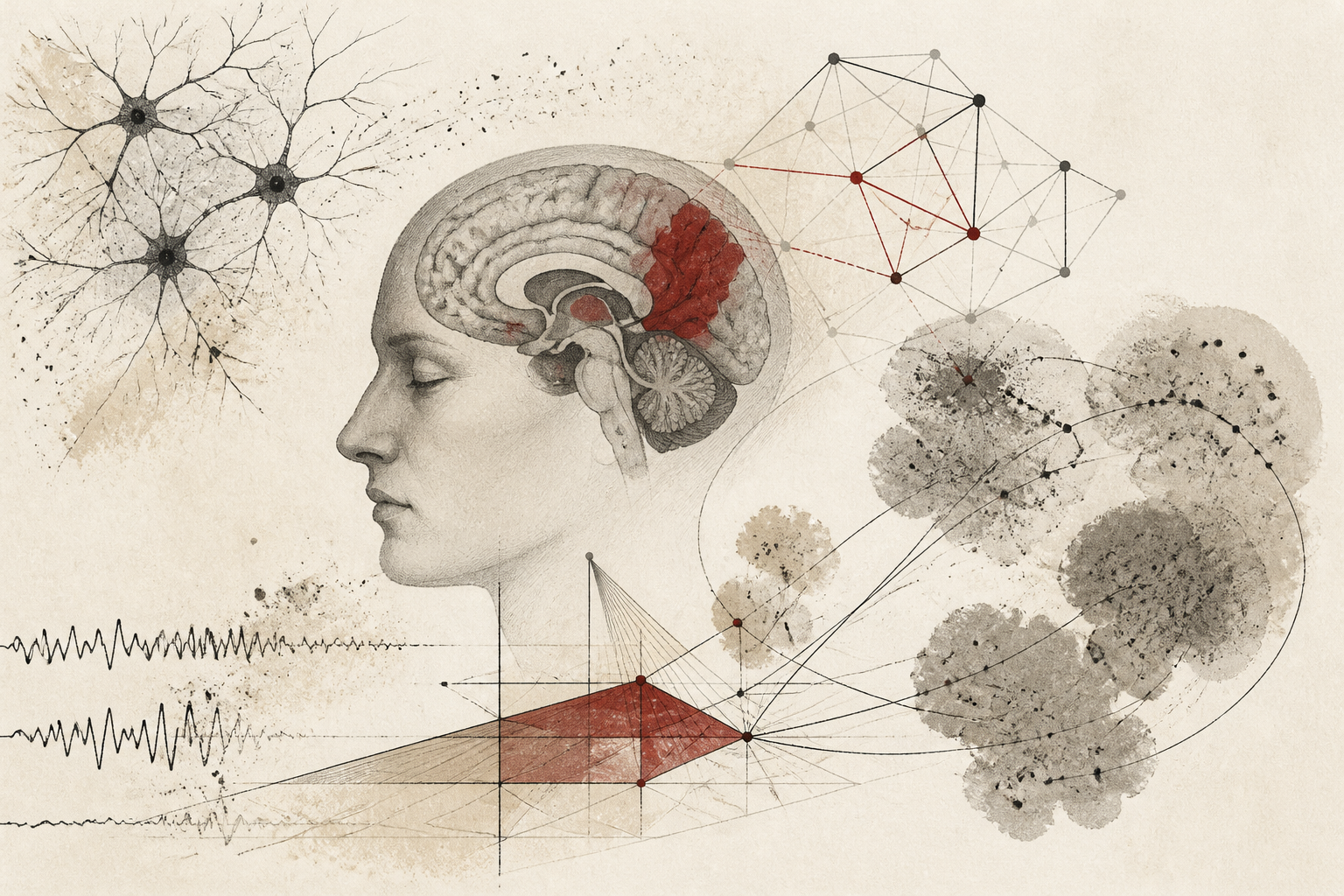
Understanding the mechanism by which the human brain translates sensory input into complex, goal-directed action remains one of the central challenges of modern cognitive neuroscience. While previous research has localized specific functions to discrete cortical regions, the systemic principles governing how these regions interact to transform task-relevant information have remained elusive. A recent study published in Nature Neuroscience, titled "Network geometry shapes the transformation of task representations across the human cortex," offers a sophisticated framework for understanding this process. The researchers argue that the geometric arrangement of neural networks is not merely an anatomical byproduct but a fundamental driver of how representations are modified as they move through the cortical hierarchy.
At the core of this investigation is the concept of representational geometry—a method of quantifying how the brain organizes information in high-dimensional neural space. By examining how these geometries shift across different brain networks, the study provides a roadmap for the neural computations that allow humans to switch between diverse tasks, such as linguistic processing, mathematical reasoning, and motor execution. The findings suggest that the brain utilizes a structured, hierarchical transformation of these geometries to balance the need for specialized processing with the requirement for integrated, global communication.
The Hierarchical Transformation of Neural Representations
The study’s primary findings revolve around the systematic alteration of neural patterns as they progress from primary sensory areas to the association cortex. The researchers utilized high-resolution functional magnetic resonance imaging (fMRI) data to track how task-related information is encoded across various cortical networks. They observed that the "shape" of these representations—defined by the distances and relationships between different task states in neural space—undergoes a predictable evolution. In early sensory regions, representations are closely tied to the physical properties of the stimuli. However, as information migrates toward the prefrontal and parietal cortices, these representations are reshaped to reflect abstract task rules and goals.
This transformation is not haphazard. The researchers identified a clear gradient of geometric complexity. In lower-level networks, the neural geometry is optimized for discriminability, allowing the brain to distinguish between subtle sensory differences. In contrast, higher-level association networks exhibit a more compressed and task-aligned geometry. This compression facilitates generalization, enabling the individual to apply learned rules across different contexts. The study demonstrates that this geometric reshaping is a prerequisite for complex cognition, as it allows the brain to filter out irrelevant sensory noise and focus on the variables critical for decision-making. By mapping these changes, the authors provide evidence that the brain’s architecture is specifically tuned to support the fluid transformation of data into actionable knowledge.
Mechanisms of Geometric Control and Network Topology
To understand the underlying mechanism of these transformations, the study employed a combination of representational similarity analysis and manifold learning. The researchers focused on how the intrinsic topology of cortical networks—the way different regions are connected—constrains the possible geometries that task representations can take. They discovered that the network’s "connectivity fingerprint" acts as a scaffold. This scaffold determines the degree to which a representation can be expanded or compressed as it moves through the system. Specifically, the study highlights the role of hub regions in the multimodal association cortex, which serve as geometric integrators.
These hub regions possess a unique connectivity profile that allows them to receive inputs from multiple sensory modalities and reconfigure them into a unified task space. The methodology involved analyzing how the dimensionality of neural signals changes across the cortex. In regions with high local connectivity, the dimensionality tends to be higher, preserving detail. In regions that serve as bridges between networks, the dimensionality is strategically reduced. This reduction is not a loss of information but a sophisticated distillation process. The research suggests that the brain’s geometric transformations are governed by a principle of "efficient coding," where the network geometry is optimized to represent task variables with the minimum amount of neural resources required for accurate performance.
Interpretations of Computational Efficiency
The interpretation of these results points toward a new understanding of the brain as a geometric engine. Traditional views of brain function often emphasize the "what" and "where" of neural activity—what a region does and where it is located. This research shifts the focus to the "how" of representational transition. By showing that network geometry shapes the transformation of information, the study suggests that the physical and functional layout of the brain is an active participant in computation. The researchers interpret the observed geometric shifts as a biological solution to the problem of interference. By separating task representations into different geometric planes or manifolds, the brain can process multiple streams of information simultaneously without them becoming entangled.
Furthermore, the study suggests that the flexibility of human intelligence may stem from the ability of these geometric manifolds to be dynamically reconfigured. While the anatomical network provides the broad constraints, the specific task demands can "tilt" or "warp" the geometry to prioritize certain types of information. This provides a compelling explanation for how humans can rapidly switch from a verbal task to a visual one; the brain is not just activating different areas, but is fundamentally reshaping the geometry of its internal representations to suit the new cognitive landscape. This perspective aligns with emerging theories in artificial intelligence, where representational geometry is also a key factor in the performance of deep neural networks.
Limitations and Future Directions in Network Neuroscience
Despite the significant advances presented in the Nature Neuroscience report, several limitations and open questions remain. One primary constraint is the temporal resolution of fMRI. While fMRI is excellent for mapping the spatial geometry of the brain, it lacks the millisecond-by-millisecond precision required to see how these geometries evolve in real-time during fast decision-making processes. Future research utilizing magnetoencephalography (MEG) or electroencephalography (EEG) could complement these findings by providing a temporal dimension to the geometric transformations. Additionally, the study focused primarily on healthy adult populations. It remains to be seen how representational geometry is altered in neurodevelopmental conditions or neurodegenerative diseases, where network connectivity is known to be compromised.
Another open question involves the role of subcortical structures. The current study focuses largely on the human cortex, yet structures like the thalamus and basal ganglia play vital roles in gating information flow and modulating cortical activity. Investigating how subcortical-cortical loops influence geometric transformations will be essential for a holistic model of brain function. Furthermore, while the researchers identified the patterns of transformation, the exact cellular-level mechanisms that implement these geometric changes—such as synaptic weighting or inhibitory interneuron activity—require further exploration through translational models or advanced computational simulations.
Implications for Cognitive Science and Neurotechnology
The significance of this research extends beyond basic neuroscience into the realms of clinical application and artificial intelligence. By identifying the geometric signatures of efficient task transformation, researchers may develop new diagnostic tools for cognitive disorders. For example, if a specific condition is characterized by a failure to compress task representations in the association cortex, this could serve as a biomarker for executive dysfunction. Understanding the "geometry of health" in the brain provides a benchmark against which pathological states can be measured.
In the field of neurotechnology, these findings could inform the development of more sophisticated brain-computer interfaces (BCIs). If we understand the geometric language the brain uses to transform intentions into actions, BCIs could be designed to decode these manifolds more accurately, leading to smoother and more intuitive control of assistive devices. Ultimately, the work published in Nature Neuroscience underscores a fundamental shift in the field: the move toward viewing the brain not as a collection of parts, but as a dynamic, geometric system where the very shape of information is the key to human intelligence.
Quick answers
- What is representational geometry in neuroscience?
- It is a method of quantifying how the brain organizes information by measuring the mathematical relationships and distances between different neural activity patterns in a high-dimensional space.
- How does the human brain transform task information across different regions?
- The brain reshapes the 'geometry' of information as it moves from sensory areas to the association cortex, shifting from detailed sensory-based patterns to compressed, abstract task-related representations.
- What role does network topology play in brain function according to the study?
- Network topology acts as a structural scaffold that constrains and directs how neural representations are expanded or compressed, facilitating efficient information processing.
Rewritten by Zeit editorial AI. Based on original reporting at Nature Neuroscience.