Mapping the Genomic Landscape: How Polygenic Variants Shape the Five Factors of Personality
A massive genome-wide association study identifies 1,260 genetic loci influencing personality, demonstrating that human character emerges from thousands of minor molecular variations.
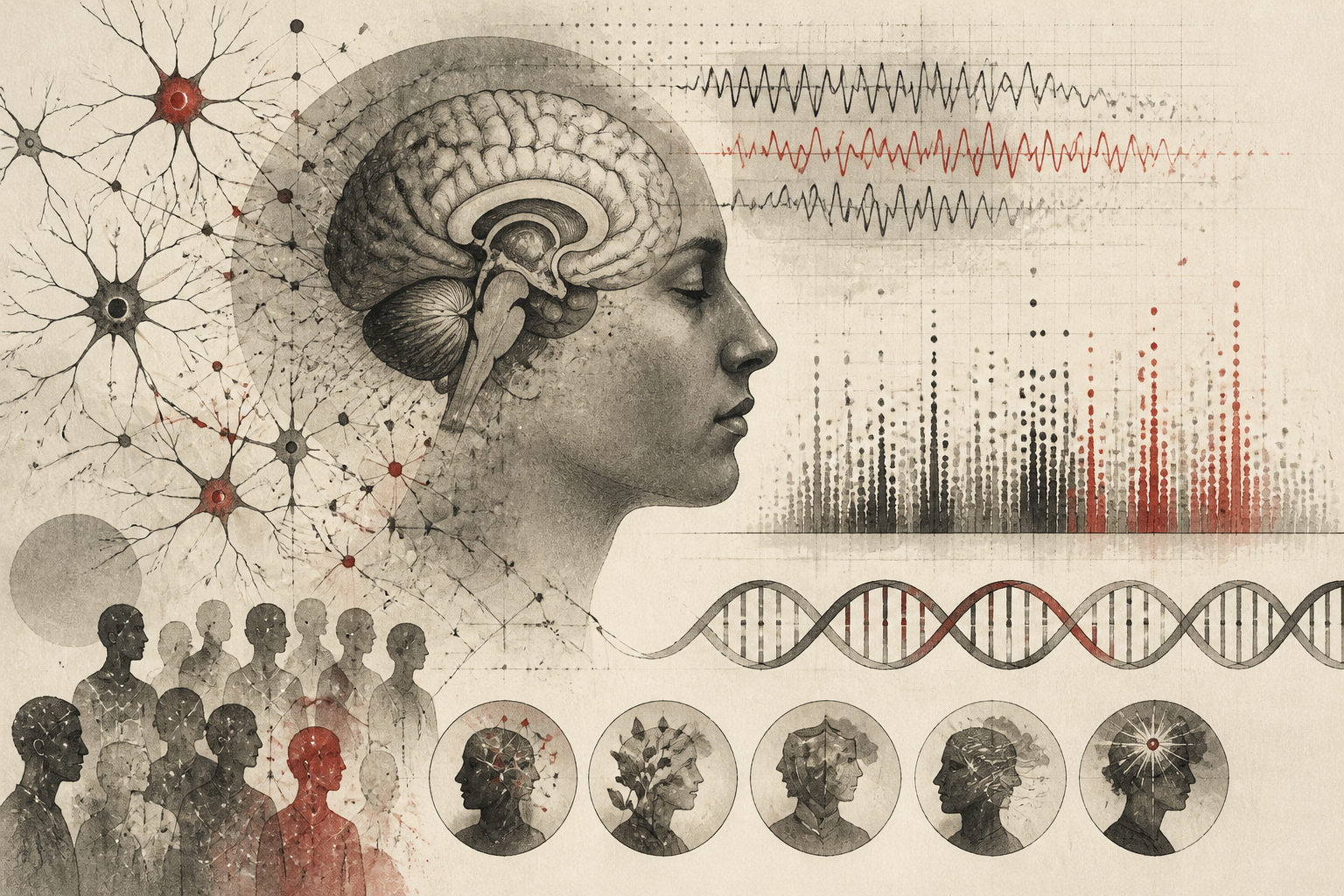
The perennial debate regarding nature versus nurture has long suggested that human personality exists at the intersection of biological predisposition and environmental influence. However, the precise molecular architecture underlying why one individual gravitates toward social engagement while another prefers solitary reflection has remained largely elusive. A landmark study published in the journal Nature, based on data from over one million participants, has provided the most comprehensive map to date of the genetic blueprint of human personality. By identifying 1,260 specific genetic variants associated with the Big Five personality traits, the research confirms that there is no single master switch for character. Instead, the study reveals that human personality is a polygenic phenomenon, driven by the additive effects of thousands of tiny DNA differences that interact with life experiences to mold the individual.
Historically, psychologists and geneticists have struggled to pin down the heritability of personality traits due to the immense complexity of the human genome and the subtle effects of individual genes. Early candidate gene studies often failed to replicate, leading to a shift toward large-scale genome-wide association studies (GWAS). This new research, reported by NeuroscienceNews.com, represents a significant leap in scale and resolution. By leveraging massive biobanks and self-reported personality assessments, the international research team was able to sift through millions of genetic markers to find those that consistently correlate with Openness, Conscientiousness, Extraversion, Agreeableness, and Neuroticism. The findings suggest that while our genetic code does not dictate our destiny, it provides a foundational scaffolding upon which the environment builds the nuances of character.
The Architecture of the Polygenic Character
The central finding of this massive analysis is the identification of 1,260 genomic loci that reach the threshold for statistical significance in relation to personality. These loci are not localized to a specific region but are distributed across the entire genome, reinforcing the idea that personality is a systemic rather than a localized trait. For years, the scientific community sought a single gene for being outgoing or a specific mutation that caused anxiety. This study effectively puts those notions to rest, demonstrating that each of the identified genetic variants contributes only a miniscule amount to the overall variance of a trait. When these variants are aggregated into a polygenic score, they begin to explain a measurable portion of why people differ in their behavioral tendencies.
Specifically, the study looked at the Big Five model, which remains the gold standard in psychological assessment. The researchers found that the genetic architecture for these traits overlaps significantly with other complex phenotypes. For example, the genetic markers associated with high levels of Neuroticism often overlap with those linked to depression and anxiety disorders. Conversely, the genetic variants for Extraversion and Conscientiousness show correlations with positive health outcomes and longevity. This suggests that the same biological pathways that influence how we perceive and interact with the world also play a role in our broader physical and mental health. The findings underscore the reality that personality is not merely a social construct but a biological reality deeply embedded in our cellular functioning.
Mechanisms of Genetic Influence and Developmental Pathways
To understand how these 1,260 variants translate into behavior, it is necessary to examine the biological pathways involved. The study indicates that many of the identified genetic variants are located in or near genes that are highly expressed in the brain, particularly in regions responsible for emotional regulation, reward processing, and executive function. These include the prefrontal cortex and the amygdala, which are critical for decision-making and the processing of social cues. The genetic blueprint appears to influence the density of neurotransmitter receptors and the efficiency of synaptic signaling, thereby setting the baseline for how an individual responds to external stimuli.
Furthermore, the methodology of this study highlights the importance of the environment in activating or suppressing these genetic predispositions. The researchers emphasize that the 1,260 variants do not act in a vacuum. Instead, they interact with environmental factors—such as upbringing, education, and traumatic events—in a process known as gene-environment interaction. A person might possess a high genetic load for Neuroticism, but in a stable and supportive environment, those genes may never manifest as a clinical disorder. This dynamic suggests that the genetic blueprint is more of a set of probabilities than a fixed script. The scale of the study allowed researchers to see past the noise of individual life stories to find the underlying signal of these biological tendencies across a massive global cohort.
Interpretation, Limitations, and Ethical Considerations
While the identification of over a thousand genetic loci is a monumental achievement, the researchers urge caution in how these results are interpreted. Even with 1,260 variants, the total amount of personality variance explained by these genetic markers remains relatively small—typically in the range of a few percentage points for each trait. This phenomenon, known as the missing heritability problem, suggests that there are likely tens of thousands of additional variants with even smaller effects that have yet to be discovered. Additionally, the study relied heavily on populations of European ancestry, which limits the generalizability of the findings to other global populations. Diversity in genetic research is crucial to ensure that the findings reflect the full spectrum of human biology.
There are also significant ethical questions raised by the ability to predict personality traits from DNA. As polygenic scores become more accurate, there is a risk of genetic determinism, where individuals might be judged or pigeonholed based on their biological profile. If an employer or an insurance company could theoretically assess a person's genetic predisposition for Conscientiousness or Neuroticism, it could lead to new forms of discrimination. The researchers stress that their work is intended to advance basic science and improve mental health outcomes, not to provide a tool for social engineering. The complexity of the interaction between genes and environment means that a person's genetic score will never be a perfect predictor of their actual behavior.
Future Horizons in Personality Neuroscience
The significance of this study extends far beyond the list of 1,260 variants. It provides a roadmap for the future of personalized medicine and psychological intervention. By understanding the biological foundations of personality, clinicians may eventually be able to tailor therapies to an individual’s specific genetic profile. For instance, a person with a high genetic predisposition for Neuroticism might benefit more from specific types of cognitive-behavioral therapy or pharmacological interventions that target the underlying pathways identified in this research. The study also opens the door to investigating how personality changes over the lifespan and how genetic influences might wax or wane as we age.
In conclusion, the mapping of the genetic blueprint of personality marks a turning point in our understanding of the human condition. It confirms that we are neither blank slates nor biological automatons. Instead, we are the product of a complex, ongoing dialogue between our DNA and the world we inhabit. As the findings from NeuroscienceNews.com and the Nature study suggest, our character is woven from thousands of tiny molecular threads, each contributing to the unique tapestry of who we are. The challenge for future researchers will be to further decode these signals while navigating the profound ethical and social implications of having the keys to our own biological code.
Quick answers
- Is there a single gene that determines if someone is an extrovert?
- No, there is no single 'extraversion gene.' Research shows that personality is polygenic, influenced by thousands of tiny genetic differences across the genome.
- How many genetic variants were linked to personality in the Nature study?
- The study identified 1,260 specific genetic loci that correlate with the Big Five personality traits.
- Do these genetic findings mean personality is unchangeable?
- No. The study emphasizes that these genetic variants interact with life experiences and environment to shape character, suggesting that genetics provide a baseline rather than a fixed outcome.
Rewritten by Zeit editorial AI. Based on original reporting at NeuroscienceNews.com.