Mapping the Genomic Architecture of Somatosensation: The Role of the Creld1 Gene
Researchers have identified the Creld1 gene as a fundamental regulator of touch sensitivity and cross-modal sensory processing in new behavioral genomics research.
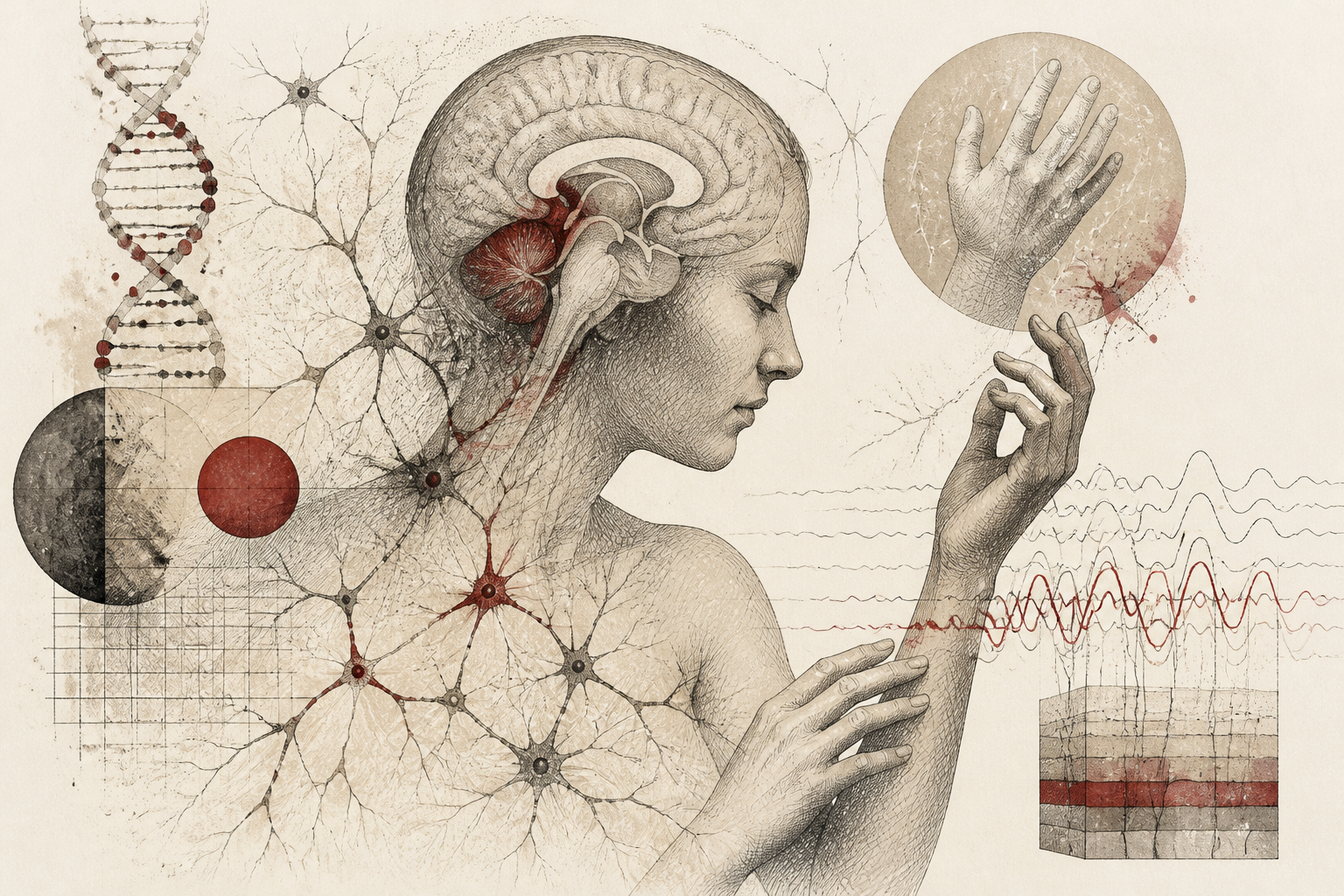
In the complex landscape of sensory biology, the ability of an organism to perceive and respond to tactile stimuli—somatosensation—remains one of the most vital yet genetically elusive functions. While much is known about the peripheral receptors that detect pressure or temperature, the underlying genomic regulators that dictate individual variance in touch sensitivity have long remained obscured. However, a significant study recently published in Nature Neuroscience has brought these hidden mechanisms into sharper focus. By employing an expansive behavioral genomics approach, researchers have identified the gene Creld1 as a cross-modal regulator of somatosensation. This discovery not only sheds light on the genetic blueprints of physical sensation but also offers a potential framework for understanding how sensory processing is integrated across different modalities in the mammalian nervous system.
The Genomic Landscape of Sensory Perception
Somatosensation is a multifaceted sensory system that encompasses the perception of touch, pain, temperature, and body position. In humans and other mammals, the range of sensitivity to these stimuli varies significantly between individuals. Some individuals exhibit heightened sensitivity to light touch, while others may require more intense stimulation to trigger a response. Traditionally, neuroscience has attributed these differences to the density of peripheral nerve endings or the structural properties of the skin. However, these physiological explanations do not fully account for the heritable component of sensory thresholds. The research team behind the Nature Neuroscience report sought to bridge this gap by investigating the specific genes that govern the development and function of somatosensory pathways.
To achieve this, the researchers utilized a massive behavioral screening process, integrating genomic data with high-throughput sensory testing. The study focused on identifying quantitative trait loci (QTLs)—sections of DNA that correlate with a particular phenotypic trait. By observing how variations in the genome corresponded to variations in tactile behavior, the team was able to pinpoint Creld1 (Cysteine-Rich with EGF-Like Domains 1) as a candidate of primary interest. Before this study, Creld1 was largely known for its role in heart development and its association with certain cardiac defects; its involvement in the nervous system’s processing of tactile information represents a major shift in our understanding of the gene’s biological utility.
Mechanisms of Cross-Modal Regulation
The most striking finding of the research is that Creld1 does not operate in a vacuum. Rather than acting as a simple switch for one type of sensation, it appears to function as a cross-modal regulator. In the context of this study, cross-modal regulation refers to the gene's ability to influence multiple aspects of sensory input and processing simultaneously. The researchers found that Creld1 expression levels in specific neuronal populations were directly proportional to the organism's sensitivity to mechanical stimuli. When Creld1 function was modulated, it led to observable changes in how the brain processed tactile signals, suggesting that the gene is integral to the "tuning" of the somatosensory system.
Methodologically, the study employed a sophisticated array of tools, including CRISPR-Cas9 gene editing, RNA sequencing, and advanced behavioral assays. By knocking down Creld1 in specific mouse models, the scientists observed a significant reduction in sensitivity to mechanical touch. Conversely, the presence of specific Creld1 variants was associated with heightened responsiveness. The data indicated that the gene is active both in the peripheral sensory neurons and within the central nervous system, particularly in areas responsible for the initial integration of sensory data. This dual presence suggests that Creld1 helps coordinate the flow of information from the skin to the brain, ensuring that sensory signals are neither lost in transit nor amplified to the point of discomfort.
Interpretation and Physiological Implications
The identification of Creld1 as a somatosensory regulator carries deep implications for the field of behavioral genomics. It suggests that our sensory experience is not merely a byproduct of environment or physical anatomy, but is strictly governed by a genetic rheostat. The study’s findings imply that Creld1 may influence the development of the synapse—the junction between neurons—where sensory information is transmitted. By regulating the efficiency of these synapses, Creld1 effectively sets the "gain" for the entire somatosensory system.
Furthermore, the cross-modal nature of this regulation suggests that the genetic mechanisms underlying touch may be shared with other sensory systems. While the study primarily focused on somatosensation, the researchers noted that the pathways influenced by Creld1 are also involved in the processing of other stimuli. This raises the possibility that certain individuals are genetically predisposed to be "sensory seekers" or "sensory avoiders" across multiple domains—including sight and sound—due to the activity of a small set of regulatory genes. The study thus provides a genetic basis for the observation that sensory sensitivities often cluster together in clinical and non-clinical populations.
Limitations and Future Research Directions
Despite the breakthrough, the researchers are careful to note the limitations of the current findings. While Creld1 has been identified as a key player, it is unlikely to be the sole determinant of somatosensation. The sensory system is polygenic, meaning it is influenced by the interaction of hundreds, if not thousands, of genes. The current study identifies a major node in this network, but the full map of genetic interactions remains to be charted. Additionally, because the primary models used were rodents, further research is required to confirm the extent to which these findings translate to human physiology. While the Creld1 gene is highly conserved across species, the complexity of human psychological perception of touch involves higher-order cognitive processes that are difficult to replicate in animal models.
Open questions also remain regarding the specific molecular signaling pathways that Creld1 activates. Does it interact with specific ion channels, or does it influence the structural growth of dendrites? Determining the exact biochemical steps between gene expression and behavioral response will be the next frontier for this research group. Moreover, the link between Creld1 and neurodevelopmental conditions characterized by sensory processing issues—such as autism spectrum disorder or sensory processing disorder—remains an area ripe for exploration. If Creld1 is indeed a master regulator of sensory gain, it could become a target for future therapeutic interventions aimed at modulating sensory hypersensitivity.
Why Behavioral Genomics Matters
The work published in Nature Neuroscience represents a milestone in the effort to decode the biological basis of behavior. By moving from broad behavioral observations to specific genetic markers, researchers are beginning to understand why the world feels different to different people. For the academic community at Zeit Psychology Online University, this research underscores the necessity of an interdisciplinary approach that combines genetics, neuroscience, and behavioral psychology. As we continue to uncover genes like Creld1, we move closer to a personalized understanding of human experience, where an individual's sensory profile can be understood at the molecular level. This study stands as a testament to the power of behavioral genomics to illuminate the invisible forces that shape our interaction with the physical world.
Quick answers
- What is the primary role of the Creld1 gene according to recent research?
- Recent research identifies Creld1 as a cross-modal regulator of somatosensation, meaning it helps govern the body's sensitivity to touch and how that sensory information is processed.
- How did researchers identify Creld1's function in the sensory system?
- Scientists used behavioral genomics and quantitative trait loci (QTL) mapping to correlate specific genetic variations with differences in tactile behavior and sensitivity.
- What are the implications of Creld1 being a cross-modal regulator?
- It suggests that the gene influences multiple sensory pathways simultaneously, potentially setting the 'gain' or sensitivity level for various types of sensory input across the nervous system.
Rewritten by Zeit editorial AI. Based on original reporting at Nature Neuroscience.