Mapping the Claustrum: Neuroimaging Reveals Key Role in Uncertainty and Prediction Error
Recent research published in Nature Neuroscience identifies the human claustrum as a central hub for monitoring environmental volatility and internal predictive accuracy.
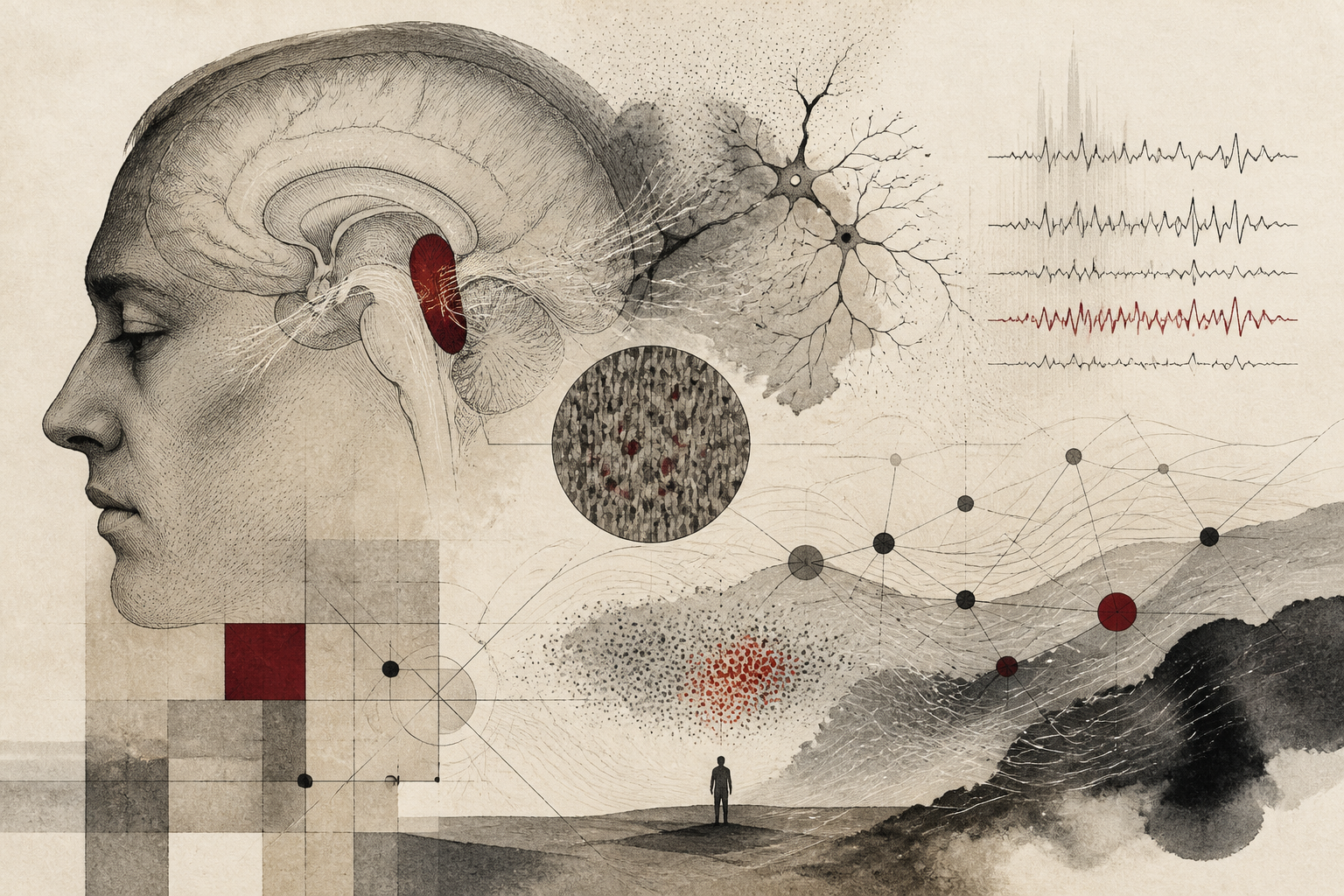
In the complex architecture of the human brain, few structures have remained as enigmatic as the claustrum. Tucked beneath the neocortex, this thin, irregular sheet of neurons has long fascinated neuroanatomists due to its extensive connectivity with almost every other region of the brain. While historic hypotheses suggested the claustrum served as a seat of consciousness or a central conductor of sensory information, empirical data has frequently lagged behind theoretical speculation. However, a significant study published in *Nature Neuroscience* provides a new empirical foundation for understanding this structure. The research demonstrates that the human claustrum plays a specialized role in tracking uncertainty and prediction errors, acting as a critical monitor for the brain’s internal models of the world.
At its core, the study investigates how the brain manages the constant influx of sensory data that may or may not align with expectations. Human cognition is increasingly understood as a predictive process; the brain does not merely react to the environment but actively anticipates it. When these anticipations fail, the resulting discrepancy is known as a prediction error. The findings reported by the research team suggest that the claustrum is uniquely positioned to manage these errors, particularly when the environment becomes volatile or unpredictable. By shifting the focus from consciousness to information processing, the study offers a paradigm shift in claustrum research.
Methodological Approaches to an Enigmatic Structure
The difficulty in studying the claustrum historically stems from its morphology. Because it is an extremely narrow, elongated structure, traditional functional magnetic resonance imaging (fMRI) often lacks the resolution to isolate its activity from the neighboring insular cortex and putamen. To overcome these technical hurdles, the researchers employed high-resolution neuroimaging combined with sophisticated computational modeling. This dual approach allowed the team to dissociate the signals originating specifically within the claustrum from those in the surrounding gray matter.
Participants in the study engaged in tasks designed to manipulate levels of uncertainty and the frequency of unexpected outcomes. By creating an environment where the probability of certain rewards or stimuli changed over time, the researchers could observe how the claustrum responded to different degrees of environmental stability. The computational models used were essential for quantifying 'prediction error' and 'uncertainty' as distinct mathematical variables. These variables were then regressed against the fMRI data to identify which brain regions tracked these specific metrics. The results pinpointed the claustrum as a primary node that scaled its activity in direct response to the magnitude of the surprise experienced by the participant.
Decoding Uncertainty and Prediction Error
The most striking finding of the research is the claustrum’s dual sensitivity. It does not simply react when a mistake is made; rather, it appears to monitor the reliability of the environment itself. In neurobiological terms, the study found that the claustrum tracks 'expected uncertainty'—the known unknowns where a subject realizes the environment is noisy—and 'unexpected uncertainty,' which occurs when a fundamental shift in environmental rules takes place. This suggests that the claustrum functions as a high-level oversight mechanism that alerts the rest of the cortex when internal predictions are no longer reliable.
Furthermore, the researchers observed that the claustrum’s activity patterns were distinct from those found in the anterior cingulate cortex or the insula, regions also known for error monitoring. While the insula often responds to the physiological or emotional salience of an error, the claustrum appears to represent the informational value of the error. It provides a computational signal that indicates the need for the brain to update its internal maps. This distinction is vital for understanding the hierarchy of the human brain's executive functions. The claustrum acts less like a sensory relay and more like an analytical filter that determines when a discrepancy between expectation and reality is significant enough to warrant a change in behavior or attention.
Limitations and Theoretical Implications
Despite the precision of the high-resolution fMRI utilized in this study, the researchers acknowledge several inherent limitations. The claustrum is a highly heterogeneous structure, and current imaging technology, while advanced, may still struggle to differentiate between its various sub-territories. It remains unclear whether different portions of the claustrum handle different sensory modalities or if the entire structure acts as a unified monitor for all types of prediction errors. Additionally, because the study relied on correlational fMRI data, it cannot definitively prove a causal link. While the claustrum tracks these signals, further research using methods like transcranial magnetic stimulation or studies of patients with localized claustrum lesions would be necessary to confirm that the structure is essential for these processes.
Another open question involves the claustrum’s output. While the study clarifies what information the claustrum receives and processes, it remains to be seen how this information is disseminated to the rest of the brain to effect change. If the claustrum signals that uncertainty is high, how does it physically 'instruct' the prefrontal cortex to switch strategies? The mechanism of this communicative broadcast remains a frontier for future investigation. The researchers suggest that the claustrum’s unique cellular makeup, including its 'crown-of-thorns' neurons that project widely across the cortex, likely facilitates this rapid distribution of uncertainty signals.
The Broader Impact on Cognitive Science
Why does the identification of the claustrum’s role in uncertainty matter to the broader scientific community? The implications extend beyond basic anatomy into the realms of psychiatry and artificial intelligence. Many neurological and psychiatric conditions, such as schizophrenia and anxiety disorders, are characterized by an inability to accurately process uncertainty or a tendency to over-respond to prediction errors. If the claustrum is indeed the hub for these calculations, it may become a target for future therapeutic interventions aimed at stabilizing the brain's predictive mechanisms.
Moreover, the study contributes to our understanding of the 'Bayesian Brain' hypothesis, which posits that the human mind functions as a statistical engine. By locating a specific hardware component for these statistical calculations, the research bridges the gap between abstract mathematical theories of cognition and concrete neurobiology. As we continue to map the functions of the claustrum, we move closer to a unified theory of how the human brain maintains a coherent sense of reality in a constantly changing world. This study, as reported in *Nature Neuroscience*, serves as a pivotal step in transforming the claustrum from a mysterious 'black box' into a clearly defined pillar of the human cognitive architecture.
Quick answers
- What is the claustrum and why is it difficult to study?
- The claustrum is a thin, hidden layer of neurons in the brain with connections to many other regions. It is difficult to study because its narrow shape makes it hard to isolate from surrounding tissue using standard brain scans.
- How does the claustrum respond to uncertainty according to the latest research?
- Research shows the claustrum tracks both 'expected' and 'unexpected' uncertainty, acting as a monitor that signals when the environment changes or when internal predictions are incorrect.
- What are the potential medical implications of these claustrum findings?
- Understanding how the claustrum processes errors could lead to new treatments for disorders like schizophrenia or anxiety, where the brain's ability to handle uncertainty is impaired.
Rewritten by Zeit editorial AI. Based on original reporting at Nature Neuroscience.