Mapping Neurotransmitter Interactions: The Impact of Fiber Density on Sensor Accuracy
Recent findings in Nature Neuroscience highlight how local innervation density influences the crosstalk between dopamine and norepinephrine sensors.
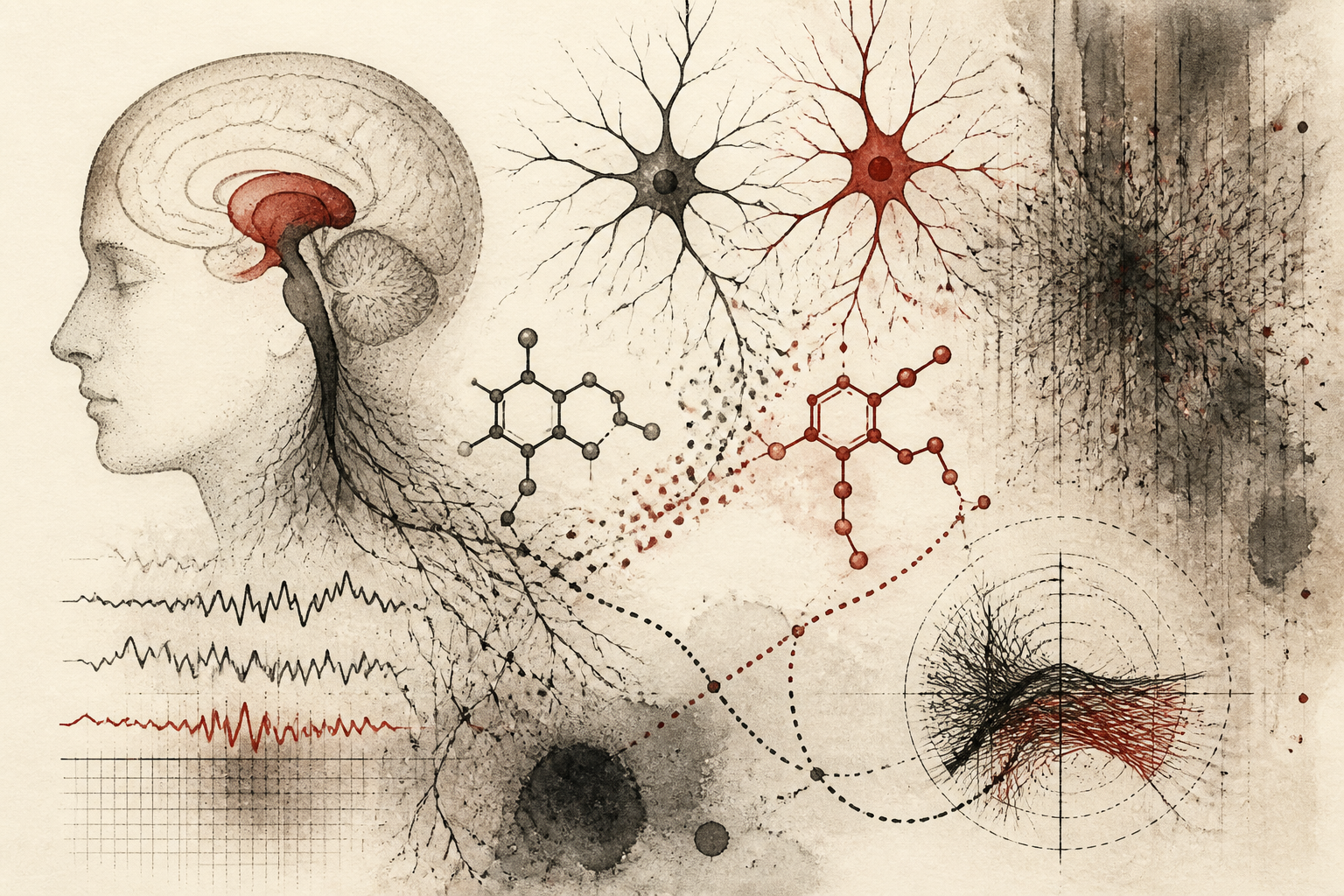
A recent investigation published in *Nature Neuroscience* offers crucial insights into the complexities and constraints inherent in molecular sensing technologies employed to observe brain activity. This study, bearing the title "Norepinephrine and dopamine sensor crosstalk depends on local innervation density," directly confronts a persistent challenge in neurobiology: the inherent difficulty in differentiating between chemically analogous monoamines in real-time measurements. The research specifically explored the extent of signal interference, termed 'crosstalk,' occurring between sensors engineered to detect dopamine and norepinephrine, two vital neuromodulators. The findings suggest that the accuracy of these sophisticated tools is not uniformly distributed across brain regions but is instead intimately tied to the local architectural landscape of neural innervation.
Unpacking the Challenge of Neurotransmitter Specificity
The brain's intricate signaling networks rely on a diverse array of neurotransmitters, each with specific roles in modulating mood, cognition, movement, and reward. Among these, the monoamines, such as dopamine and norepinephrine, are particularly challenging to study with high fidelity *in vivo*. Their chemical structures are remarkably similar, leading to an inherent susceptibility for molecular sensors to misidentify one for the other. This phenomenon, known as crosstalk, has long cast a shadow over the interpretation of data gathered through real-time neurochemical monitoring. Previous research has often grappled with this issue, employing various strategies to enhance sensor selectivity, yet a comprehensive understanding of the contextual factors influencing this specificity has remained elusive. The ability to precisely delineate the activity of individual neurotransmitters is paramount for accurately dissecting their distinct contributions to neurological function and dysfunction.
Local Architecture Dictates Sensor Accuracy
The research team employed cutting-edge genetically encoded sensors to monitor neurotransmitter release across diverse brain regions. Their central discovery reveals that the accuracy of these sensors is not a universal constant but is profoundly influenced by the local innervation density—the concentration of nerve fibers—within specific anatomical zones. This finding represents a significant advancement, moving beyond a purely chemical understanding of sensor performance to incorporate the crucial element of biological context. In brain regions characterized by a high relative density of norepinephrine-producing neurons compared to dopamine-producing neurons, the sensors exhibited a notable decline in specificity. This loss of specificity manifested as a blending of chemical signals, indicating that the sensor was not reliably distinguishing between dopamine and norepinephrine in these architecturally specific environments. This implies that the spatial organization of neural projections directly impacts the functional performance of molecular probes.
The Mechanism of Crosstalk in Dense Innervation
While the study did not explicitly detail the precise molecular mechanism by which high innervation density leads to increased crosstalk, several possibilities can be inferred. In regions with a dense co-localization of dopamine and norepinephrine terminals, the sheer proximity and concentration of release sites could overwhelm the sensor's capacity for selective binding. Even highly selective sensors are not perfectly exclusive; they possess a finite, albeit high, affinity for their intended target but may still exhibit a lower, yet measurable, affinity for chemically similar molecules. When the concentration of the "off-target" neurotransmitter is exceptionally high due to dense innervation, even this lower affinity can lead to significant binding and thus signal detection, effectively registering as a false positive or an ambiguous signal. Furthermore, the kinetics of release and reuptake in densely innervated areas might also play a role, potentially leading to transiently high local concentrations of both monoamines that could further confound sensor discrimination. The interplay between sensor affinity, local neurotransmitter concentrations, and the dynamics of release and clearance likely contributes to the observed crosstalk.
Implications for Neurochemical Interpretation
This research carries significant weight for the academic community and indeed for anyone engaged in neurochemical research. The revelation that previous interpretations of neurochemical data might require re-evaluation based on regional brain architecture is profound. It compels a reconsideration of findings from studies that utilized similar molecular sensing technologies without explicitly accounting for local innervation densities. What might have been attributed solely to dopamine activity in a specific region, for instance, could, in fact, have been a blended signal reflecting contributions from both dopamine and norepinephrine, particularly in areas with dense noradrenergic projections. This underscores a fundamental principle: the biological context of the tissue is as crucial as the inherent chemical sensitivity of the measurement tool itself. By systematically integrating the physical density of neural projections into experimental design and data analysis, researchers can significantly enhance the calibration of their instruments, thereby mitigating the risk of false positives and achieving a more veridical representation of neurochemical dynamics.
Limitations and Future Directions
While providing critical insights, the study inherently presents avenues for future research. One limitation could be the specific set of genetically encoded sensors utilized; exploring a broader range of sensor designs with varying affinities and selectivities could further refine our understanding of this crosstalk phenomenon. The study also prompts questions about the precise quantitative relationship between innervation density and the degree of crosstalk, which could be explored through systematic anatomical mapping alongside sensor deployment. Furthermore, investigating whether other factors, such as the temporal dynamics of neurotransmitter release or the presence of neuromodulators, also influence sensor specificity in densely innervated regions would be a valuable next step. Understanding how these factors interact could lead to the development of even more robust and context-aware sensing technologies.
Why This Matters for Zeit University Students and Clinicians
For students and clinicians within the Zeit — Psychology and Neuroscience University community, these findings hold substantial relevance. Psychology students learning about the neural basis of behavior and cognition will gain a deeper appreciation for the methodological rigor required to accurately map neurotransmitter functions. Understanding that the very tools used to measure these crucial chemicals are influenced by brain architecture highlights the complexity of scientific inquiry and the iterative nature of knowledge acquisition. For neuroscience students, this research offers a practical lesson in experimental design and data interpretation, emphasizing the need to consider biological context alongside chemical principles.
For aspiring clinicians, particularly those interested in neuropsychopharmacology, these insights are invaluable. Many neurological and psychiatric disorders involve dysregulation of monoamine systems. A more precise understanding of dopamine and norepinephrine activity, free from methodological artifacts due to crosstalk, is essential for developing targeted therapeutic interventions. If, for example, a drug is designed to modulate dopamine, but studies show ambiguous results due to norepinephrine crosstalk in specific brain regions, it could lead to misinterpretations of drug efficacy or side effects. This research provides a methodological roadmap for improving the precision of neuroimaging and pharmacological studies, ultimately ensuring that the distinct and often overlapping roles of dopamine and norepinephrine in behavior, cognition, and disease are more accurately mapped in future neurological research. This heightened accuracy is foundational for advancing our understanding of brain health and developing effective treatments.
A Forward Look to Precision Neurobiology
This study marks a significant step towards a future of precision neurobiology where the intricate interplay between molecular detection and anatomical context is fully appreciated and leveraged. The implications extend beyond dopamine and norepinephrine, suggesting that similar considerations might apply to other chemically similar neurotransmitter families. The development of advanced, context-aware sensing technologies, perhaps incorporating real-time anatomical mapping or computational corrections based on predicted innervation densities, represents a compelling future direction. Ultimately, this work contributes to a more nuanced and accurate understanding of the brain's chemical language, paving the way for more precise diagnostics, targeted therapies, and a deeper comprehension of the neural underpinnings of mental processes. By meticulously accounting for the biological reality of neural architecture, the field can move closer to an uncontaminated view of neurotransmitter function.
Quick answers
- What is crosstalk in neurobiology?
- Crosstalk occurs when a sensor designed for one specific neurotransmitter, like dopamine, mistakenly reacts to a structurally similar molecule, like norepinephrine.
- How does innervation density affect brain sensors?
- High concentrations of nerve fibers for one neurotransmitter can overwhelm a sensor's specificity, leading to inaccurate readings of chemical activity in that region.
- Why is this research important for psychology?
- Understanding precise chemical signaling is vital for studying reward, stress, and motor control, ensuring that treatments for related disorders target the correct neurotransmitter systems.
Rewritten by Zeit editorial AI. Based on original reporting at Nature Neuroscience.