Mapping Dimensionality: How Localized Recurrence Shapes Neural Architecture
New research published in Nature Neuroscience explores the structural mechanisms behind high-dimensional neural activity across diverse brain regions.
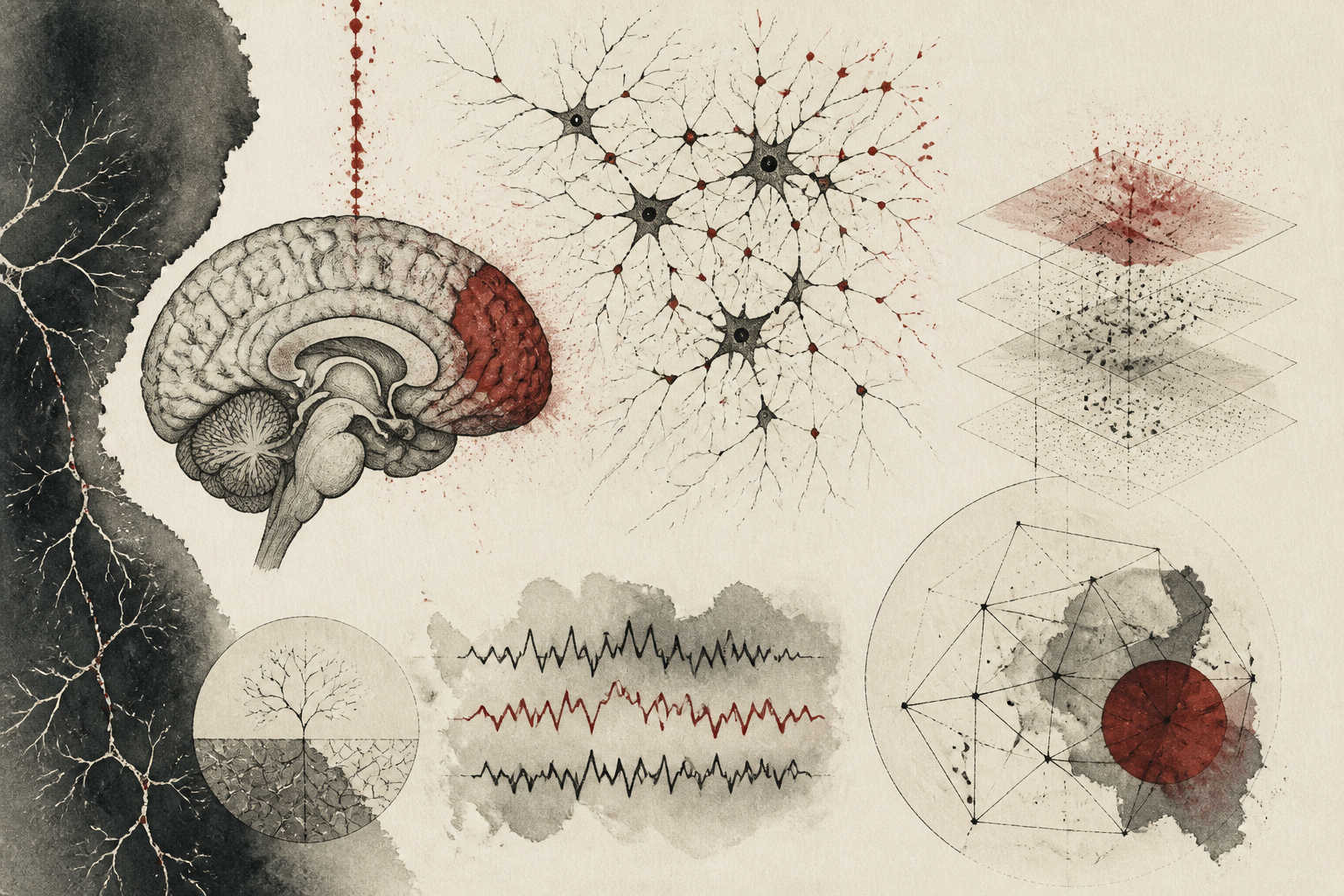
Understanding the fundamental principles that govern how the brain organizes information remains one of the most significant challenges in modern neuroscience. For decades, researchers have sought to reconcile the immense complexity of neural firing patterns with the functional constraints required for cognition and motor control. A pivotal study recently published in Nature Neuroscience, titled "Strong and localized recurrence controls the dimensionality of neural activity across brain areas," offers a comprehensive framework for understanding this relationship. By examining the structural connectivity within neural circuits, the study identifies localized recurrence as a primary driver of neural dimensionality, providing new insights into how different brain regions balance information capacity with stability.
The concept of dimensionality in neuroscience refers to the number of independent variables required to describe the collective activity of a neural population. A high-dimensional system can represent a vast array of distinct information states, while a low-dimensional system is more constrained, often reflecting simpler, more coordinated patterns of activity. Historically, the scientific community has debated whether high dimensionality is a universal feature of the brain or if it varies significantly between regions based on their specific computational demands. The researchers behind this Nature Neuroscience report argue that the answer lies in the architecture of recurrent connections—the feedback loops where neurons stimulate or inhibit their neighbors within a localized network.
Structural Determinants of Neural Complexity
To investigate these dynamics, the research team employed a combination of advanced neuroimaging data and computational modeling. They analyzed large-scale datasets encompassing multiple brain regions, ranging from sensory processing areas to higher-order associative cortices. The core finding of the study is that the strength and spatial localization of recurrent connections directly dictate the dimensionality of the resulting neural activity. Specifically, regions characterized by strong, localized recurrence—where neurons primarily interact with nearby peers in a self-reinforcing manner—exhibited higher dimensionality. This suggests that the brain does not employ a one-size-fits-all approach to connectivity; rather, it tunes the density and reach of its internal loops to calibrate the complexity of its output.
The researchers observed that when recurrent inhibition and excitation are tightly balanced and confined to small spatial clusters, the network can support a greater variety of independent firing patterns. This structural arrangement prevents the system from collapsing into a few dominant modes of activity, which is often seen in more globally connected or weakly recurrent networks. By maintaining this localized intensity, the brain can effectively maximize its representational space, allowing for the simultaneous processing of diverse stimuli or the execution of complex cognitive tasks without cross-talk or informational bottlenecks.
The Mechanism of Localized Recurrence
The methodological approach of the study involved simulating neural networks with varying degrees of connectivity to isolate the impact of recurrence on dimensionality. The team utilized a "mean-field" theoretical framework to predict how changes in synaptic strength and spatial decay would influence the manifold—the mathematical space—in which neural activity resides. Their models demonstrated that as recurrence becomes more localized, the eigenvalues of the connectivity matrix spread out, preventing the neural population from being captured by just a few principal components.
In practical terms, this means that in areas like the primary visual cortex or the prefrontal cortex, the specific way neurons are wired to their immediate neighbors creates a fertile ground for high-dimensional representations. The study highlights that this is not merely a byproduct of the number of neurons involved, but a specific consequence of the geometry of their connections. Even in populations with a similar number of total synapses, those with stronger local loops maintained higher dimensionality than those with broad, diffuse connectivity. This distinction is crucial because it identifies a specific biological "knob" that the brain can turn to adjust its computational capacity.
Interpretations and Functional Implications
The implications of these findings extend to our understanding of how the brain avoids the pitfalls of over-simplification. If neural activity were universally low-dimensional, the brain would lack the flexibility to handle the nuances of the environment. Conversely, if activity were unstructured and infinitely high-dimensional, the brain would struggle to extract meaningful patterns or maintain stable motor commands. The Nature Neuroscience study suggests that localized recurrence acts as a stabilizing force that enables high dimensionality without sacrificing the integrity of the signal.
Furthermore, the research provides a potential explanation for the functional differences between brain regions. Sensory areas, which must process high-resolution input from the outside world, may rely on localized recurrence to preserve the fine details of that data. In contrast, motor regions or areas involved in global state transitions might favor different connectivity profiles to ensure robust, repeatable outcomes. By linking the micro-scale architecture of synapses to the macro-scale properties of neural manifolds, the study bridges a long-standing gap in systems neuroscience.
Limitations and Future Inquiries
Despite the robustness of the findings, the researchers acknowledge several limitations that warrant further investigation. The current models primarily focus on stationary states and may not fully capture the transient, non-equilibrium dynamics that occur during rapid learning or intense emotional responses. Additionally, while the study utilizes data from various mammalian brains, the degree to which these principles apply across the full diversity of the animal kingdom remains an open question. There is also the challenge of plasticity; the study describes a structural template, but neural connections are constantly being reshaped by experience. How localized recurrence evolves during development or in response to injury is a critical frontier for future research.
Another open question involves the role of long-range projections. While the study emphasizes localized recurrence, brain regions do not operate in isolation. Understanding how local high-dimensional activity is integrated into global low-dimensional trends—such as those seen in global brain states like arousal or sleep—will require even more complex multiscale models. The researchers suggest that future work should focus on the interaction between these local high-dimensional hubs and the long-distance pathways that link them, potentially revealing a hierarchical structure of dimensionality across the entire central nervous system.
Why Connectivity Architecture Matters
The significance of this research lies in its ability to provide a formal mathematical and biological basis for neural complexity. For clinical neuroscience, these findings offer a new lens through which to view neurological disorders. Conditions characterized by cognitive rigidity or sensory processing issues might be understood as disruptions in the localized recurrence of specific circuits. If the dimensionality of a network is reduced due to a loss of local synaptic density, the individual’s ability to process complex information would be fundamentally impaired.
In the realm of artificial intelligence, these biological insights could inform the design of more efficient neural networks. Current AI models often struggle with the trade-off between stability and expressive power. By mimicking the localized recurrence patterns identified in the human brain, engineers might develop systems that are both more robust and capable of higher-dimensional representation. Ultimately, the work published in Nature Neuroscience reaffirms that the physical structure of the brain—down to the specific way a neuron communicates with its neighbor—is the fundamental architect of our cognitive reality. As we continue to map these recurrent loops, we move closer to a complete understanding of the brain's internal logic and its extraordinary capacity for information processing.
Quick answers
- What is neural dimensionality in the context of this study?
- Neural dimensionality refers to the number of independent variables needed to describe the activity patterns of a group of neurons, representing the network's information capacity.
- How does localized recurrence affect the brain?
- Strong, localized recurrent connections—where neurons interact primarily with nearby neighbors—allow brain regions to maintain higher-dimensional activity and more complex information states.
- What is the source of this research on brain connectivity?
- The findings were published in the journal Nature Neuroscience under the title 'Strong and localized recurrence controls the dimensionality of neural activity across brain areas'.
Rewritten by Zeit editorial AI. Based on original reporting at Nature Neuroscience.