Mapping Consensus: How Reciprocal Neural Connections Drive Dynamic Cortical Processing
Researchers at Nature Neuroscience identify how bidirectional feedback loops between neocortical areas allow the brain to reach a unified interpretation of sensory data.
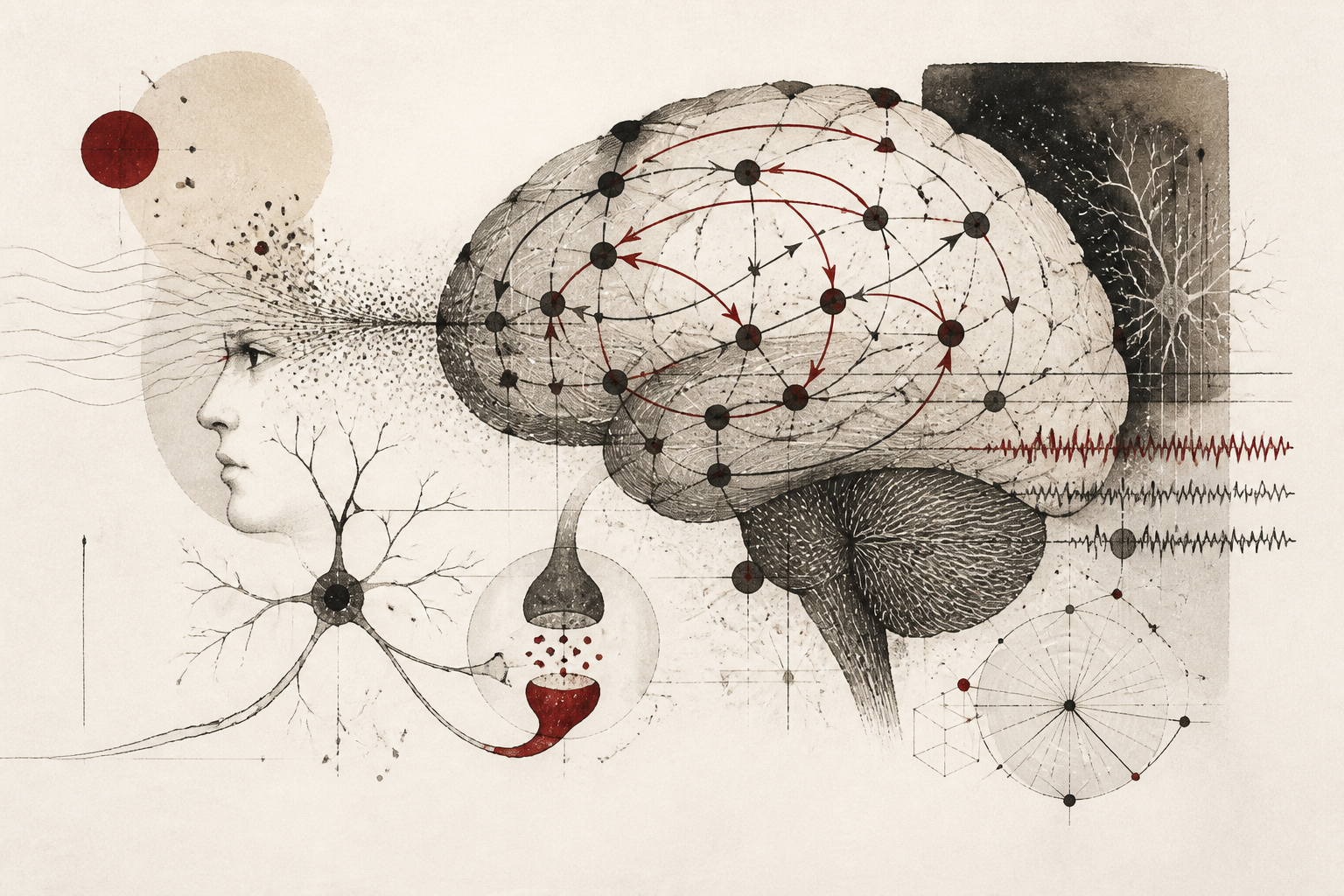
The human brain is often conceptualized as a hierarchical processor, where information flows in a linear fashion from basic sensory inputs to complex cognitive interpretations. However, recent neuroscientific evidence suggests that this view is incomplete. A seminal study published in Nature Neuroscience, titled "Reciprocal connections dynamically build consensus between neocortical areas," challenges the traditional unidirectional model. By examining the intricate architecture of the neocortex, researchers have uncovered how reciprocal, bidirectional connections between different brain regions do not merely exchange data but actively negotiate to form a stable consensus. This discovery provides a new framework for understanding how the brain transitions from fragmented sensory perceptions to a coherent internal reality.
The Architecture of Neural Negotiation
The neocortex is organized into distinct areas, each specialized for particular tasks, such as visual recognition, auditory processing, or motor planning. Historically, the relationship between these areas was viewed through the lens of feedforward pathways, where lower-level regions pass signals to higher-order regions for final processing. The Nature Neuroscience report shifts this perspective by focusing on the dense web of feedback loops that return information from higher areas back to the lower ones. These reciprocal connections are not secondary to the primary signal; rather, they are the mechanism by which the brain resolves ambiguity. When a sensory signal is unclear, such as seeing a shape in the fog, the higher-order regions send predictive templates back to the primary visual cortex. This dialogue continues until the activity across both areas aligns, creating a state of neural consensus.
This dynamic is essential for survival. In complex environments, the brain is constantly bombarded with noisy and often contradictory data. If the cortex relied solely on feedforward mechanisms, the risk of misinterpretation would be high, and the time required to process complex scenes would be prohibitive. By employing a reciprocal architecture, the brain can rapidly converge on a single, reliable interpretation of the world. The study emphasizes that this consensus is not a static state but a highly fluid process that updates in milliseconds as new information arrives or as internal priorities change.
Uncovering the Mechanisms of Synchronized Consensus
To understand how this consensus is achieved, the researchers employed advanced neuroimaging and electrophysiological techniques to monitor real-time interactions between cortical layers. They observed that reciprocal connections operate through a specific pattern of synchronization. When two cortical areas are in the process of building a consensus, their neural oscillations—the rhythmic firing of neurons—begin to align in frequency and phase. This synchronization acts as a communication channel, allowing the two areas to effectively "talk" to one another. The Nature Neuroscience findings suggest that this is not a one-way command from the top down, but a democratic negotiation.
The study utilized computational modeling to simulate how these reciprocal loops function under varying conditions of uncertainty. The models revealed that when the sensory input is strong and clear, the feedforward signals dominate, and consensus is reached quickly. However, when the input is weak or ambiguous, the feedback signals from higher-order areas become more influential. In these scenarios, the higher-order regions essentially provide a "best guess" based on prior experience, which then modulates the sensitivity of the lower-level neurons. This iterative loop continues until the discrepancy between the prediction and the input is minimized. This specific mechanism, known as predictive coding, relies entirely on the strength and speed of reciprocal connections.
Implications for Cognitive Theory and Neurobiology
The interpretation of these findings extends far beyond basic sensory processing. By demonstrating that cortical areas must reach a consensus, the study provides a biological basis for many psychological phenomena, such as cognitive dissonance and perceptual stability. If the reciprocal pathways are disrupted, the brain may fail to reach a consensus, leading to fragmented perception or even hallucinations. This has profound implications for our understanding of neurodivergence and psychiatric conditions. For instance, in conditions where feedback loops are weakened, the brain might rely too heavily on raw sensory data without the context provided by higher-order areas, leading to sensory overload. Conversely, if feedback is too dominant, the brain may ignore sensory reality in favor of internal predispositions.
Furthermore, this research challenges the artificial intelligence community to rethink current neural network architectures. Most modern AI models, including deep learning networks, are predominantly feedforward. While these models are highly effective at classification tasks, they lack the flexibility and error-correction capabilities of the human neocortex. Integrating reciprocal connections into AI could lead to more robust systems that can handle ambiguity and learn from fewer examples by mimicking the consensus-building strategies of the human brain. The researchers suggest that the dynamic nature of these connections is the key to the brain's unmatched efficiency in energy consumption and processing speed.
Limitations and Future Avenues of Inquiry
Despite the breakthrough, the researchers acknowledge significant limitations in our current understanding of these pathways. While the study maps the general dynamics of consensus building, the precise molecular and cellular rules that govern which neurons participate in these loops remain unclear. The complexity of the neocortex, with its billions of synapses, means that mapping every reciprocal connection is a task that will take decades. Additionally, the study primarily focused on interactions between two adjacent cortical areas. In reality, the brain involves dozens of areas communicating simultaneously, creating a global consensus that integrates vision, touch, sound, and memory. How the brain manages this multi-party negotiation without becoming trapped in endless feedback loops is a question that remains unanswered.
Future research must also consider the role of subcortical structures, such as the thalamus, in facilitating these cortical conversations. The thalamus has long been known as a relay station, but emerging evidence suggests it may act as a mediator or a "switchboard" that helps synchronize reciprocal connections between cortical regions. Exploring this three-way interaction between lower-level cortex, higher-level cortex, and the thalamus will be essential for a complete model of neural consensus.
The Broad Significance of Neural Consensus
Understanding how the brain builds consensus is fundamental to the mission of Zeit Psychology Online University and the broader scientific community. It reminds us that perception is not a passive reception of the world, but an active, social-like interaction between different parts of our anatomy. The Nature Neuroscience study reinforces the idea that the brain is a system built on collaboration rather than hierarchy. By investigating the reciprocal connections that define our cognitive experience, we move closer to solving the mysteries of consciousness and the biological roots of the human mind. As we continue to decode these dynamic consensus-building processes, we gain not only a better map of the brain but a deeper appreciation for the sophisticated elegance of human thought.
Quick answers
- What is neural consensus in the neocortex?
- Neural consensus is a dynamic process where different areas of the brain's neocortex use bidirectional feedback loops to agree on a single, stable interpretation of sensory information.
- How do reciprocal connections differ from feedforward pathways?
- Feedforward pathways move information one way from sensory organs to higher brain centers, while reciprocal connections allow higher centers to send feedback to lower ones, creating a two-way dialogue.
- Why is this Nature Neuroscience study important for AI development?
- It suggests that adding reciprocal, consensus-building loops to artificial neural networks could improve their ability to handle ambiguous data and correct errors, similar to the human brain.
Rewritten by Zeit editorial AI. Based on original reporting at Nature Neuroscience.