Mapping Cognitive Flexibility: How Neural Geometry Shapes Learning Efficiency
Recent research in Nature Neuroscience reveals how the geometric structure of neural activity determines our capacity to acquire and generalize new information.
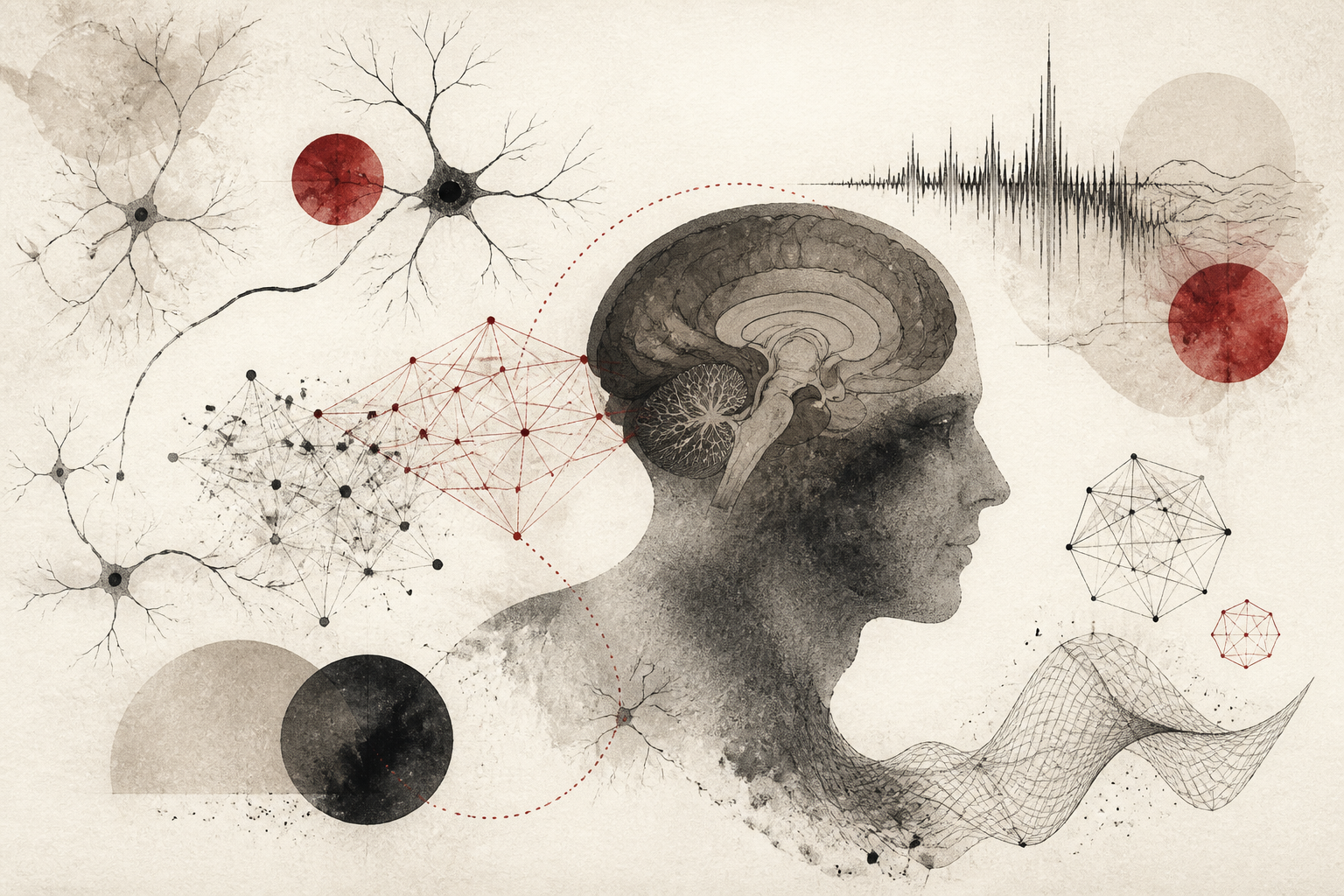
The process by which the human brain distills complex sensory input into actionable knowledge has long remained a central enigma in cognitive science. While traditional models focused on the strength of individual synaptic connections, a pioneering study published in Nature Neuroscience, titled "Neural geometry guides learning," suggests that the foundational architecture of information processing is less about isolated signals and more about the spatial arrangement of neural activity. This research introduces the concept of neural geometry as a critical determinant of cognitive flexibility, proposing that the way our brains represent information in a multi-dimensional space dictates how easily we can adapt to new environmental demands.
At the heart of this investigation is the observation that learning is not merely an additive process of gathering facts. Instead, it involves the reorganization of internal mental maps. According to the researchers, the efficiency of this reorganization is heavily influenced by the pre-existing geometric properties of neural population activity. By analyzing how neurons fire in concert across high-dimensional manifolds, the study identifies a specific structural prerequisite for rapid learning: the alignment between the task’s requirements and the inherent shape of the brain's internal representations. This discovery provides a novel lens through which to view the limitations and capabilities of human cognition, moving the discourse beyond simple plasticity toward a structural understanding of intelligence.
The Architecture of Mental Representation
To understand neural geometry, one must conceptualize the brain as a high-dimensional processing engine. When we engage with a task, thousands of neurons fire simultaneously, creating a pattern that can be mapped as a point in a mathematical space. Over time, these points form shapes, or manifolds, which represent the brain's organizational strategy for a particular domain of knowledge. The study highlights that these shapes are not arbitrary. Instead, they possess specific geometric properties—such as dimensionality, curvature, and orientation—that act as a scaffold for new learning.
Historically, the neuroscientific community viewed the brain as a tabula rasa that could be reconfigured through sheer repetition. However, the findings presented in Nature Neuroscience suggest that the brain's current state—its geometric starting point—places significant constraints on future learning. If a new task requires a representation that is orthogonal to the existing neural manifold, the learning process becomes arduous and slow. Conversely, if the task aligns with the existing geometry, the brain can integrate the new information with remarkable speed. This suggests that the "shape" of our thoughts literally paves the way for what we are capable of learning next, providing a biological basis for the concept of cognitive readiness.
Empirical Findings and Geometric Alignment
The researchers employed sophisticated neuroimaging and computational modeling to track how neural activity evolved during learning exercises. They observed that individuals who exhibited high levels of task performance often possessed neural geometries that were "flatter" or more compressed in dimensions irrelevant to the task, while maintaining high resolution in critical dimensions. This geometric efficiency allows the brain to filter out noise and focus on the variables that drive success.
One of the most striking findings was the predictive power of neural geometry. By examining the initial state of a participant's neural manifold before they mastered a task, the researchers could predict the eventual rate of learning. This indicates that the geometric structure is not just a byproduct of having learned something, but a prerequisite. The study demonstrated that learning is most effective when the neural representations are structured in a way that minimizes the distance the brain must travel to reach a target state. This "path of least resistance" in neural space explains why certain skills feel intuitive to some individuals while remaining elusive to others, even when the level of effort is equalized.
The Mechanism of Manifold Reorganization
The mechanism driving this phenomenon is rooted in how the brain balances stability with plasticity. Neural manifolds provide stability by anchoring information in a consistent geometric format, preventing every new experience from overwriting existing knowledge. However, for learning to occur, these manifolds must be capable of subtle shifts. The study suggests that the brain utilizes a process of geometric alignment where synaptic changes are directed toward rotating or expanding the manifold to encompass new task demands.
This process is governed by what the authors describe as "guidance by geometry." Rather than performing a random search for the correct neural configuration, the brain uses the existing shape of its activity to constrain the search space. This significantly reduces the computational burden on the prefrontal cortex and other executive centers. By leveraging the geometric structure, the brain can perform complex generalizations, applying the "logic" of one manifold to a different but geometrically similar task. This explains the phenomenon of transfer learning, where mastery of one discipline facilitates the acquisition of another, provided they share underlying structural characteristics.
Limitations and Theoretical Constraints
While the study marks a significant advancement, it also acknowledges important limitations that warrant further investigation. One primary concern is the scalability of these geometric models. While the researchers successfully mapped manifolds in controlled experimental settings with limited variables, the human environment is infinitely more complex. It remains to be seen how the brain manages the vast, overlapping manifolds required for everyday life without succumbing to "representational drift," where the geometry shifts so much that old information is lost.
Furthermore, the study primarily focused on cortical activity, leaving the role of subcortical structures—such as the basal ganglia and the hippocampus—relatively unexplored in this geometric context. These regions are known to be vital for habit formation and spatial memory, and their influence on the geometry of the neocortex is likely profound. There is also the question of causality: while neural geometry correlates with learning outcomes, the exact biological mechanisms that "sculpt" these manifolds during development remain to be fully elucidated. The research provides a map, but the cellular machinery that builds these maps is still being charted.
Future Implications for Cognitive Enhancement
The implications of this research extend far beyond the laboratory. By understanding the geometric constraints on learning, educators and clinicians could potentially develop more targeted interventions for cognitive development. For instance, if a student is struggling with a specific concept, it may be because their current neural geometry is not yet prepared to represent that information. Tailored "pre-learning" exercises could be designed to shift the neural manifold into a more receptive state, essentially preparing the geometric ground for more complex data.
In the realm of artificial intelligence, these findings offer a blueprint for creating more adaptable neural networks. Current AI often suffers from "catastrophic forgetting," where new learning wipes out previous training. By incorporating the principles of neural geometry observed in the human brain, developers might create systems that preserve the structural integrity of their knowledge while remaining flexible enough to expand. Ultimately, the work published in Nature Neuroscience reminds us that the mind is not just a collection of thoughts, but a sophisticated geometric construct, where the shape of our inner world defines the boundaries of our potential.
Quick answers
- What is neural geometry?
- Neural geometry refers to the spatial organization and mathematical structure of population-level neuron activity, often visualized as manifolds in a high-dimensional space.
- How does neural geometry influence learning according to Nature Neuroscience?
- The study suggests that the pre-existing shape of neural manifolds acts as a scaffold, where learning is faster if the task requirements align with the brain's current geometric structure.
- Can neural geometry predict how fast someone learns?
- Yes, the researchers found that by analyzing the initial state of a person's neural manifold, they could predict the rate at which that individual would master a new task.
Rewritten by Zeit editorial AI. Based on original reporting at Nature Neuroscience.