Interpreting Neural Intent: The Evolving Landscape of Speech Brain-Computer Interfaces
Researcher Sergey Stavisky discusses the transition from motor-control prosthetics to high-fidelity speech synthesis via neural implants.
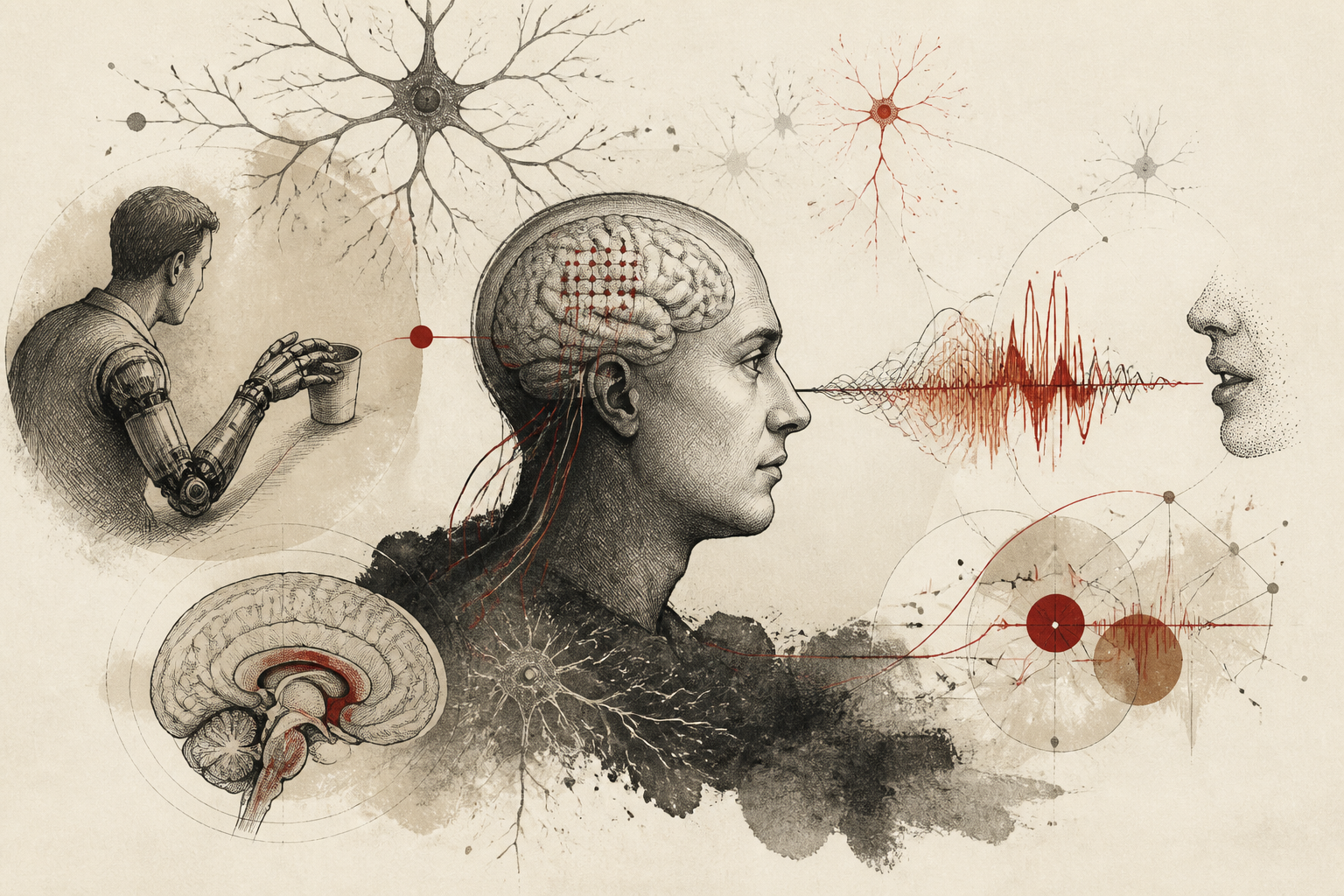
In the specialized field of neuroprosthetics, the ability to restore complex human communication stands as a primary objective. Recent developments in high-performance speech brain-computer interfaces (BCIs) represent a significant shift from simple motor control to the decoding of intricate linguistic patterns directly from the motor cortex. In a detailed discussion documented by Nature Neuroscience, Sergey Stavisky, a leading researcher in the field, provides an overview of the current state of these technologies and the methodologies required to translate neural firing into audible speech. The work highlights a transition toward clinical feasibility, moving past proof-of-concept laboratory demonstrations toward systems that can potentially function in real-world environments for individuals with profound speech impairments.
The Technical Foundations of Speech Decoding
The fundamental challenge in speech BCI technology involves interpreting the high-dimensional signals generated by the brain during the intent to speak. Stavisky notes that earlier iterations of BCIs focused largely on physical movement, such as controlling a robotic arm or moving a cursor on a screen. However, speech presents a unique complexity due to the speed and precision required for articulation. The human vocal apparatus involves the coordination of dozens of muscles, and the neural representation of these movements is exceptionally dense. By utilizing microelectrode arrays implanted in the speech-related areas of the motor cortex, researchers are now able to record the activity of individual neurons as a participant attempts to speak. This process relies on identifying the specific neural signatures associated with different phonemes, the building blocks of language, rather than just basic motor commands.
The progression of this technology is rooted in advancements in machine learning and signal processing. Stavisky explains that the raw neural data is processed through recurrent neural networks and other deep learning architectures that are trained to recognize patterns. This allows the system to predict what word or sound the user is trying to produce in real-time. The shift from decoding simple movements to decoding the rapid, fluid movements of speech represents a major leap in computational neuroscience. It requires not only high-resolution hardware but also algorithms capable of handling the temporal nuances of language, where the meaning of a signal is often dependent on the signals that preceded it.
Methodological Advances and High-Performance Metrics
A critical component of recent research success involves the increase in communication speed. For a BCI to be considered clinically useful, it must approach the rate of natural conversation, which typically ranges from 150 to 160 words per minute. Stavisky points out that recent high-performance speech BCIs have achieved rates that significantly exceed previous benchmarks, sometimes reaching over 60 words per minute. While still slower than natural speech, these speeds represent a transformative improvement over traditional assistive devices, such as eye-tracking systems or single-switch interfaces, which often operate at fewer than 10 words per minute. The methodology involves a closed-loop system where the user receives immediate feedback, allowing for a degree of neural adaptation that further improves the accuracy of the device over time.
Furthermore, the robustness of these systems is being tested through large vocabularies. Previous studies often limited the BCI to a small set of predetermined words to maintain accuracy. Stavisky discusses the transition toward large-vocabulary decoding, where the system can handle thousands of words. This is achieved by combining neural decoding with language models similar to those used in modern smartphones. By predicting the most likely next word based on the decoded neural signal and the context of the sentence, the system can correct for minor errors in the neural interpretation. This synergy between direct brain sensing and predictive linguistics is what has enabled the leap in performance observed in the latest clinical trials.
Limitations and the Path Toward Clinical Integration
Despite these advancements, significant hurdles remain before speech BCIs can become standard medical treatments. Stavisky emphasizes the issue of system longevity and stability. Currently, the microelectrode arrays used in these studies can experience signal degradation over months or years due to the body's natural immune response to the implant. Ensuring that a BCI remains functional for a decade or more is essential for widespread adoption. Additionally, the current systems often require a team of engineers to calibrate the software daily. For these devices to be practical, they must move toward an autonomous state where the user can turn the system on and use it without expert intervention.
Another limitation discussed is the physical nature of the implants. Most high-performance BCIs are currently wired, requiring a physical connection through the skull to external computers. The transition to fully wireless, invisible, and long-lasting implants is a major engineering goal. There is also the question of generalizability; different individuals may have different neural representations of speech, especially those who have suffered from strokes or neurodegenerative diseases like Amyotrophic Lateral Sclerosis (ALS). Stavisky notes that the field must prove these systems work across a diverse patient population with varying degrees of neurological damage. The data indicates that while the motor cortex often remains active even when the physical ability to speak is lost, the quality of these signals can vary significantly between users.
Ethical Considerations and Future Directions
The prospect of reading internal speech raises important ethical and privacy concerns that the scientific community is beginning to address. While current BCIs decode the motor intent to speak—meaning the user must actively try to move their vocal muscles—future systems might attempt to decode purely internal thoughts. Stavisky highlights the importance of maintaining user agency and ensuring that only intended communication is transmitted. This distinction between "imagined speech" and "intended motor speech" is vital for protecting the cognitive privacy of the individuals using the technology. As the sensitivity of neural sensors increases, the protocols for data security and informed consent must evolve in parallel.
Looking forward, the integration of speech BCIs with synthetic voice technology offers a way to restore not just words, but the personal identity of the user. By using pre-recorded samples of a patient’s own voice from before they lost the ability to speak, researchers can create a personalized synthesizer that is driven by the BCI. This holistic approach to communication restoration addresses the psychological impact of losing one’s voice. As Sergey Stavisky concludes in the Nature Neuroscience interview, the field is moving from a phase of discovery into a phase of refinement. The focus is now on making these sophisticated tools durable, portable, and accessible to the thousands of people worldwide who live in a state of silence despite having a functioning mind.
Quick answers
- What is the primary goal of speech brain-computer interfaces?
- The primary goal is to restore fast, natural communication to individuals with speech disabilities by decoding neural signals into text or synthetic audio.
- How fast are current experimental speech BCIs?
- Recent high-performance models have reached speeds exceeding 60 words per minute, significantly faster than traditional assistive tools but still slower than natural speech.
- What are the main technical challenges for BCIs mentioned by Stavisky?
- Key challenges include the long-term stability of electrode implants, the need for wireless systems, and making the software autonomous for home use.
Rewritten by Zeit editorial AI. Based on original reporting at Nature Neuroscience.