Glucocorticoids and Spatial Cognition: How Stress Disrupts the Brain’s Grid Cell Network
Recent research reveals that cortisol impairs the precision of grid cells in the entorhinal cortex, significantly hindering spatial navigation when external visual landmarks are absent.
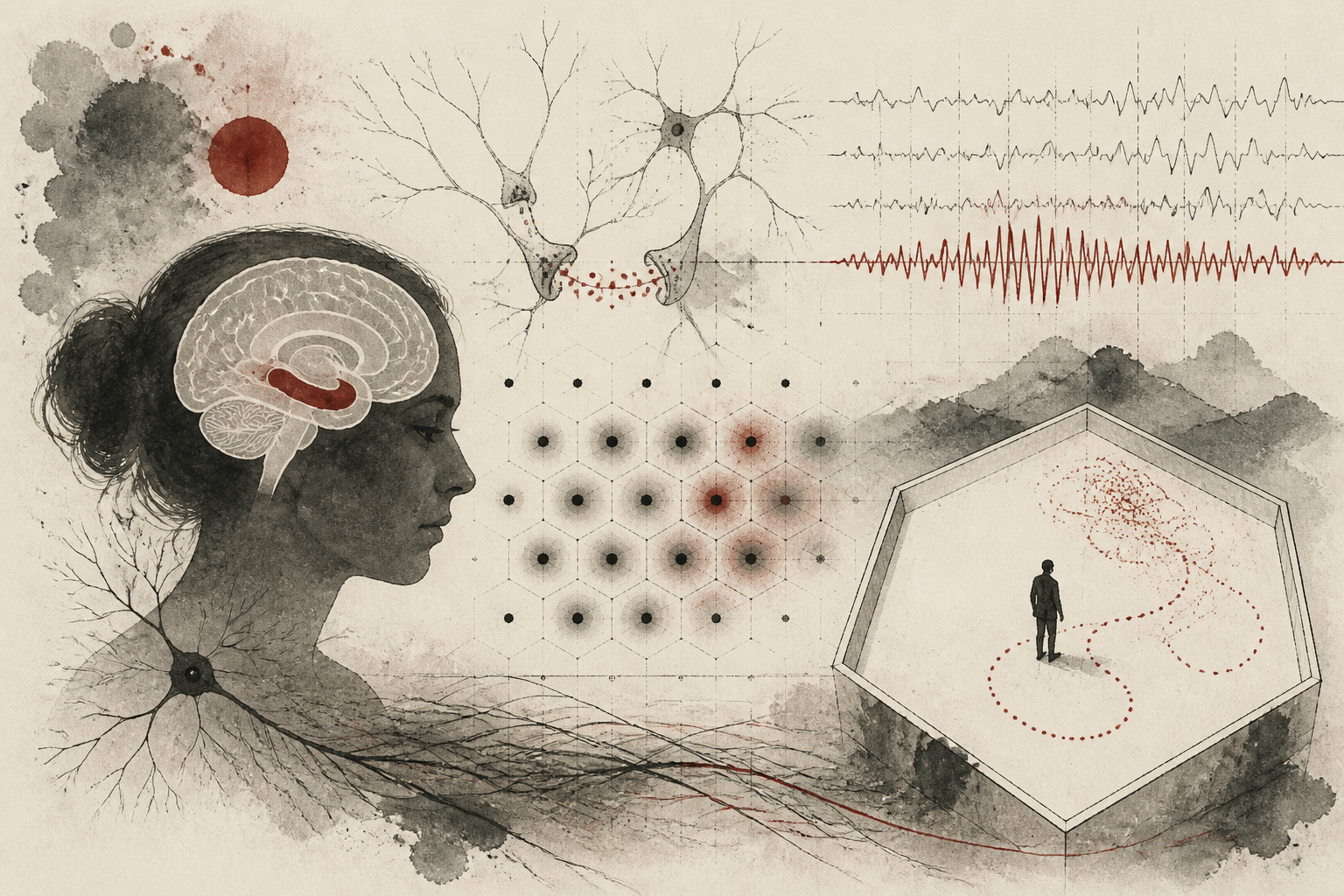
The human capacity for spatial navigation relies on a sophisticated internal mapping system that operates with the precision of a global positioning satellite. However, recent empirical evidence suggests that this biological GPS is remarkably vulnerable to the physiological manifestations of psychological pressure. According to a study published in ScienceDaily, researchers have identified a direct link between the administration of cortisol—the body's primary stress hormone—and a significant decline in navigational accuracy. This research provides a neurobiological explanation for why individuals often feel disoriented or lose their sense of direction when experiencing acute stress, highlighting a specific disruption in the neural architecture responsible for spatial representation.
Historically, the field of cognitive neuroscience has understood spatial awareness through the lens of specialized neurons known as grid cells. These cells, located in the entorhinal cortex, fire in a regular hexagonal pattern as an individual moves through space, providing a coordinate system that allows for an internal representation of distance and direction. The recent findings suggest that the introduction of glucocorticoids, such as cortisol, effectively scrambles this signal. By disrupting the rhythmic firing patterns of these cells, stress prevents the brain from maintaining a stable and accurate map of its surroundings, particularly when environmental cues are limited.
The Neurobiological Impact of Cortisol on Grid Cell Stability
The research methodology employed high-resolution functional magnetic resonance imaging (fMRI) to observe the brains of participants as they navigated a complex virtual environment. Before the task, one group of participants was administered a dose of cortisol to simulate a physiological stress response, while a control group received a placebo. The results indicated a stark divergence in performance. Participants under the influence of the stress hormone demonstrated a marked inability to maintain their orientation within the virtual space. The fMRI data revealed that the grid cell patterns in the entorhinal cortex became irregular and fragmented in the cortisol group, suggesting that the hormone directly interferes with the cellular mechanisms that generate spatial coordinates.
This disruption appears to be particularly pronounced during 'path integration,' the process by which the brain calculates its current position based on previous movements rather than external landmarks. In the absence of visual anchors, the grid cell system is the primary driver of navigation. The study found that cortisol specifically weakened this internal calculation. While the control group could navigate effectively even when landmarks were obscured, the cortisol-affected group showed a near-total collapse of their internal mapping capabilities. This suggests that the physiological response to stress does not just distract the individual, but actively degrades the computational integrity of the brain’s spatial processing units.
Compensatory Mechanisms and the Role of the Striatum
One of the most compelling findings of the study involves how the brain attempts to compensate for the failure of its primary navigation system. As the grid cell activity in the entorhinal cortex faltered, researchers observed an uptick in activity within another region of the brain: the striatum. The striatum is typically associated with habit-based learning and stimulus-response behavior rather than the flexible, map-like representation of space provided by the hippocampus and entorhinal cortex. This shift suggests a hierarchical reorganization of cognitive strategies under stress.
When the sophisticated, map-based system fails due to cortisol interference, the brain reverts to a more primitive, landmark-based strategy governed by the striatum. However, this compensatory mechanism is significantly less flexible. While it allows an individual to move toward a specific, visible goal, it does not support the complex spatial reasoning required to take shortcuts or navigate through unknown territory. The transition from a flexible cognitive map to a rigid habit-based system explains why stressed individuals can follow a well-known path but become hopelessly lost if they are forced to deviate from a routine route. This neurobiological trade-off highlights the limitations of the brain’s resilience when faced with chemical interruptions to its primary processing centers.
Limitations and Theoretical Implications for Spatial Memory
While the study provides a robust framework for understanding stress-induced disorientation, several limitations remain that warrant further academic inquiry. First, the use of a virtual environment, while necessary for controlled fMRI observations, may not fully capture the multisensory experience of physical navigation, which involves vestibular and proprioceptive feedback. Furthermore, the administration of synthetic cortisol is a proxy for acute stress, but it may not perfectly replicate the complex hormonal cocktail—including adrenaline and norepinephrine—that characterizes a real-world high-stakes situation. Researchers also noted that the degree of impairment varied among individuals, suggesting that some brains may have a higher resilience to glucocorticoid-induced disruption.
These findings also raise questions about the long-term impact of chronic stress on spatial memory. If acute cortisol spikes can scramble grid cell activity, it is possible that prolonged exposure to high stress levels could lead to structural changes in the entorhinal cortex or a permanent reliance on the less efficient striatal navigation system. Understanding these dynamics is essential for developing interventions for populations that operate in high-stress environments, such as emergency responders or military personnel, for whom spatial accuracy is a critical component of operational success.
Future Directions and Clinical Relevance
The broader implications of this research extend into the realm of clinical psychology and gerontology. Conditions such as Alzheimer’s disease often manifest early symptoms in the entorhinal cortex, leading to the characteristic 'wandering' and disorientation seen in patients. By identifying how stress exacerbates grid cell dysfunction, clinicians may be able to develop better strategies for managing spatial symptoms in neurodegenerative diseases. Minimizing stress could potentially preserve the functional integrity of the grid cell network for longer periods in at-risk populations.
In conclusion, the study provided by ScienceDaily underscores the delicate balance required for high-level cognitive functioning. The brain’s internal GPS is not a static tool but a dynamic system highly sensitive to the body's internal chemistry. As we continue to map the intersections between the endocrine system and cognitive architecture, it becomes increasingly clear that our ability to find our way through the world is fundamentally tied to our physiological state. Maintaining the precision of our mental maps requires not just cognitive effort, but a neurobiological environment free from the scrambling effects of acute stress.
Quick answers
- How does cortisol affect the brain's navigation system?
- Cortisol disrupts the firing patterns of grid cells in the entorhinal cortex, which act as the brain's internal coordinate system, leading to disorientation.
- What happens to navigation when landmarks are removed under stress?
- When visual landmarks are absent, the grid cell system fails almost entirely under stress, forcing the brain to rely on less efficient habit-based regions like the striatum.
- What are grid cells and where are they located?
- Grid cells are specialized neurons in the entorhinal cortex that provide a hexagonal coordinate system for tracking distance and direction in space.
Rewritten by Zeit editorial AI. Based on original reporting at ScienceDaily — Mind & Brain.