Genetic Crossroads: Mapping Shared Risks Between Neurology and Psychiatry
A comprehensive genome-wide analysis reveals the complex overlapping genetic architecture linking distinct brain disorders and behavioral traits.
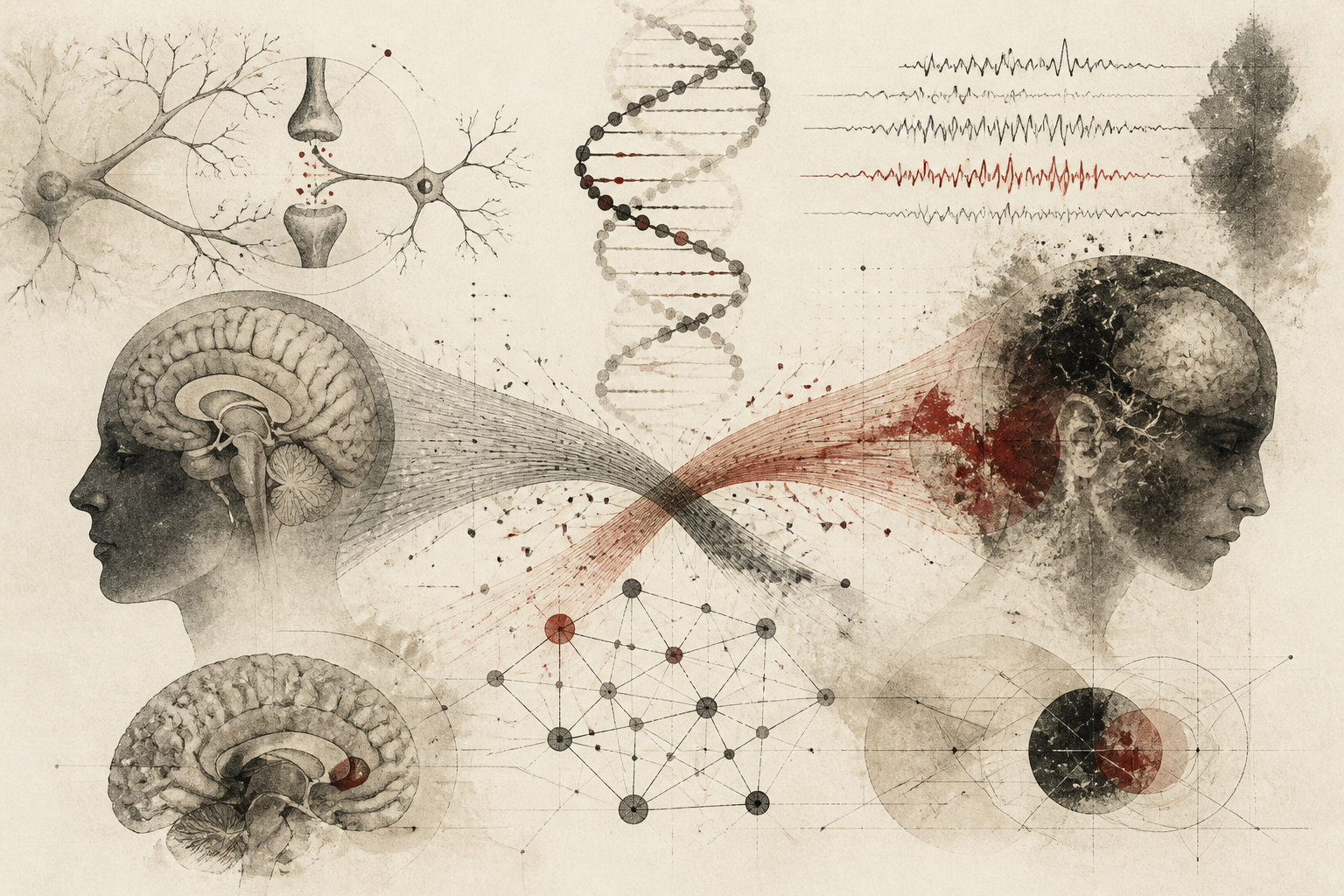
The historical divide between neurology and psychiatry has often been predicated on the presence of observable physical lesions versus the manifestation of behavioral or emotional symptoms. However, modern genomics is increasingly challenging this binary classification. According to a significant genome-wide analysis published in Nature Neuroscience, the genetic risk architecture underlying complex brain disorders suggests a highly interconnected landscape where traditional diagnostic boundaries blur. By examining the shared hereditary foundations of these conditions, researchers are uncovering how a single genetic variant might predispose an individual to multiple, seemingly unrelated clinical outcomes.
This investigation into the shared genetic underpinnings of neurological and psychiatric disorders represents a paradigm shift in how academic medicine views the brain. For decades, clinicians have treated conditions like epilepsy or multiple sclerosis as distinct entities from depression or schizophrenia. Yet, the findings detailed in the Nature Neuroscience report indicate that the biological pathways involved in these conditions are often intertwined. This shared architecture suggests that the clinical presentation of a disorder may be less a matter of isolated genetic failures and more a result of systemic vulnerabilities across common neural networks.
Genomic Foundations of Co-occurring Pathologies
The study utilized large-scale datasets to perform a cross-disorder analysis, focusing on how specific genetic markers correlate across different diagnostic categories. The researchers identified a spectrum of genetic overlap that ranges from highly specific to broadly pleiotropic. In many instances, the genetic risk for psychiatric conditions showed a stronger internal correlation compared to neurological disorders, which tended to be more genetically distinct from one another. For example, the genetic correlations among disorders like schizophrenia, bipolar disorder, and major depressive disorder were robust, suggesting a common psychological vulnerability rooted in identical genomic loci.
Conversely, the neurological cluster—including disorders such as Alzheimer’s disease and Parkinson’s disease—demonstrated less internal genetic cohesion than the psychiatric group. However, the most compelling findings emerged at the intersection of these two fields. The data indicates that certain neurological conditions share significant genetic signals with psychiatric traits, particularly regarding cognitive processing and emotional regulation. These overlaps provide a biological explanation for why patients with primary neurological diagnoses frequently present with secondary psychiatric symptoms, such as anxiety in Parkinson’s patients or depression in those with multiple sclerosis.
Mechanisms of Shared Risk and Methodological Rigor
The methodology employed in this genome-wide analysis involved sophisticated statistical modeling to parse through millions of single-nucleotide polymorphisms (SNPs). By applying techniques such as Linkage Equilibrium (LD) score regression, the research team was able to quantify the genetic correlation between pairs of traits without requiring the same individuals to be in both samples. This approach allows for the integration of massive cohorts, increasing the statistical power necessary to identify subtle overlaps that would be invisible in smaller clinical trials.
One of the primary mechanisms identified through this analysis is the role of regulatory elements in the brain’s development. Many of the shared genetic variants were located in non-coding regions of the genome that control how genes are expressed in specific neural tissues. This suggests that the shared risk is not necessarily due to faulty proteins, but rather to the timing and intensity of gene activity during critical windows of brain maturation. The study points toward synaptic plasticity and ion channel functioning as common denominators that, when disrupted, can lead to the diverse symptom clusters associated with both psychiatric and neurological illness.
Interpretation of the Neural Overlap
Interpretations of these findings suggest that the medical community may eventually need to move toward a more dimensionally-based diagnostic system, such as the Research Domain Criteria (RDoC) proposed by the National Institute of Mental Health. If the genetic risk for a disorder like ADHD also predisposes an individual to migraine or certain types of cognitive decline, the traditional silos of medical specialization may hinder holistic treatment. The high degree of genetic correlation between certain behavioral traits—such as risk-taking or educational attainment—and clinical disorders further suggests that what we define as a 'disorder' may be the extreme end of a continuous spectrum of human genetic variation.
Furthermore, the analysis clarifies the evolutionary aspect of these risks. The fact that many psychiatric disorders share genetic hits that are also associated with high-level cognitive traits suggests that some of the risk for mental illness may be a byproduct of the evolutionary pressures that developed the human neocortex. The genetic "cost" of a highly complex brain may be a heightened susceptibility to the dysregulations that manifest as psychiatric conditions. This perspective shifts the narrative from one of biological deficit to one of biological complexity.
Limitations and Future Investigations
Despite the depth of the analysis, several limitations remain. Genetic correlations do not imply causation; the presence of a shared risk factor does not mean one disorder causes another, nor does it guarantee that an individual will develop any condition at all. Most of the data utilized in these genome-wide studies still skew heavily toward populations of European ancestry, which limits the global generalizability of the findings. The researchers emphasize that the actual phenotypic expression of these genes is heavily influenced by environmental factors, epigenetic modifications, and stochastic events that current genomic models cannot fully capture.
Open questions remain regarding the "missing heritability" of many brain disorders. While shared SNPs explain a portion of the risk, a significant amount of the variance remains unaccounted for. Future research must look beyond common variants to investigate the role of rare mutations, structural genomic variations, and the complex interplay between the gut-brain axis and the immune system, all of which likely contribute to the overarching architecture of brain health.
The Clinical and Educational Imperative
Understanding the shared genetic risk architecture is vital for the future of precision medicine. By identifying the common biological pathways that underpin a range of disorders, researchers can develop pharmacological interventions that target systemic neural vulnerabilities rather than just masking the symptoms of a single diagnosis. For institutions like Zeit Psychology Online University, these findings underscore the necessity of an interdisciplinary curriculum. Future practitioners must be as well-versed in molecular genetics as they are in behavioral therapy.
In conclusion, the Nature Neuroscience report validates the intuition that the brain is a singular, integrated organ where the lines between 'mind' and 'matter' are increasingly thin. As we refine our map of the genomic landscape, our ability to predict, diagnose, and treat the full spectrum of brain-related conditions will improve, moving us closer to a future where psychiatric and neurological care are seamlessly integrated. The genetic ties that bind these conditions are not merely academic curiosities; they are the keys to unlocking more compassionate and effective healthcare for millions of people worldwide.
Quick answers
- What is the main finding of the Nature Neuroscience genetic study?
- The study found significant genetic overlap and shared risk architecture between many psychiatric and neurological disorders, suggesting they share common biological pathways.
- Are psychiatric disorders more genetically similar than neurological ones?
- Yes, the analysis indicated that psychiatric conditions tend to show higher internal genetic correlation with each other compared to the more genetically distinct neurological disorders.
- How does genetic overlap impact medical diagnosis?
- It suggests that traditional diagnostic boundaries may be fluid, supporting a more dimensional approach to brain health that considers shared biological vulnerabilities across different symptoms.
Editorial Team