Evolutionary Origins: Non-Human Primates Demonstrate Intuitive Geometric Sense
Recent research reveals that Rhesus macaques share a fundamental grasp of Euclidean geometry with human children, suggesting an ancient evolutionary origin for spatial logic.
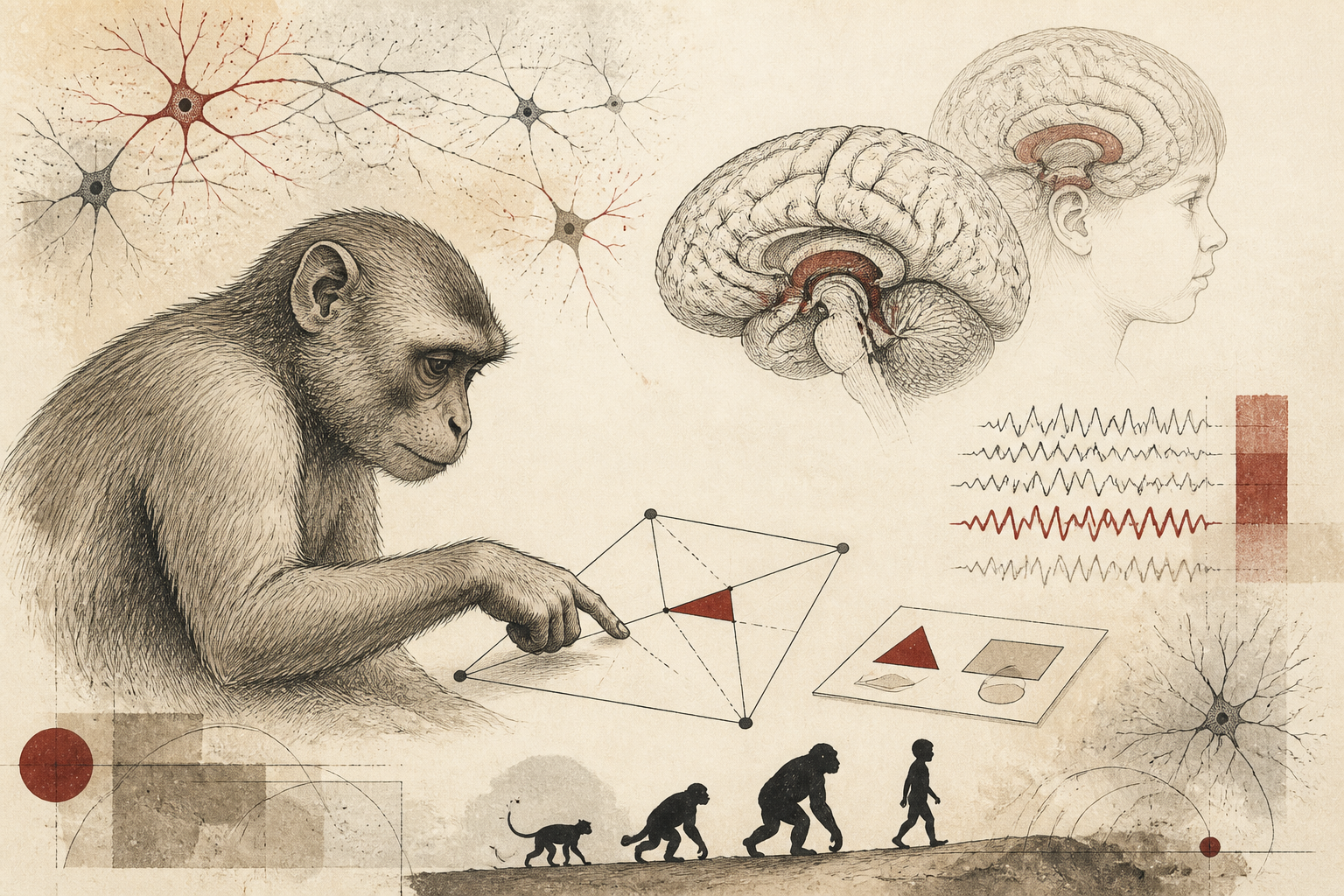
A collaborative study published in *Neuroscience News* indicates that the ability to perceive and utilize geometric principles is not an exclusively human trait but is shared with non-human primates. Researchers exploring the cognitive foundations of spatial reasoning discovered that Rhesus macaques exhibit an intuitive understanding of Euclidean geometry similar to that of young children, long before formal education or language acquisition.
To investigate these parallels, the research team designed an experimental task involving the identification of shapes based on geometric properties. Both the macaques and a group of young children were asked to identify an 'odd-one-out' from a set of quadrilaterals. The stimuli were manipulated to vary in terms of symmetry, angle, and parallel lines. The results demonstrated that both species utilized similar visual cues to categorize the shapes, prioritizing geometric regularity over other visual features.
The findings suggest that the cognitive hardware required to process points, lines, and shapes is deeply rooted in the primate lineage. While humans eventually develop sophisticated mathematical systems to quantify these concepts, the underlying 'geometric core' appears to be an evolutionary byproduct of navigating complex physical environments. The study highlights that the human capacity for high-level mathematics likely bootstraps onto these ancient, pre-linguistic spatial intuitions.
By comparing the error patterns and success rates between the two groups, researchers noted a striking consistency in how geometry is processed. This suggests that the 'language of geometry' is not a cultural invention but a biological framework shaped by natural selection. As ZU Psychology and Neuroscience continues to monitor developments in comparative cognition, this study serves as a pivotal piece of evidence for the continuity between human and non-human primate minds in the domain of abstract logic.
Source: NeuroscienceNews.com
Quick answers
- Do monkeys need training to understand geometry?
- The study suggests monkeys possess an intuitive, non-symbolic grasp of geometric regularity that does not require formal training or language.
- How did researchers compare human and monkey geometric logic?
- Both species participated in 'odd-one-out' tasks using quadrilaterals to see if they recognized patterns like symmetry and parallelism.
- What does this mean for the history of human mathematics?
- It suggests that formal human mathematics is built upon an ancient evolutionary foundation of spatial intuition shared with other primates.
Rewritten by Zeit editorial AI. Based on original reporting at NeuroscienceNews.com.