Dual Origins: Mapping the Parallel Progenitors of the Developing Vertebrate Brain
Recent findings in Nature Neuroscience reveal that the vertebrate brain emerges from two distinct neural ectoderm lineages rather than a single progenitor pool.
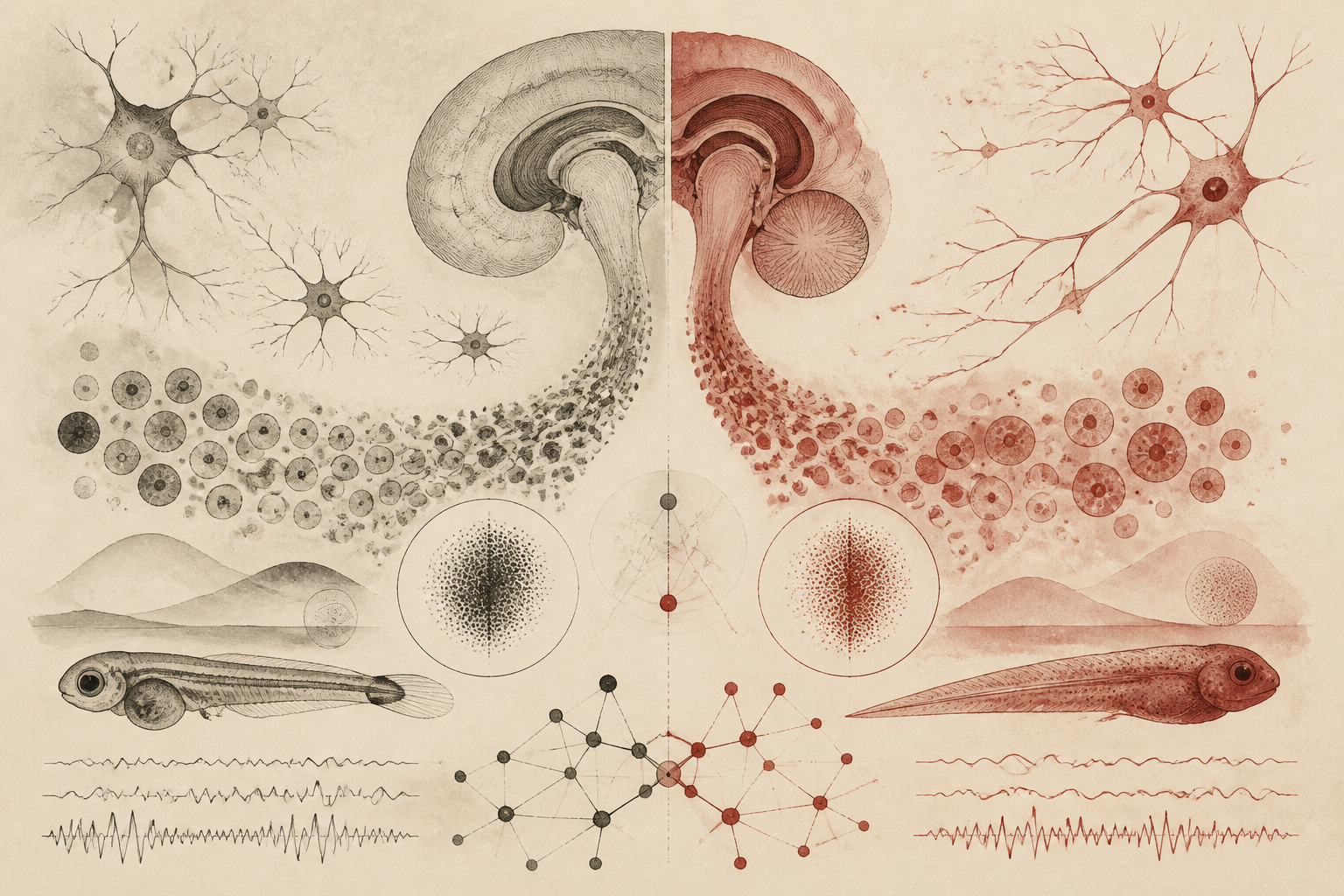
For decades, the fundamental architecture of the vertebrate nervous system was understood through the lens of a singular developmental origin. The prevailing consensus in developmental neurobiology suggested that the brain and spinal cord emerged from a relatively homogenous population of neural ectoderm cells, which gradually differentiated into specialized structures. However, a landmark study published in *Nature Neuroscience* by an international research collective has fundamentally challenged this monistic view. By utilizing high-resolution single-cell sequencing and sophisticated lineage tracing, researchers have identified two parallel neural ectoderm progenitor populations that contribute to the brain's formation in distinct ways. This discovery not only recalibrates our understanding of embryonic development but also offers a new framework for investigating the origins of neurodevelopmental disorders.
The Dual-Origin Paradigm in Neurogenesis
The traditional model of neuroectoderm development posits that a single sheet of cells, responding to a gradient of signaling molecules, undergoes morphogenesis to form the neural tube. In this classical view, the spatial identity of a neuron is primarily a product of its position within this tube. However, the study led by the research team (as reported in *Nature Neuroscience*, 2024) suggests that the starting material is more heterogeneous than previously assumed. By tracking the earliest stages of gastrulation and neurulation, the investigators found that the neural plate is actually composed of two distinct progenitor lineages that coexist in parallel. These lineages are characterized by unique genetic signatures and different developmental trajectories, suggesting that the complexity of the vertebrate brain is hard-wired much earlier in the developmental process than previously realized.
This paradigm shift suggests that the brain is not a monolithic structure derived from a uniform source, but rather a mosaic formed by the convergence of these two lineages. One progenitor population appears to be more ancient in an evolutionary sense, contributing to conserved subcortical structures, while the second population provides a significant contribution to the expansive growth of the forebrain. This dual-origin model provides a more robust explanation for how different regions of the brain can exhibit such vastly different cellular compositions and functional capacities while emerging from the same embryonic layer.
Advanced Methodologies in Lineage Tracking
To uncover these hidden populations, the research team employed a multi-omic approach that combined single-cell RNA sequencing (scRNA-seq) with spatial transcriptomics. By analyzing thousands of individual cells at various time points during early development, the researchers were able to construct a high-definition map of cell fate transitions. The data revealed that even before the neural tube closes, two clusters of cells exhibit divergent gene expression profiles. These profiles were not merely transient states but represented stable lineages that could be traced forward into the mature brain structures of the model organisms used in the study.
In addition to sequencing, the researchers utilized CRISPR-based barcoding to perform in vivo lineage tracing. This technique allowed them to "tag" early progenitor cells and observe their descendants throughout the maturation process. The results confirmed that the two populations remained largely segregated in their contributions. One lineage predominantly gave rise to the ventral components of the brain, while the other was primarily responsible for dorsal expansion. The precision of these methods allowed the team to dismiss the possibility that these were merely variations within a single population, instead confirming them as two independent parallel tracks of neural development.
Mechanisms of Lineage Specification and Divergence
The study identifies specific signaling pathways, including the Wnt and BMP pathways, as key regulators of this lineage split. While these pathways have long been known to play roles in patterning, the researchers discovered that they act as early switches that commit neural ectoderm cells to one of the two parallel tracks. The timing of these signals is critical; a narrow window during late gastrulation determines which progenitor pool a cell will join. This biochemical commitment occurs even before the physical morphological changes of the neural plate become visible, highlighting a sophisticated level of molecular pre-patterning.
Furthermore, the research points to distinct transcription factor networks that maintain the identity of these parallel lines. As the progenitors divide and migrate, these networks ensure that the cells retain their original lineage characteristics even as they respond to local environmental cues. This explains how the brain maintains structural integrity despite the immense complexity of its development. The two lineages do not merely exist side-by-side; they interact dynamically, with one population often providing the structural scaffolding upon which the other expands. This interaction is essential for the proper folding and layering of the brain's specialized regions.
Limitations and Theoretical Open Questions
Despite the groundbreaking nature of these findings, the study acknowledges several limitations that warrant further investigation. Firstly, the primary research was conducted using vertebrate model systems, and while the fundamental mechanisms of neurulation are highly conserved, the degree to which this dual-progenitor model applies to human cortical development remains to be fully validated. The sheer scale and complexity of the human brain may involve additional layers of progenitor diversity that are not captured in simpler models. Furthermore, the study focused on the earliest stages of specification; the long-term functional differences between neurons derived from the two separate lineages are not yet fully understood.
Another open question involves the evolutionary history of these parallel tracks. It is currently unclear whether the dual-origin system is a primitive trait of all chordates or a specialized adaptation that facilitated the massive encephalization seen in higher vertebrates. Future comparative studies across a wider range of species will be necessary to determine when this bifurcation first appeared in the evolutionary tree. Additionally, the researchers noted that while the lineages are distinct, there is a small degree of overlap at the boundaries, suggesting a potential for cellular plasticity that was not the primary focus of this specific investigation.
Implications for Neurodevelopmental Pathology
The identification of two parallel progenitor populations has profound implications for our understanding of neurodevelopmental disorders such as microcephaly, autism, and schizophrenia. If the brain is built from two distinct sources, it is possible that certain disorders are lineage-specific. For example, a genetic mutation that affects only one of the two progenitor pools might lead to specific structural deficits in the forebrain while leaving subcortical structures intact. This could explain the high degree of clinical variability seen in many neurological conditions.
Moreover, this research provides new targets for regenerative medicine. Understanding the specific molecular requirements of each progenitor lineage could allow scientists to more accurately direct the differentiation of stem cells for therapeutic use. By mimicking the natural parallel tracks of development, it may be possible to grow more complex and anatomically correct neural tissues in vitro. In conclusion, the work published in *Nature Neuroscience* represents a significant leap forward, moving the field away from a singular view of brain origin and toward a more nuanced, dual-track understanding of how the most complex organ in the known universe comes to be.
Quick answers
- What is the primary discovery regarding brain development in the Nature Neuroscience study?
- Researchers discovered that the vertebrate brain originates from two distinct, parallel neural ectoderm progenitor populations rather than a single uniform pool of cells.
- How did researchers identify these two different cell lineages?
- The team used a combination of single-cell RNA sequencing (scRNA-seq) and CRISPR-based lineage tracing to map gene expression and track the descendants of early embryonic cells.
- Why is the dual-origin model of the brain important for medicine?
- It suggests that neurodevelopmental disorders could stem from issues in one specific lineage, potentially explaining why some conditions affect only specific regions of the brain.
Rewritten by Zeit editorial AI. Based on original reporting at Nature Neuroscience.