Closing the Loop: A Low-Power Breakthrough in Adaptive Neuromodulation for Depression
EPFL researchers have developed LogSync, a neural chip that enables real-time, responsive deep brain stimulation by monitoring complex network oscillations with minimal power consumption.
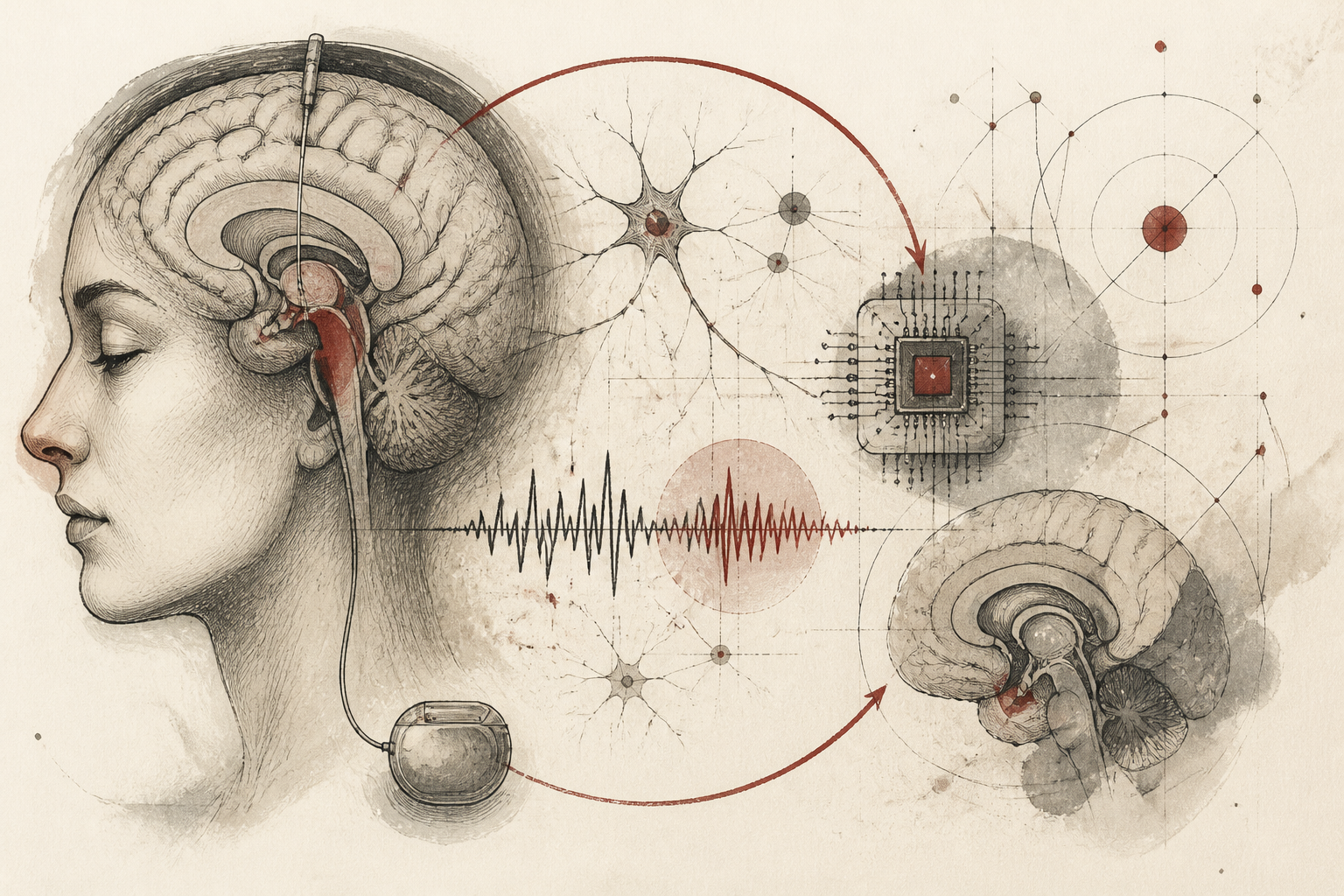
Advances in neurotechnology have long promised a new era for psychiatric treatment, yet the transition from laboratory prototypes to viable, long-term implants has faced significant engineering hurdles. Among the most promising avenues for treating treatment-resistant depression is deep brain stimulation (DBS), a method that involves delivering electrical pulses to specific neural targets. However, traditional DBS operates on a continuous, open-loop basis, providing a steady stream of stimulation regardless of the patient’s immediate physiological state. According to a report by NeuroscienceNews.com, researchers at the École Polytechnique Fédérale de Lausanne (EPFL) have achieved a milestone in this field by developing LogSync, an ultra-low-power system-on-chip designed to facilitate adaptive, closed-loop neuromodulation for complex psychiatric disorders.
Unlike motor disorders such as Parkinson’s disease, which often involve localized neural signals, psychiatric conditions like major depressive disorder are characterized by dysregulation across broad, multi-region brain networks. Effective treatment requires a system capable of not only delivering stimulation but also sensing and interpreting the intricate dance of neural oscillations between disparate areas of the brain. The challenge has been to perform this sophisticated signal processing within the stringent power and heat constraints of an implantable device. The LogSync chip represents a significant step forward, operating under 200 microwatts while decoding the oscillatory synchrony that defines pathological states in psychiatric illness.
The Complexity of Psychiatric Networks and the LogSync Solution
The fundamental difficulty in applying deep brain stimulation to depression lies in the nature of the condition itself. Depression is not located in a single “switch” within the brain; rather, it manifests as an imbalance in the functional connectivity between several regions, including the prefrontal cortex and the limbic system. To provide truly personalized and effective relief, a device must be able to detect when these networks fall out of sync and respond accordingly. This requires a “closed-loop” architecture, where the device listens to the brain and adjusts its output in real-time. Until now, the computational power required to analyze these multi-region signals threatened to drain batteries too quickly or generate excessive heat, which could damage sensitive brain tissue.
The EPFL team, led by researchers specializing in microelectronic design, addressed this by focusing on the efficiency of signal extraction. The LogSync system-on-chip is engineered to monitor the phase and amplitude relationships between different neural oscillations. By focusing on these specific markers of synchrony, the device can identify the neural signatures associated with depressive episodes. The ultra-low-power profile of the chip, staying below the 200-microwatt threshold, is particularly noteworthy. In the context of medical implants, every microwatt saved translates to longer battery life and smaller device footprints, both of which are critical for patient comfort and the long-term viability of the surgical intervention.
Decoding Neural Synchrony Through Innovative Circuitry
The technical brilliance of LogSync lies in its ability to perform on-chip processing of multi-channel neural data. Traditional systems often rely on transmitting raw data to an external processor, a process that is both energy-intensive and prone to latency. By integrating the decoding logic directly onto the silicon chip, the EPFL researchers have created a system that can react almost instantaneously to changes in the patient’s neural state. The chip utilizes specialized circuits to extract oscillatory synchrony, which refers to the way different groups of neurons fire in coordination. In many psychiatric models, an excess or a lack of this synchrony between specific regions is viewed as a primary biomarker for symptoms.
This method of decoding represents a shift from simple power-spectral analysis to a more nuanced understanding of network dynamics. By measuring the phase-locking value or the coherence between signals from different electrodes, the LogSync chip can determine the “health” of the network. When the system detects a deviation from the desired synchrony pattern, it can trigger a precise electrical pulse to nudge the network back into a balanced state. This adaptive approach ensures that the brain is only stimulated when necessary, potentially reducing the side effects associated with constant stimulation and preventing the brain from developing a tolerance to the treatment.
Clinical Interpretations and the Path to Human Integration
The implications of this research extend far beyond the technical specifications of the chip. From a clinical perspective, the transition to adaptive DBS could revolutionize how we manage chronic, treatment-resistant depression. For many patients who have failed to respond to pharmacotherapy or traditional psychotherapy, DBS offers a final hope. However, the current iteration of the technology is often criticized for being too “blind.” By providing a device that responds to the patient’s internal state, clinicians can move toward a model of precision psychiatry. The ability to decode multi-region networks means that the treatment can be tailored to the specific neural circuitry of the individual, recognizing that the biological manifestation of depression can vary significantly from person to person.
Furthermore, the low power consumption of the LogSync chip suggests that future devices could be much less invasive. Smaller batteries mean smaller implants, which reduces the risks associated with neurosurgery and improves the cosmetic outcomes for the patient. The achievement reported by the EPFL researchers validates the concept that complex, network-level biomarkers can be processed in real-time without the need for bulky hardware. This opens the door for a new generation of “smart” implants that act as a surrogate regulatory system for the brain, intervening only when the natural mechanisms of emotional regulation fail.
Limitations and Future Directions in Neuroprosthetics
Despite the success of the LogSync chip in laboratory settings and its theoretical promise, several hurdles remain before it can become a standard of care. First and foremost is the identification of definitive biomarkers. While the chip is capable of decoding oscillatory synchrony, the scientific community is still working to confirm which specific patterns of synchrony are the most reliable indicators of depressive states across a broad population. The device is only as effective as the algorithms it runs, and those algorithms depend on our fundamental understanding of psychiatric neurobiology. Additionally, the long-term stability of the interface between the electrodes and the brain tissue remains a concern, as scarring or signal degradation could interfere with the chip’s ability to accurately sense neural activity over several years.
There is also the question of the “state-space” of psychiatric illness. Unlike the tremors of Parkinson’s, which are relatively easy to quantify, the subjective experience of depression is multifaceted. Future research will need to determine how well the LogSync chip can differentiate between a temporary low mood and a clinical depressive episode that requires intervention. The EPFL team acknowledges that while the hardware is a breakthrough, the software and the clinical parameters for its use will require extensive validation in human trials. The ethical considerations of autonomous brain-computer interfaces also remain a topic of intense debate, as the device essentially makes decisions about a patient’s emotional regulation without their conscious input.
The Broader Impact on Neurotechnology and Society
The development of the LogSync chip marks a pivotal moment in the convergence of microelectronics and neuroscience. By successfully miniaturizing the processing power needed to track multi-region brain networks, the EPFL researchers have provided a blueprint for future devices targeting a wide range of neurological and psychiatric conditions. Beyond depression, this technology could theoretically be adapted for bipolar disorder, obsessive-compulsive disorder, or even chronic pain management—all of which involve complex network dysregulation. As these devices become more sophisticated and less power-hungry, the boundary between biological and artificial neural regulation will continue to blur.
Ultimately, the goal of this research, as highlighted by the original NeuroscienceNews.com report, is to improve the quality of life for those living with debilitating mental health conditions. By moving away from the “one-size-fits-all” approach of continuous stimulation and toward an intelligent, responsive system, the medical community can offer more personalized, effective, and sustainable treatments. The LogSync chip is not just a piece of silicon; it is a testament to the potential of interdisciplinary collaboration to solve some of the most complex problems in human health. As this technology moves toward clinical application, it carries the promise of a future where psychiatric illness can be managed with the same precision as a cardiac arrhythmia, giving patients back control over their lives and their minds.
Quick answers
- What is LogSync in the context of neurotechnology?
- LogSync is an ultra-low-power system-on-chip developed by EPFL researchers that allows for real-time, closed-loop deep brain stimulation by decoding multi-region brain network oscillations.
- How does adaptive DBS differ from traditional deep brain stimulation?
- Traditional DBS provides constant electrical pulses, whereas adaptive DBS (closed-loop) monitors brain activity and only delivers stimulation when it detects specific neural biomarkers associated with a disease state.
- Why is low power consumption important for brain implants?
- Low power consumption, such as LogSync's sub-200 microwatt operation, extends battery life, reduces device size, and prevents heat-related damage to brain tissue, making long-term implantation safer.
Rewritten by Zeit editorial AI. Based on original reporting at NeuroscienceNews.com.