Cerebellar Modulation of Dopaminergic Pathways: A New Paradigm in Reward Processing
Recent neurobiological research reveals the cerebellum plays a direct role in regulating dopamine levels, fundamentally shifting our understanding of how the brain drives motivated behavior.
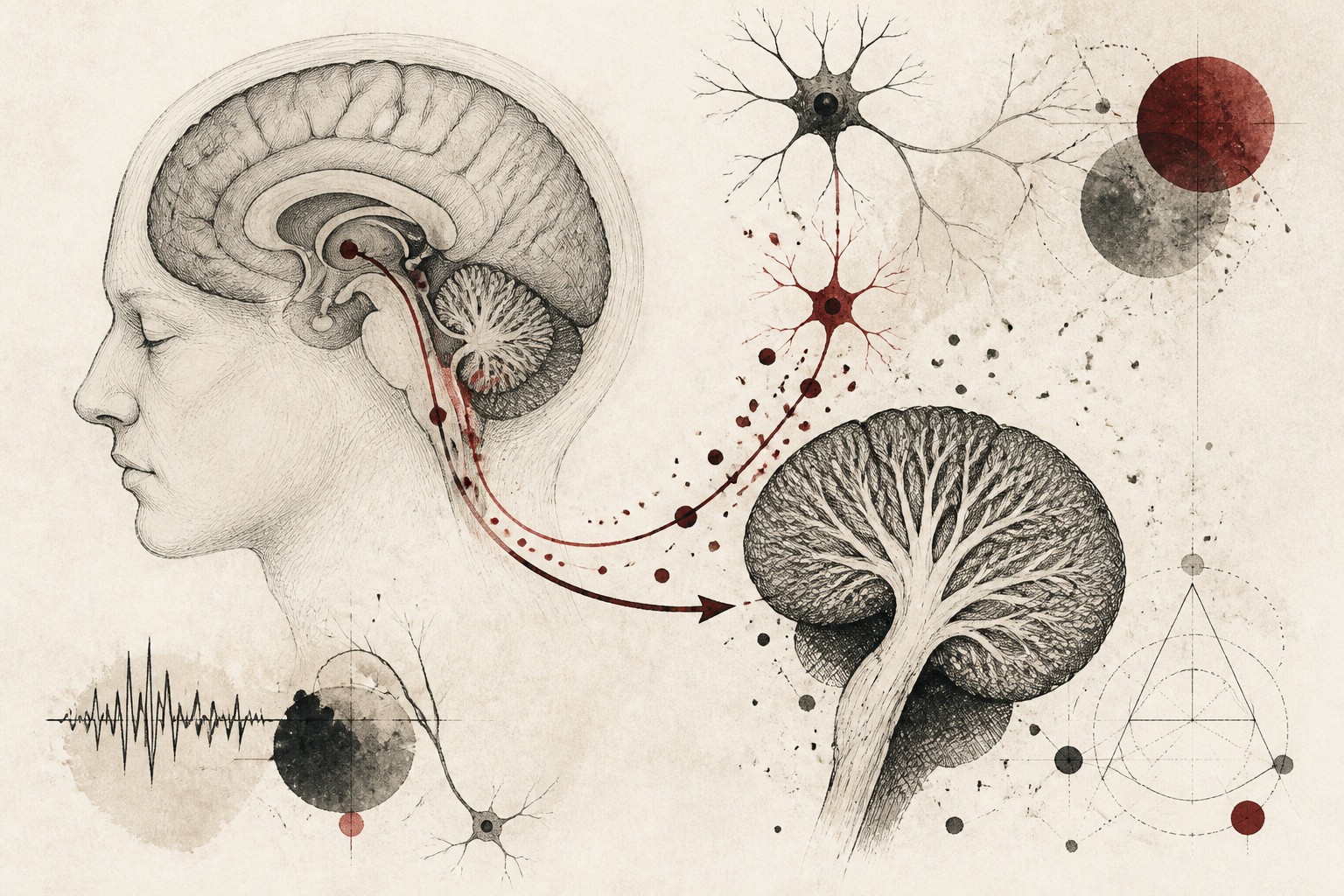
The traditional neuroscientific view of the cerebellum has long relegated it to the periphery of cognitive and emotional regulation, categorizing it primarily as a coordinator of motor control and fine-tuned physical movement. However, emerging research published in Nature Neuroscience challenges this rigid localization of function. By identifying a sophisticated neural circuit that connects the cerebellum to the brain's primary reward centers, researchers have uncovered a mechanism where the hindbrain does not merely assist in movement but actively predicts and instructs the release of dopamine. This discovery suggests that the cerebellum is an essential architect of motivated behavior, integrating sensory feedback with reward expectation to shape how organisms pursue goals.
For decades, the midbrain's dopaminergic system, particularly the ventral tegmental area (VTA), was considered the undisputed command center for reinforcement learning and pleasure. The cerebellum was thought to remain in its own lane, correcting errors in gait and posture. The new findings disrupt this dichotomy, showing that cerebellar output provides a critical signal that both anticipates future rewards and adjusts the magnitude of dopamine release based on environmental cues. This paradigm shift offers a more holistic view of the central nervous system, where the distinction between "motor" and "cognitive" regions is increasingly blurred in favor of highly integrated functional loops.
Mapping the Cerebro-Ventral Tegmental Circuitry
The foundation of this research lies in the anatomical and functional mapping of the pathways connecting the cerebellar nuclei to the VTA. Using advanced optogenetic tools and high-resolution neuroimaging, the investigators identified specific projection neurons in the cerebellum that synapse directly onto dopaminergic neurons in the midbrain. This is not a secondary or indirect connection; it is a high-speed highway that allows the cerebellum to transmit information about timing and sensory context directly to the reward system.
In experimental models, the researchers observed that activating these specific cerebellar pathways was sufficient to trigger a release of dopamine in the nucleus accumbens, a downstream target of the VTA associated with reward seeking. Conversely, when these pathways were inhibited, the subjects showed a marked decrease in their motivation to pursue rewards, even when they were readily available. This suggests that the cerebellum provides a necessary "go" signal that primes the dopaminergic system for action. The precision of this circuitry implies that the cerebellum uses its inherent capacity for temporal processing to ensure that dopamine is released at the optimal moment to reinforce a particular behavior.
Predictive Coding and Reward Instruction
A key finding of the study involves the cerebellum's role in predictive coding. In psychology, predictive coding refers to the brain's ability to create internal models of the world to anticipate future events. The cerebellum is uniquely suited for this task due to its dense architecture and massive computational power. The research indicates that the cerebellum monitors the environment for cues that have previously been associated with positive outcomes. When such a cue is detected, the cerebellum sends an "instructive" signal to the VTA, effectively predicting the arrival of a reward before it actually occurs.
This predictive function is critical for survival. If an organism only experienced a dopamine surge upon the consumption of food, it would lack the anticipatory drive required to forage or hunt. By providing a pre-emptive dopaminergic boost, the cerebellum facilitates the transition from a state of rest to a state of motivated pursuit. Furthermore, the study suggests that the cerebellum helps calculate "reward prediction errors." If a predicted reward fails to materialize, the cerebellum can signal the VTA to suppress dopamine release, allowing the brain to update its internal models and avoid wasting energy on unproductive behaviors in the future.
Interpreting the Implications for Behavioral Motivation
The interpretation of these findings extends far beyond basic anatomy. By demonstrating that the cerebellum is an active participant in reward processing, the study provides a new lens through which to view disorders of motivation and affect. If the cerebellum is responsible for instructing dopamine release, then dysfunction within this hindbrain structure could contribute to the symptoms seen in depression, addiction, and Attention Deficit Hyperactivity Disorder (ADHD). In these conditions, the brain's ability to properly value rewards or sustain motivation is often impaired.
Historically, treatments for these disorders have focused almost exclusively on the frontal cortex and the midbrain. These new insights suggest that the cerebellum may be a viable target for therapeutic intervention. For instance, non-invasive brain stimulation techniques like transcranial magnetic stimulation (TMS), when applied to specific cerebellar regions, might be able to modulate dopamine levels in the VTA, providing a novel way to address treatment-resistant motivational deficits. This shifts the clinical focus toward the back of the brain, a region previously ignored in the context of psychiatric health.
Methodological Considerations and Open Questions
While the study presents a robust case for cerebellar involvement in reward, several limitations and open questions remain. The primary experiments were conducted using animal models, which, while providing excellent cellular resolution, may not fully capture the complexity of human social motivation. The transition from rodent circuitry to human neuropsychology requires careful validation through longitudinal fMRI studies and clinical observations. Additionally, the researchers noted that while the cerebellar-VTA pathway is a major contributor to motivation, it is part of a much larger network. Determining the hierarchy of these signals—how the cerebellum's input compares to inputs from the prefrontal cortex, for example—remains a challenge for future research.
Another open question involves the specificity of the rewards. Does the cerebellum distinguish between primary rewards, such as food and water, and more abstract, higher-order rewards? In humans, reward systems are activated by social praise, financial gain, and intellectual achievement. Whether the cerebellum plays a similar "instructive" role in these complex human behaviors is a frontier that neuroscientists are just beginning to explore. Understanding the nuances of how the cerebellum processes different types of value will be essential for creating a complete map of the motivated brain.
Conclusion: Why the Cerebellum Matters for Modern Psychology
The research published in Nature Neuroscience serves as a definitive turning point in neurobiology. It reminds us that the brain is not a collection of isolated islands but a web of interconnected systems that work in concert to produce behavior. The discovery that the cerebellum encodes dopamine rewards and drives motivation forces us to abandon the simplistic "motor vs. cognitive" divide. For students and practitioners at Zeit Psychology Online University, this highlights the importance of staying abreast of biological foundations that inform psychological theory.
As we continue to unravel the mysteries of the cerebellum, it becomes clear that this "little brain" at the base of our skull is a major player in the human experience. Its ability to predict the future and instruct our internal chemistry ensures that we remain engaged with our environment, pursuing the goals that sustain life and foster growth. By integrating the cerebellum into our models of reward and motivation, we move one step closer to a comprehensive understanding of what it means to be a sentient, motivated being.
Quick answers
- What is the traditional view of the cerebellum's function?
- Historically, the cerebellum was viewed primarily as a motor control center responsible for coordinating physical movement, balance, and posture.
- How does the cerebellum influence dopamine levels according to the study?
- The cerebellum sends direct signals to the ventral tegmental area (VTA), predicting rewards and instructing the release of dopamine to drive motivated behavior.
- What are the clinical implications of this research?
- It suggests the cerebellum could be a target for treating motivational disorders like depression or addiction, potentially through non-invasive brain stimulation.
Rewritten by Zeit editorial AI. Based on original reporting at Nature Neuroscience.