Bio-Inspired AI Model Accelerates Video Processing Efficiency
Researchers at the Chinese Academy of Sciences have developed a new model that reduces video processing time by 65% by mimicking human visual attention.
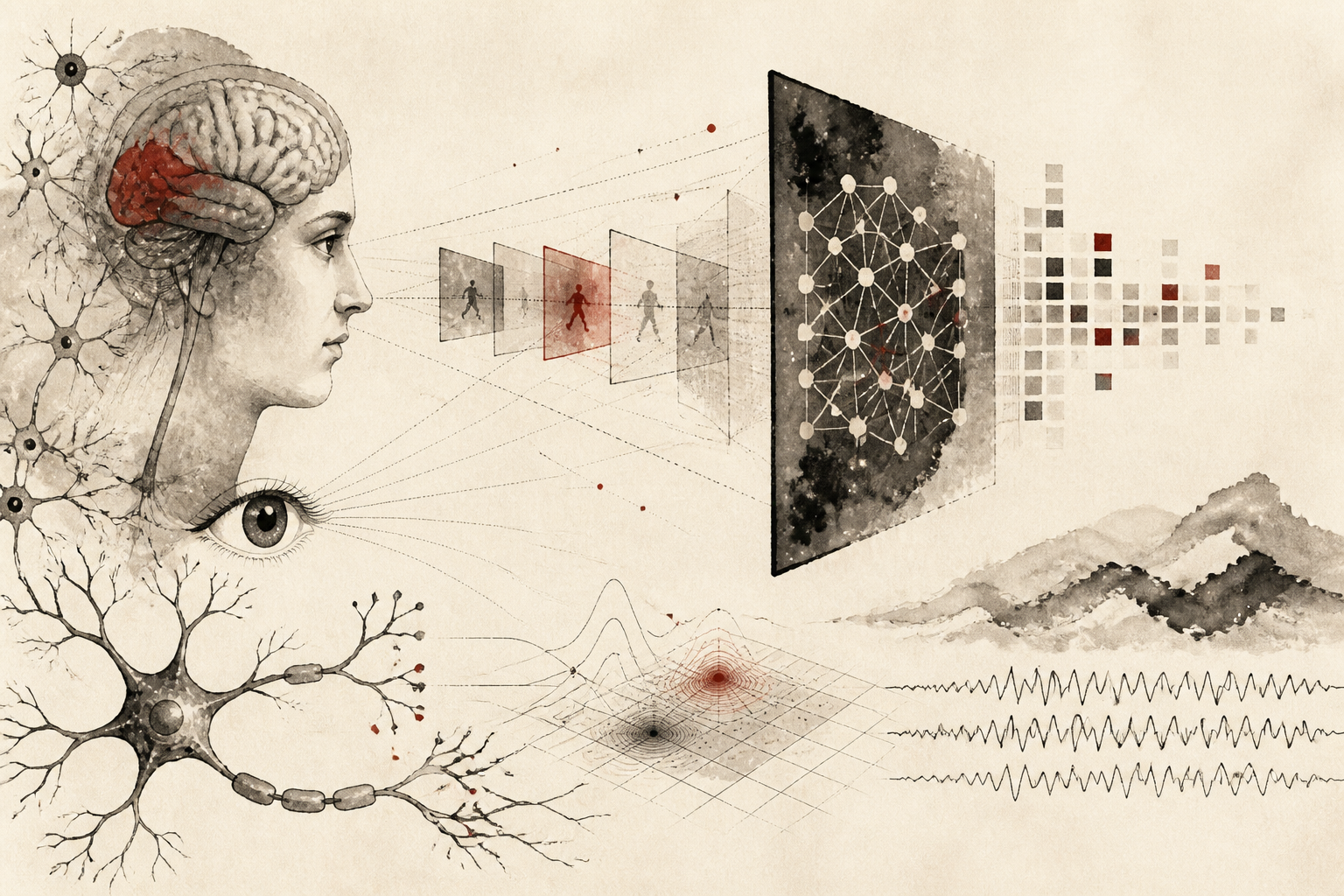
A groundbreaking development from the Chinese Academy of Sciences has introduced a novel artificial intelligence model designed to dramatically enhance video processing efficiency, drawing directly from the intricate mechanisms of human visual attention. This new model, dubbed the Event-guided Multi-modal Fusion Disentangled Variational Autoencoder (EMF-dVAE), represents a significant stride in neuromorphic engineering, achieving a 65% reduction in processing time by selectively focusing on critical visual information, much like the human brain. The research underscores the profound impact cognitive science principles can have on engineering solutions for real-world computational challenges, particularly within the burgeoning fields of computer vision and artificial intelligence.
The Challenge of Digital Vision
Traditional computer vision systems face substantial hurdles when confronted with the immense data volumes characteristic of modern video streams. High-resolution footage, pervasive in applications from security surveillance to autonomous navigation, generates a continuous torrent of pixel information. Processing this data exhaustively can lead to significant latency, hindering real-time applications, and demanding substantial computational resources, translating into high energy consumption. This inherent inefficiency has long been a bottleneck, impeding the deployment of advanced AI in scenarios requiring immediate and reliable visual interpretation. Conventional methods often process every pixel in every frame, an approach that is computationally expensive and frequently redundant, as much of the visual field remains static or provides negligible new information.
Bio-Inspired Innovation: The EMF-dVAE Model
The EMF-dVAE model directly confronts these challenges by adopting a bio-inspired strategy that mirrors the human brain's remarkable ability to prioritize relevant visual stimuli while effectively filtering out extraneous noise. Central to its innovation is the use of "event-based data." Unlike traditional frame-based video, where each frame captures a complete snapshot, event-based data focuses solely on changes occurring within a scene. This sparse data representation captures only the moments when pixels change intensity, significantly reducing the overall data load. The model then integrates this efficient event data with traditional image frames, creating a multi-modal input. This fusion strategy is explicitly designed to emulate saccadic movements—the rapid, jerky eye movements humans make to shift gaze—and the broader mechanisms of selective attention that allow biological systems to quickly discern and react to pertinent information within a dynamic visual environment.
Empirical evaluations of the EMF-dVAE model have yielded compelling results. The bio-inspired architecture reportedly reduces video processing time by approximately 65% when compared to conventional models. Beyond this notable speedup, the system exhibits remarkable data efficiency, requiring only about 15% of the visual data typically necessary for accurate interpretation. This drastic reduction in data usage does not come at the cost of performance; rather, researchers observed an improvement in overall accuracy. This enhanced accuracy is particularly pronounced in dynamic environments, where rapid motion often introduces blurring or data loss in conventional AI systems due to their inability to adapt quickly to changes. The EMF-dVAE's event-driven approach inherently handles these dynamic shifts more robustly, focusing on the changes themselves rather than struggling to process every detail of every fleeting moment.
Mechanisms and Interpretations
The underlying mechanism of the EMF-dVAE can be understood through its "disentangled variational autoencoder" architecture. A variational autoencoder (VAE) is a type of neural network capable of learning compressed representations of data. The "disentangled" aspect suggests that the VAE is designed to separate different, independent factors of variation within the visual data. For instance, it might learn to represent an object's position independently from its identity, or its motion independently from its static appearance. When coupled with event-based data, this disentanglement allows the model to efficiently encode and decode visual information by focusing on salient features of change. The "multi-modal fusion" refers to the model's ability to seamlessly integrate the sparse, high-temporal-resolution event data with the richer, high-spatial-resolution traditional frame data. This integration allows the system to leverage the strengths of both data types: the speed and change-detection capabilities of event data, and the contextual detail of frame data. This dual input, processed through a mechanism inspired by biological sensory integration, allows for a more holistic and efficient understanding of visual scenes.
Expert interpretation of these findings suggests that the success of EMF-dVAE lies in its ability to selectively allocate computational resources. Instead of uniformly processing all visual input, the model dynamically prioritizes information based on its relevance, a hallmark of intelligent biological systems. This selective processing significantly reduces computational load without sacrificing accuracy, and in some cases, even enhancing it by focusing on the most informative aspects of a scene. The "event-guided" aspect implies that changes in the visual field act as natural triggers for attention and processing, much like salient stimuli capture attention in human vision. This approach represents a paradigm shift from brute-force processing to intelligent, biologically plausible information gating.
Limitations and Future Directions
While highly promising, the EMF-dVAE model, like any new technology, presents its own set of limitations and open questions. The precise computational overhead of the multi-modal fusion process itself, despite overall efficiency gains, warrants further investigation. The generalizability of its performance across an even wider array of dynamic environments and lighting conditions, beyond those tested, remains an area for continued empirical validation. Furthermore, the explicit mechanisms by which the model achieves "disentanglement" of visual features could be further elucidated, potentially leading to even more efficient and robust architectures. Researchers might also explore how the model adapts to novel, unprecedented visual events, and how its learning process can be optimized for continuous adaptation in real-world scenarios. The scalability of this approach to extremely high-resolution, multi-sensor inputs also presents an ongoing research challenge.
Significance for Psychology and Neuroscience
For students and clinicians in psychology and neuroscience, this development holds profound implications. The EMF-dVAE stands as a tangible example of how insights from cognitive neuroscience, particularly in areas like visual perception, attention, and sensory integration, can directly inform and revolutionize artificial intelligence. It bridges the theoretical understanding of biological information processing with practical engineering solutions. This interdisciplinary success reinforces the value of studying biological systems not just for fundamental knowledge, but as blueprints for advanced technological design. Clinicians might also consider how the principles embedded in such models could inform the development of assistive technologies or diagnostic tools, especially for conditions involving visual processing deficits, by providing new ways to model and understand visual attention.
Looking forward, the EMF-dVAE model paves the way for a new generation of AI systems that are not only more powerful but also significantly more energy-efficient and adaptable. Its principles could be extended beyond video processing to other sensory modalities, such as auditory or tactile data, leading to bio-inspired multi-modal AI that more closely mimics human perception. This development represents a crucial step towards robust edge computing and autonomous systems, such as self-driving vehicles, advanced robotics, and even sophisticated surgical tools, which demand real-time processing under stringent energy constraints. By optimizing how machines "see" through the lens of cognitive neuroscience, neuromorphic engineering, exemplified by the EMF-dVAE, is poised to unlock solutions to contemporary bottlenecks in big data analytics and artificial intelligence, ushering in an era of more intelligent, efficient, and biologically plausible computational systems.
Quick answers
- What is the EMF-dVAE model?
- It is a brain-inspired AI model that combines event-based data with traditional images to process video more efficiently.
- How much does this AI reduce processing time?
- The model reduces processing time by 65% compared to conventional video processing methods.
- How does the model mimic the human brain?
- It uses selective attention to focus only on relevant visual changes, rather than processing all data equally, similar to human vision.
Rewritten by Zeit editorial AI. Based on original reporting at NeuroscienceNews.com.