Astrocytic Sequences in the Hippocampus Identified as Drivers of Memory Formation
New research in Nature Neuroscience reveals that astrocytes form organized temporal sequences during learning, challenging the neuron-centric model of memory encoding.
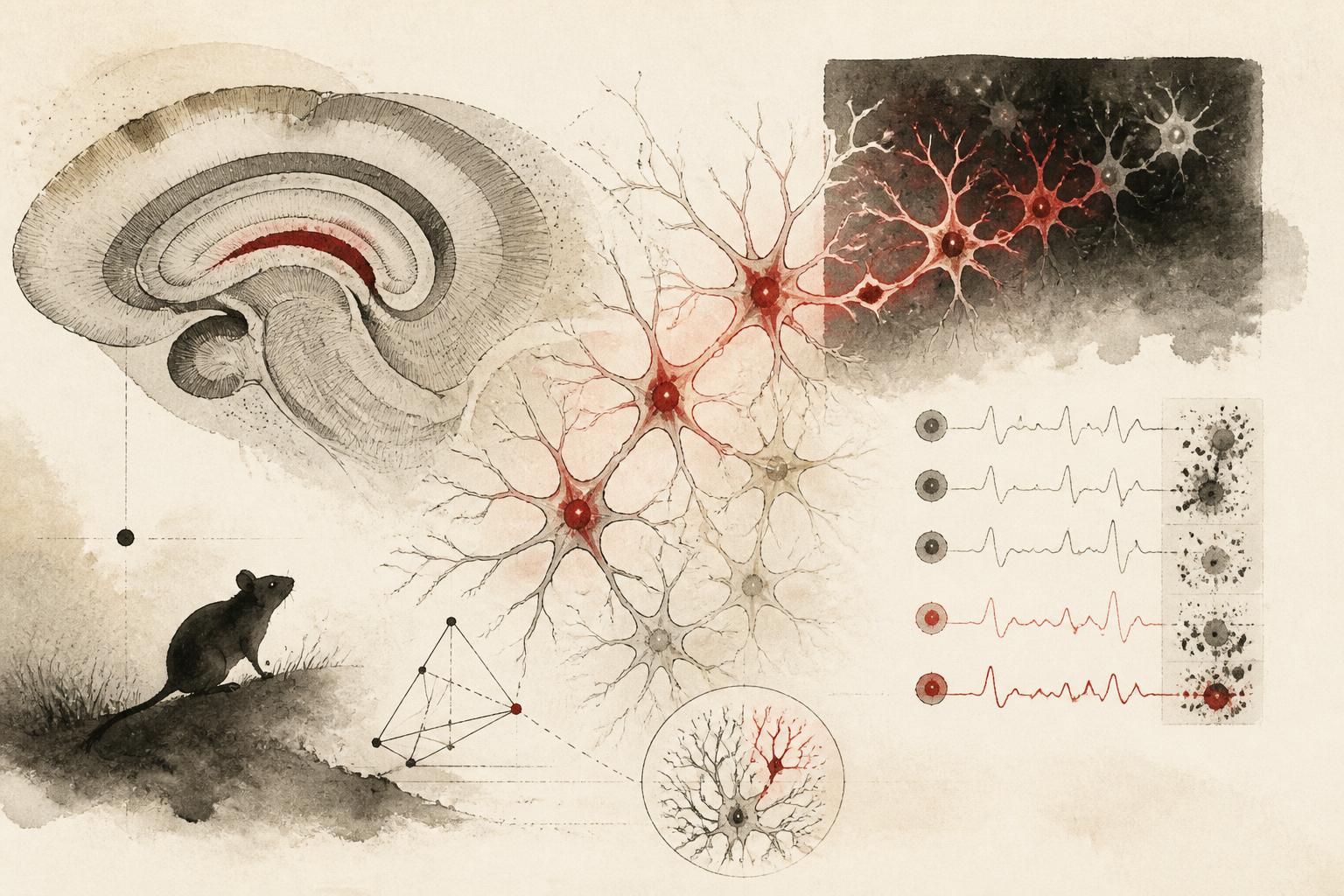
In the foundational models of cognitive neuroscience, the hippocampus has long been characterized as a neural library where neurons serve as the primary scribes of experience. However, recent evidence published in Nature Neuroscience by a collaborative research team suggests that this paradigm is incomplete. The study, titled "Hippocampal astrocytic sequences emerge during learning and memory recall," demonstrates that astrocytes—star-shaped non-neuronal cells—do not merely provide metabolic support but actively participate in the temporal encoding of information. By observing the activity of these cells during navigational tasks, researchers identified structured sequences of astrocytic calcium signaling that mirror the behavioral demands of learning and the precision of memory recall.
Historically, astrocytes were dismissed as the passive "glue" of the central nervous system. While their roles in maintaining the blood-brain barrier and regulating neurotransmitter uptake were well-documented, their contribution to high-level cognitive functions like spatial navigation remained speculative. This study shifts the focus toward the tripartite synapse model, where the astrocyte is an equal partner in signal processing. The research highlights a sophisticated level of organization within the astrocytic network that emerges specifically when an animal is engaged in learning a new environment, suggesting that these cells are integral to the formation of the engram, or the physical trace of a memory.
Spatiotemporal Organization and Learning Dynamics
The central finding of the research lies in the discovery of astrocytic sequences. Using advanced calcium imaging techniques in live mice, the researchers monitored the activity of hippocampal astrocytes as the animals navigated a virtual reality environment. They observed that as the mice learned the spatial layout and the locations of rewards, the astrocytes began to fire in a highly specific, chronological order. This was not a random or diffuse activation; rather, the cells formed a reliable chain of activity that corresponded to the animal's progress through the task.
Crucially, these sequences were not present when the animals were in a familiar, non-task-related state. The emergence of these patterns was tightly coupled with the acquisition of new information. As the mice became more proficient at navigating the virtual space, the astrocytic sequences became more distinct and robust. This temporal precision suggests that astrocytes are capable of tracking time and space in a manner previously thought to be the exclusive domain of place cells and grid cells. The study further demonstrated that during memory recall, these same astrocytic sequences were reactivated, providing a secondary layer of information processing that reinforces the neural signals.
Mechanisms of Astrocytic Calcium Signaling
To understand how these sequences are generated, the researchers looked at the intracellular dynamics of the astrocytes. Unlike neurons, which communicate via electrical impulses, astrocytes communicate through fluctuations in calcium concentration. The study utilized genetically encoded calcium indicators to visualize these fluctuations with high resolution. The findings indicate that the astrocytic sequences are driven by specific receptors on the astrocytic membrane that respond to the release of neurotransmitters from neighboring neurons.
However, the interaction is not a simple one-way street. The research suggests a feedback loop where the astrocytic calcium waves can, in turn, modulate synaptic strength. This bidirectional communication allows the astrocytic network to act as a temporal filter, smoothing out neural noise and highlighting the most relevant signals during the learning process. By analyzing the timing of these calcium events, the team found that astrocytic activity often preceded or occurred in tandem with significant neural firing, suggesting that astrocytes may play a preparatory or gatekeeping role in memory formation. The mathematical modeling used in the study confirmed that these sequences were statistically significant and could not be explained by random physiological fluctuations.
Implications for Synaptic Plasticity and Interpretation
The interpretation of these findings points toward a radical expansion of how we define a "circuit." In the traditional view, the circuit is purely electronic and neuronal. The Nature Neuroscience study argues for a hybrid circuit where the slow-acting, long-lasting calcium signals of astrocytes provide a context for the rapid-fire action potentials of neurons. This suggests that memory is not just a series of rapid connections but a layered process involving different biological timescales. The astrocytic sequences may serve as a bridge, sustaining information over several seconds or minutes, which helps the brain integrate disparate elements of an experience into a cohesive memory.
This discovery also offers a new lens through which to view synaptic plasticity. If astrocytes are active participants in sequence generation, then long-term potentiation—the process by which synapses strengthen—may be dependent on the rhythmic activity of these glial cells. The study indicates that when astrocytic signaling was experimentally disrupted, the animals showed significant deficits in both learning and the subsequent recall of spatial information. This provides causal evidence that the sequences are not just a byproduct of neural activity but are necessary for the cognitive function itself.
Limitations and Open Questions in Glial Research
While the study represents a landmark achievement in glial biology, it also opens several new avenues of inquiry characterized by current technical and theoretical limitations. One primary limitation is the resolution of calcium imaging compared to electrophysiology. While we can track the sequence of astrocytic activation, the exact molecular triggers that initiate the start of a sequence remain partially obscured. It is also unclear how these astrocytic sequences scale in larger brains, such as those of primates or humans, where the astrocyte-to-neuron ratio is significantly higher than in rodents.
Furthermore, the study focused on spatial navigation within the hippocampus. A pressing question for future research is whether similar astrocytic sequences exist in other regions of the brain, such as the prefrontal cortex or the amygdala, which handle executive function and emotional processing, respectively. If astrocytic sequencing is a universal feature of learning, it would suggest that the entire architecture of the brain's information processing system needs to be re-evaluated. Researchers also need to determine if these sequences are altered in neurodegenerative diseases like Alzheimer’s, where hippocampal function is primarily targeted.
The Path Toward a New Cognitive Neuroscience
The significance of this research extends beyond basic biology; it has profound implications for how we treat memory-related disorders. If astrocytes are the primary drivers of the temporal sequences required for memory, then they may represent a new therapeutic target. Current pharmacological interventions for memory loss almost exclusively target neuronal receptors. This study suggests that stabilizing or enhancing astrocytic calcium signaling could provide an alternative pathway for restoring cognitive function in patients with brain injuries or aging-related decline.
Ultimately, the work published in Nature Neuroscience marks a transition from a neuro-centric to a system-wide understanding of the brain. By showing that astrocytes are capable of sophisticated, sequence-based information encoding, the research elevates these cells from supporting actors to lead protagonists in the story of human cognition. As we continue to decode the language of astrocytic sequences, we move closer to a full understanding of how the brain transforms transient experiences into the enduring structures of memory. The discovery that the brain's 'glue' actually holds the rhythm of our thoughts represents one of the most significant shifts in neuroscience in the last decade.
Quick answers
- What is the main finding regarding astrocytes in the new Nature Neuroscience study?
- The study found that astrocytes in the hippocampus form organized, chronological sequences of activity during learning and memory recall, rather than acting as passive support cells.
- How do astrocytes communicate if they don't use electrical impulses like neurons?
- Astrocytes use fluctuations in calcium concentrations to process and transmit information, forming spatiotemporal patterns that researchers can track with imaging.
- Why does this research change our understanding of memory?
- It suggests that memory is not solely a product of neural activity; astrocytes provide a necessary temporal framework that helps encode and stabilize the physical traces of memory.
Rewritten by Zeit editorial AI. Based on original reporting at Nature Neuroscience.