Antarctic Isolation Study Reveals Social Friction Risks for Future Mars Missions
Researchers monitoring a crew in Antarctica found that prolonged social density, rather than just isolation, triggers interpersonal tension and cultural fragmentation.
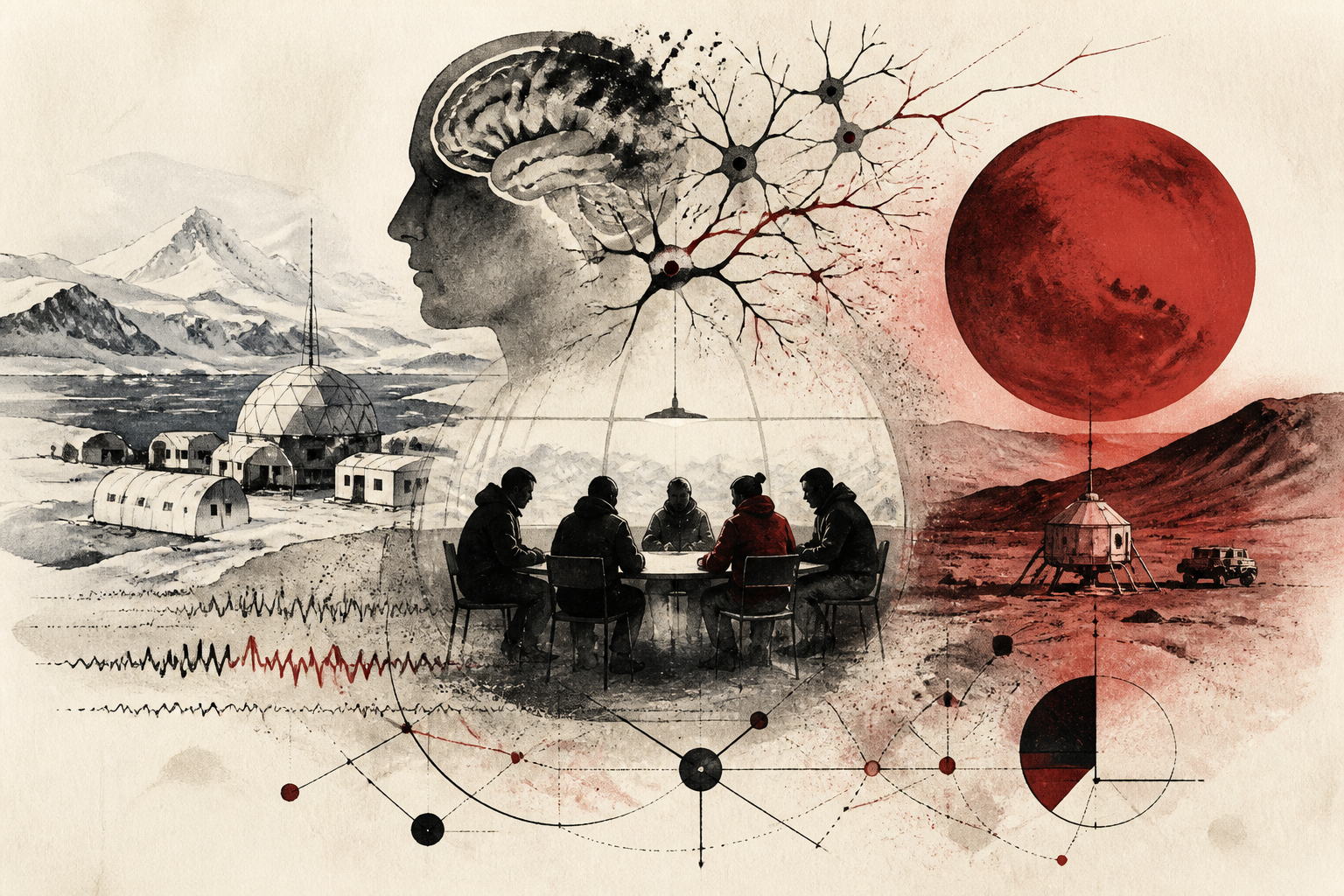
Long-duration space travel presents a myriad of physiological challenges, ranging from radiation exposure to bone density loss. However, as the global aerospace community looks toward crewed missions to Mars, a burgeoning body of evidence suggests that the most volatile variable may be the human psyche. A recent longitudinal study conducted over a ten-month period in Antarctica has provided a stark preview of the social dynamics likely to unfold in the pressurized confines of a spacecraft. The findings, originally reported by ScienceDaily, indicate that the primary psychological hurdle for astronauts may not be the traditional concept of loneliness, but rather the friction caused by unavoidable, continuous social proximity. By monitoring a crew of twelve individuals in one of the most remote environments on Earth, researchers have identified critical shifts in trust and social cohesion that could jeopardize long-term mission objectives if left unaddressed.
The Social Constraints of Extreme Environments
The environment of a research station in Antarctica serves as a high-fidelity analog for space travel due to its absolute isolation, extreme temperatures, and the logistical impossibility of immediate evacuation. For ten months, a diverse crew of twelve professionals lived and worked in these conditions, providing a rare window into the longitudinal evolution of group dynamics. Unlike shorter expeditions, the ten-month duration covers the 'mid-mission' phase, a period often characterized in psychological literature as a point where initial novelty fades and psychological fatigue sets in. The study aimed to track how social bonds, individual well-being, and professional cooperation fluctuated as the sun remained below the horizon and the physical boundaries of their world shrank to the walls of the station.
Interpersonal Density and the Erosion of Trust
The central finding of the research challenges the conventional wisdom regarding isolation. While much of the existing preparation for Mars missions focuses on mitigating the effects of being separated from friends and family on Earth, this study suggests that the surplus of interaction with crewmates is equally destabilizing. Researchers observed that frequent, unavoidable contact was positively correlated with rising levels of interpersonal tension. As the months progressed, the 'social density' of the environment began to take a toll on the participants' ability to maintain neutral professional relationships. Rather than fostering a sense of shared purpose, the constant presence of the same small group of people led to a decrease in overall trust. Minor idiosyncrasies that might be ignored in a standard workplace became significant sources of irritation, eventually escalating into systemic mistrust between crew members.
Cultural Fragmentation and Subgroup Formation
Perhaps the most concerning observation for mission planners was the emergence of social schisms within the twelve-person cohort. As the environment became more stressful, the crew increasingly gravitated toward individuals who shared their specific cultural or linguistic backgrounds. This phenomenon of subgroup formation, often referred to in sociology as 'faultlines,' effectively divided the mission personnel into smaller, isolated cliques. These divisions were not merely social; they influenced the flow of information and the level of cooperation across the station. When the crew fractured along language-based lines, the collective identity of the mission was weakened. For a Mars-bound vessel, where interdependency is a requirement for survival, such cultural silos could lead to catastrophic failures in communication during emergencies. The study highlights that shared professional goals are often insufficient to override the biological impulse to seek comfort in familiar cultural identifiers when under prolonged stress.
Methodological Approaches to Monitoring Morale
To capture these shifting dynamics, the research team employed a multi-modal approach to data collection. Participants provided regular self-reports on their mood, perceived stress levels, and their feelings toward their colleagues. Beyond subjective surveys, the study utilized behavioral observation and sociometric data to track who interacted with whom and for how long. By mapping these social networks over the ten-month duration, the researchers were able to visualize the gradual drifting apart of the group. This methodology allowed the team to identify the precise points at which tension began to outweigh cooperation. It also provided a timeline of when cultural cliques began to solidify, offering future mission commanders a potential early-warning system for identifying social decay before it impacts mission safety.
Limitations and Theoretical Implications
While the Antarctic station is an excellent analog, it is not a perfect replica of a deep-space environment. The presence of Earth-normal gravity and the ability to eventually return home—even if delayed by months—provides a psychological safety net that Mars explorers will lack. Furthermore, the small sample size of twelve individuals, while typical for such extreme environment studies, limits the ability to generalize these findings to larger or differently composed groups. There is also the 'observer effect' to consider; the knowledge that their social interactions were being monitored for a psychological study may have influenced the participants' behavior, either by causing them to suppress conflict or, conversely, by making them more self-conscious of their social standings. Future research must determine if these patterns hold across different professional backgrounds, such as comparing scientists to military-trained astronauts.
Future Paradigms for Deep-Space Crew Selection
The implications of this study, as noted in the ScienceDaily report, suggest a paradigm shift in how international space agencies must approach crew selection and training. It is no longer enough to select individuals based on technical proficiency and individual psychological resilience. Instead, the focus must shift toward 'social compatibility' and the proactive management of cultural faultlines. Mission planners may need to implement structured 'social distancing' protocols even within small habitats to give individuals the necessary psychological privacy to recover from social density. Additionally, training programs must place a heavier emphasis on cross-cultural communication and conflict resolution to prevent the formation of exclusionary subgroups. As we prepare to send humans further into the solar system than ever before, understanding the delicate balance between isolation and over-exposure will be the key to ensuring that the first footprints on Mars are not preceded by a breakdown in human cooperation.
Quick answers
- What was the main psychological challenge found in the 10-month Antarctic mission study?
- The study found that frequent contact and social density led to increased tension and mistrust among the crew, rather than just loneliness from outside isolation.
- How did the Antarctic crew's social structure change over time?
- The crew increasingly divided into subgroups or cliques based on shared cultural backgrounds and languages, which weakened the overall group cohesion.
- Why is the Antarctic study important for future Mars missions?
- It serves as a high-fidelity analog for the isolation of space, helping scientists understand how to prevent interpersonal conflict and cultural fragmentation during long-duration voyages.
Rewritten by Zeit editorial AI. Based on original reporting at ScienceDaily — Mind & Brain.